Search results for: {search_term_string}
Our house flip cover is designed for short-term cosmetic renovations. If you’ve got a do-up project that’s liveable, in reasonable condition, and just needs a refresh to get it market-ready, this policy is ideal.
We can cover homes that:
We cover cosmetic renovations — things like painting, new carpet, or replacing fixtures.
We don’t cover structural alterations — so it’s important to know the difference before purchasing this policy.
If you’re planning work that involves changing the structure of the home, you’ll need a separate contract works policy.
Is your project suitable for initio’s Flip Policy?
Works covered by a House flip policy
Cosmetic Renovations
If you’re doing cosmetic renovations to your house (with no structural alterations) you can place cover under a House flip policy.
What’s considered ‘Cosmetic Renovations’?
Cosmetic renovations are work that doesn’t involve structural alterations or changes to the house. Some examples that are covered by the House flip cover are:
- Painting (outside and inside)
- Installing new carpets
- Replacing a toilet
- Removing a non-load bearing wall
Works that won’t be covered by a House flip policy
Structural Renovations
The House flip cover is not designed to cover work that involves changes to the house’s structural make-up. This kind of work should be covered by a separate contract works policy on the house.
What’s considered ‘Structural Renovations’?
Some examples of structural work are:
- Re-roofing
- Building a new extension to the house
- Removing a load-bearing wall
- Re-cladding the house’s exterior
Note that this isn’t an exhaustive list. If you’re still unsure if the work you’re doing is structural, please get in touch.
Doing Structural Work and need contract works cover?
For a specialist online contract works solution we’re partnered with BuiltIn Insurance. BuiltIn are New Zealand’s trade insurance experts and have an online Contract Works insurance offering where you can get a quote for your works online, and purchase online too.
Like initio, BuiltIn are underwritten by IAG so this means that you will have the same ultimate underwriter for the house and contract works risk, which is important.
Looking for more information?
When you have had claims you may have to pay more premium on your insurance. Don’t be offended, insurance companies are just trying to automatically place a price on the risk of the driver. In insurance driving this is called ‘pricing risk’.
Car insurance is a bit different to house insurance in that when you claim on your house insurance the vast majority of the time it is something outside of your control, like a storm blowing your roof off or a burst water pipe.
However, the typical car insurance claim does have something to do with the driver of the car. While it’s not always the case, the driver (and policyholder) can be at fault if they lost control of the car and crashed.
Naturally, some drivers are more likely to have accidents. For example, young inexperienced drivers are more likely to crash than a middle aged driver in say their 40s. Insurance companies will price this difference into their base premium rate calculation.
Even within these groups (i.e. under 25 year old drivers) there are subgroups of drivers that are more prone to accidents.
In general insurance companies try to balance long term claims payment trends between good and bad drivers. If someone uses their policy more and is paid out 1 more insurance is it fair that they pay the same premium as someone that has never made a claim?
The way insurance companies try to gauge this is by assigning a Driver Grade to the person applying for the cover.
This is what they are trying to do when they ask you to disclose how many car insurance claims you have had in the last five years.
Why do we only care about claims in the last five years?
Don’t worry, we (and most insurance companies in general) know and expect that the average driver is going to have a car insurance claim in their lifetime.
People’s driving habits change over time so how you drove 20 years ago is not likely to be reflective of how you drive today. Insurance companies realise it’s unrealistic too look too far back into the past. Someone that had three accidents all over 10 years ago does not reflect their driving today.
Therefore you will only be asked about claims in the last five years. If someone has had 3 accidents or claims in the last five years there is a good chance the driver is more dangerous than the average.
Do I pay an excess when I am not at fault?
If you are at fault for an accident, or admit liability you will need to pay your policy excess on your insurance payout.
If you are not at fault, and you have the details of another party who caused the crash and who admits liability its unlikely you will have to pay an excess.
Some particular items of your policy may not have an excess that applies to the cover. Examples include theft, or windscreen damage. You should check your policy for these.
In all other cases it’s most likely that you will have to pay your excess even if you’re not at fault. If you have a crash with another driver, but you are unable to get their details there’s no definitive proof of who was at fault, and you will generally have to pay the excess on your policy.
How do Insurance companies apply the Driver Grade?
Some insurance companies will ask you to only disclose claims where you were ‘at fault’. We ask you to disclose any claims where you were either at fault, or paid the excess on the policy. We are not saying that every claim where you have paid the excess is one that is your fault, but we are trying to offset and balance premiums between those that have used their policy for payouts, and those that have not. It’s only fair.
Login in to make a claim
Related Articles:
We currently offer Landlord insurance, Landlord insurance for multiple attached units, Own home and contents insurance, House flip insurance, Car insurance, Holiday home insurance and we also have an add-on for Short term paying guests insurance (e.g. Airbnb) for your home or holiday home.
All our policies are underwritten by IAG New Zealand Limited (IAG). IAG has received a financial strength rating of AA from Standard & Poor’s (Australia) Pty Ltd, an approved rating agency. Learn more about financial strength rating.
We’re constantly working on new and exciting products and features that are designed to improve our customers experiences. We would love to hear your feedback.
Get a quote
Related Articles:
Landlord Insurance is different to standard house insurance. It covers the house itself, and the extra risks you face being a landlord for standard long term residential rentals.
Homeowners are exposed to standard risks such as fire, floods, and earthquakes. Landlords are exposed to these standard homeowner risks, as well as the risks associated with renting to tenants.
What extra cover does Landlord Insurance provide?
Damage by Tenants Loss of Rents Meth Contamination Landlord Contents
Damage by Tenants
A standard house insurance policy might have cover for accidental damage caused by tenants, but will not cover intentional damage by tenants.
Intentional damage can come from your tenant punching walls, vandalising the property or throwing a raucous party. This is a common insurance claim for landlord’s, and can often prove costly.
Initio Tenant Damage Protection
Our landlord insurance policy provides full cover up to your sum insured for accidental tenant damage. You are also covered for intentional damage, vandalism or theft.
Damage caused by your tenant, paying guests, or any person who occupies the home (and any guest associated with these people) is covered.
Our policy covers up to $25,000 per event for intentional damage. Serious fire or explosion damage is covered over the $25,000 limit and up to your property’s full sum insured.
Loss of Rents
Rental income is essential to landlords.
If your rental is damaged and it can no longer be rented, you face both the costs to repair and the lost rental income you would have otherwise received. Standard house insurance will not cover loss of rents.
A landlord insurance policy will provide cover to rebuild your property, while also paying you lost rents if the home is unliveable while being repaired.
Tenant vacating without required notice or Eviction
Loss of rent can arise from scenarios beyond property damage.
It’s not uncommon for tenants to unexpectedly vacate their property or to be evicted due to non-payment if they fall 21 days behind. Additionally, there might be instances where tenants can legally cease rent payments under their tenancy agreement, such as when access to the property is prevented or essential utilities fail.
Should these issues arise, a comprehensive landlord insurance policy from initio protects against these losses. We cover rents for up to six weeks if your tenant leaves without the required notice or is evicted for non-payment. This coverage also extends to situations preventing access to the home or significant utility failures, ensuring a gap in rent doesn’t harm your financial security.
Property Damage
We cover up to 52 weeks of rents, or the loss of rent sum insured you select.
Insurance is triggered when there is physical damage to your rental that means it can no longer be lived in. A flood damaged house can take months or even a year to repair, so is essential for any landlord especially those with mortgage payments.
We include $20,000 loss of rent for free in all our policies. That’s $384 in weekly rent for a year, with options to increase this to $40,000 or $80,000.
Meth Contamination
Meth is rampant in New Zealand and landlords are particularly at risk. A badly contaminated house can cost tens of thousands of dollars to clean so that it can legally be rented again.
Specialist landlord cover is vital, as a standard house insurance policy will not cover meth.
This can come from consumption (smoking), or manufacturing. A meth infected house can be considered unsafe to live in and will be required to be de-contaminated to an appropriate level.
Landlord insurance will cover the costs of laboratory testing, and cleaning where there is a positive reading. The cleaning process can take months, so a landlord policy with loss of rent cover on top of cleaning cover is essential for managing your risk as a landlord.
Initio Meth Cover
We provide up to $30,000 of protection for meth testing and cleaning costs where a positive meth test has been found.
Loss of rent cover applies over and above the $30,000 of cover. We will pay out your weekly rents while your property is cleaned, for up to a full 52 weeks, or up to your loss of rent sum insured.
Landlord Contents
These days it’s common for landlord’s to rent their properties pre-furnished. This can include valuable belongings such as appliances, fittings and furniture.
Landlord insurance policies now provide bolt on cover or extensions to cover small amounts of landlord contents. This can either be included as standard or you can pay extra to include it.
Contents can be covered for their depreciated present value. A good landlord insurance policy will pay for new replacement items.
Initio Landlord Contents Cover
Our policy automatically includes $20,000 of landlord contents as standard. This is a minimum amount covered by our policy for our landlord policy, for more kitted out properties there are options to increase this to $40,000 or $60,000.
This covers damage to your fittings in your rental, and can also cover theft of contents you include in the tenancy. Please note this applies to fixtures and fittings, but not your personal items.
We pay for a brand new replacement when the damaged item is no older than five years old. If the item is over five years old, we payout a present value replacement amount.
I have less than $20,000 worth of contents, can I reduce the amount? No, the limit of $20,000 is standard to the policy, you will be covered for any chattels up to that figure automatically.
Does initio landlord insurance cover my rental property if it’s furnished or unfurnished?
Yes. Whether your rental is furnished or unfurnished, you’re covered.
Initio’s landlord insurance automatically includes cover for landlord contents – things like non-fixed appliances, curtains, rugs and heaters. If you fully furnish the property, you can opt to add extra contents cover for those items too.
Want more information?
Explore these additional articles that may interest you:
This week, law changes to the Residential Tenancies legislation is set to strengthen renter’s rights. It aims to transition a landlord’s rental house into a tenant’s home.
Looking specifically at landlord insurance, the change that will have the most ramifications on landlord insurance is the removal of no-cause evictions. Essentially, it will be more difficult for landlord’s to remove bad tenants and from a risk management perspective this is not a good thing. Other changes to the legislation such as limiting rent increases, and banning rent bidding are unlikely to have a direct impact on landlord insurance.
Landlord insurance provides cover for intentional damage by tenants. If troublesome tenants are harder to remove then landlord insurers will consider that there is a higher risk that the tenant will cause damage to the property. It remains to be seen but this could lead to an increase in the value of deliberate damage insurance claims. Working out how and when the damage occurred could be further protracted when there is a tenant that is unwilling to co-operate and cannot be removed from the property. It has always been about working with the landlord, the tenant, and the property manager (if applicable) and this will not change when it comes to insurance.
While tenant damage could increase under the new rules, the legislation changes could in fact improve risk management and reduce the incidence of damage. Our view is that with bad tenants being hard to evict, it will mean that landlords increase their scrutiny during tenant selection. So, ultimately tenants with a poor record and lack of supporting references may find it harder to get rent a property, which would filter out bad tenants and lead to lower claims payouts for insurers.
The ultimate outcome of the law changes is difficult to predict. It is unlikely that insurers will make any adjustments to premiums or policy conditions as a result of the reforms.
The bulk of the legislative changes are set to be put into practice in early 2021. We expect that it will take at least 12 months before we see any outcomes or trends on claims.
About Initio
Initio is a New Zealand-based online house insurance provider. Founded in 2011 by a couple of Kiwis, Initio set out to change the broken insurance industry by using technology to put control back into the hands of the customer.
Covering landlord insurance, short-term holiday rentals and home and contents, Initio specialises in tailored online property insurance, including an all-in-one landlord insurance with built-in cover for loss of rent and damage by the tenant.
Having completed over 35,000 automated insurance transactions, Initio’s market-leading policies can be quoted, bought and amended online – all in an instant.
Initio is underwritten by NZI, a business division of IAG New Zealand Limited.
Navigating the intricacies of insuring a home with an attached flat in New Zealand, especially one that is rented out part-time, can be overwhelming for landlords and property investors. At Initio, we are dedicated to helping you make sense of these complexities, equipping you with the tools needed to make the right insurance choices for your unique situation. This article is specifically designed to assist you in understanding the process for homes with attached flats rented out occasionally.
Guidelines on Insuring Your Home and Attached Flat in NZ
If you happen to own a home with an attached flat rented out occasionally, you may find yourself unsure about how to secure the right insurance coverage. This situation differs from one where both units are exclusively used as long-term rentals (which are catered for by our multi-unit policy). Insuring a property where you live and have an attached flat rented out part-time necessitates a more nuanced approach.
Here’s what you need to know:
- Own Home policy: This policy has been crafted to cover the portion of the property that you inhabit.
- Landlord/Rental policy: This policy needs to be put in place to provide coverage for the attached flat when it’s rented out. Even if the rental isn’t full-time, coverage for the times when the flat is tenanted is ensured by the landlord/rental policy.
Should a significant claim arise, both policies would be engaged, with the combined sum insured being applicable to the whole property.
Why do I need Two Policies?
Each policy is designed specifically to cover one self-contained home/unit only and for the risks associated with the type of occupancy. The Own Home policy provides coverage for the main house/unit where you live, while the Landlord/Rental policy covers your rental home/unit including the legal liabilities and other specific risks associated with renting.
Conclusion
The process of insuring a home with an attached flat, rented out on occasion, needn’t be a difficult one. With an understanding of how Initio’s insurance products can be strategically combined, comprehensive protection of your property is ensured. Additional information on this topic, as well as other insurance solutions offered by Initio, can be found here.
Get a quote
Useful links
A closer look at property damage for New Zealand Landlords
Rental properties, for all their promise of steady income and long-term value can, if not managed correctly, become ground zero for an array of unforeseen problems and potential hazards.
The reality is that damages, an often neglected aspect of rentals, pose a considerable risk to your investment. These risks are as varied as they are prevalent, raising a pertinent question in the minds of property owners: “What damage is most likely to occur at my rental property?”
Safeguarding your investments and mitigating potential losses, and understanding these risks is essential to success as a landlord.
A thorough examination of our 2022 loss data provides a detailed analysis of the challenges faced by New Zealand property owners. Last year, claims related to rented properties — including traditional rental properties, own homes partially rented, and properties with multiple rentals, made up 35% of all the claims we received. When focusing on these rental-specific claims, we identified a broad spectrum of loss types, which we’ve classified below in terms of number of claims:
Water-related damage: At 21.6%, this was the most common type of damage. These losses typically involved scenarios including suddenly bursting pipes and rodent damage, while blocked pipes accounted for 6.4%.
Accidental damage: This category, representing 18.1% of the claims, includes an array of unexpected incidents, from minor mishaps to substantial accidents, illustrating the diverse risks property owners encounter. The losses range from outdoor misadventures, such as balls shattering windows or trees falling onto the property (while being pruned), to indoor accidents like stains on carpets and damaged rugs, often due to spills or pet-related incidents. There were also multiple kitchen bench damage incidents – caused by hot pots.
Weather-related damage: Severe weather events substantially contributed to the claims we received, with flood-related incidents constituting 11.2% and wind-induced damage representing 9.9% of the total claims. These statistics do not include the severe flooding and storms experienced earlier this year. Weather damage events are hard for property owners to mitigate.
Other incidents: Some more specific types of damages also occurred, albeit less frequently. These included
- Malicious damage by tenants (4.6%),
- Fire – accidental or unknown reasons (1.1%),
- Meth contamination (1.5%),
- Issues with keys and locks (3.5%),
- Impact damage, typically involving a vehicle (5.5%) eg car versus house
Loss of rent: There were several circumstances that led to a loss of rental income, resulting in insurance claims. Property damage rendering the property uninhabitable was one such factor and is the most common.
However, issues such as tenant abandonment, non-payment of rent, and eviction also significantly contributed. These loss-of-rent-only situations accounted for 3.3% of the total claims made.
Frequency of claim vs. cost
The above numbers are based on frequency (i.e number of claims made). We also analysed the payout values for rental property claims. The graph below shows the top five losses by value. This data is presented alongside the frequency of each of these claims. It illustrates that losses like fire are uncommon but are high in value.
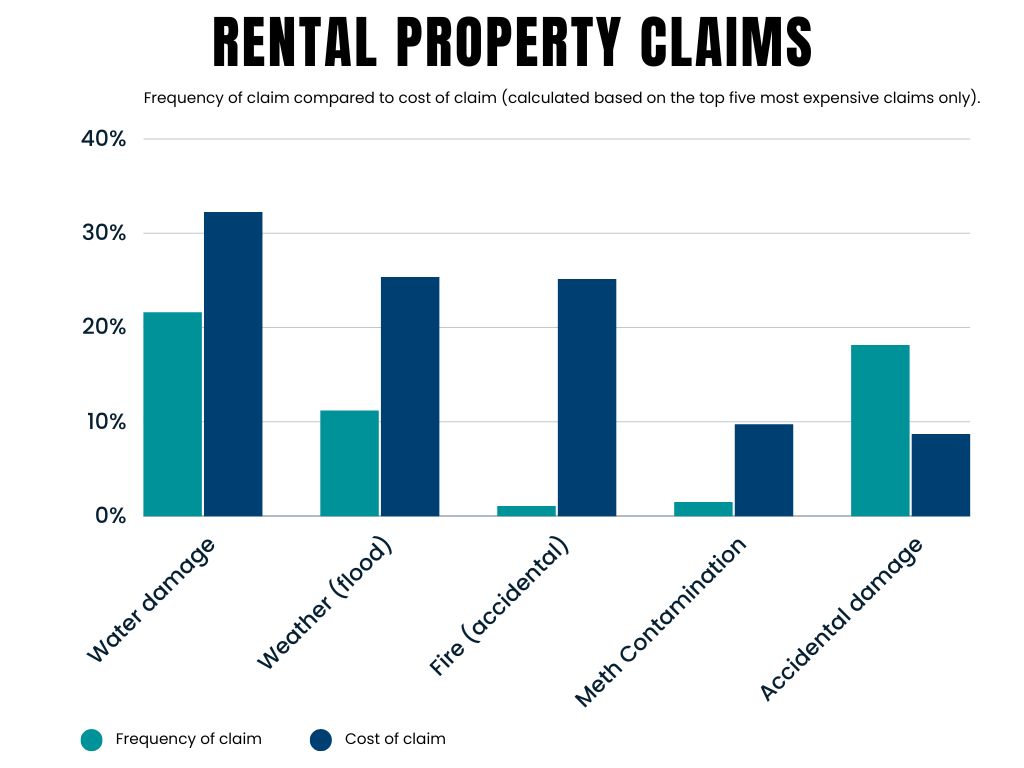
Fire-related claims constituted a mere 1.1% of the overall number of rental property claims, but made up 25% of the total value of claims paid. This underscores the potential devastation that fires can cause to rental properties. The significance of this cannot be overlooked, highlighting the importance of equipping your rental properties with smoke alarms, and fire extinguishers. By taking these simple proactive measures, you can significantly reduce the risks associated with fires and safeguard your valuable assets and your tenants.
Final word
Understanding the potential risks involved in rental property ownership can help landlords to better prepare for and protect their investments.
Proactive and pragmatic management of landlord risk is a form of insurance in its own right. In our experience, with the losses we see on a daily basis, a landlord that focuses on tenant selection, tenant vetting, regular property inspections, fire extinguishers in kitchens, regular maintenance including plumbing and electrical checks will outperform and not contribute to the statistics in this article.
Choosing an insurance provider that knows landlord insurance and who provides an insurance policy that is dedicated to the diverse needs of rental property owners is the icing on the cake for a well-rounded risk mitigation approach to landlording.
Learn more about initio’s Landlord insurance cover
The statistics presented in this article are based on a comprehensive analysis of claims data from initio for the calendar year of 2022, spanning our entire claims portfolio. Please note that all figures are approximate and have been calculated to provide a representative view of the claim trends during this period.
Can I insure my boat with initio?
No, we do not provide boat and/or marine insurance products.
Can I insure my motorcycle with initio?
No, we do not provide motorcycle insurance.
Can I change my payments from monthly to annual at renewal?
If you wish to change from monthly to annual (yearly), please take out a new annual policy from your initio dashboard and then cancel the original monthly policy. The system will also automatically arrange a refund for any unused portion of the monthly policy.
If I’m going to rent out one of the rooms in the house I live, do I need to get a landlord insurance policy?
If the boarder/tenant will be sharing facilities with you, such as kitchen and/or bathroom, then you will not need a separate policy. Our “Own Home, that’s also rented” will suit that purpose.
If the area they will be living in is self-contained (either attached to or separate from the main dwelling) with it’s own facilities, to the extent that they don’t share rooms/areas with you, then you will need to take out an additional landlord policy for that part of the property. That policy would be in addition to your Own Home policy for the portion of the home that you occupy. Together, both policies should make up the total sum insured required over the whole property.
Can I pay for one or some of my policies using a different credit card?
If you are purchasing annual insurance, you can use a different card for each and every purchase. If you are purchasing monthly insurance, we are only currently able to facilitate one card for any monthly payments under your account. If you wish to use a different card for a monthly policy, you will need to set up a new initio account using an alternative email address for any policy to be paid via the new card.
How do I login?
If you are a current policy holder already with initio you will have an initio dashboard where you can manage your insurances. You will have been emailed your login details following your first purchase with initio. Please login to your initio account here.
Your email is the first login credential required, followed by your password. If you can’t recall the email you used when you purchased your policy, please contact initio staff.
If you’ve forgotten your password, click the “Forgot my password” option to reset it. Simply follow the instructions to complete the process.
Please note that logins are only provided upon purchase of a home policy with initio.
Where do I find my renewal invoice to pay?
We don’t send invoices for the upcoming year in the traditional sense, if you are looking for the cost to renew your annual policy for the upcoming year, you can find that information by using the “review & confirm” button on the relevant policy. More information regarding that can be found here.
Once the renewal has been completed and paid, the paid invoice information is immediately emailed to you and is thereafter available on your initio dashboard for viewing. All of your historical Invoices/Receipts will remain available via your initio dashboard.
How do I determine the amount of replacement cover to take for my home? Does the amount of replacement cover includes demolition costs?
Please refer to our support page here for your home and here for your contents.
Which cover should I choose to insure my rental?
To insure a rental property set up as one self contained dwelling that you lease to tenants on a long term residential lease, please use our Landlord policy. We also have a multi-unit landlord cover for small blocks of flats or if you own more than one connected rental unit.
If I hire a car, does my vehicle policy insure the hired car?
No, your initio policy does not cover the hire vehicle, we recommend arranging cover with the hire company.
A candid take on initio’s approach to you and your home
At initio we are ‘all-in’ on customer experience. We ruthlessly pursue customer satisfaction with our technology, support and communications …. But only for a certain type of customer. In short, we are not for everyone.
Yes, we’re audacious enough to say: “Sorry, we can’t be your insurance provider” – at least not if it means compromising the ethos that underpins our brand, or transacting with you in a way that doesn’t celebrate the use of our tech. We provide superior ease of insurance and customer service, but only to a specific kind of customer who appreciates and respects our ‘digital by default’ approach.
Catering to the Modern, Digital-Savvy Customer
Our business model is laser-focused on a modern, self-reliant breed of customers. The digital age has dramatically reshaped the insurance industry, and initio remains at the forefront of this transformation. We are designed for customers who value autonomy, speed, and convenience, rather than the traditional, hands-on approach.
Customers who are comfortable transacting online, managing their property portfolios with digital tools, and who comprehend that competitive premiums and high-touch hand-holding services are often mutually exclusive, are our ideal clientele. For these customers we are digital by default, and human when you need us.
The Interplay of Technology and Affordability
“Why can’t you just start the policy for me over the phone”
“Why don’t you call me every year when my policy renews so we can have a chat about it”
“Why can’t you just send me your bank account and I’ll transfer the premium funds”
“Send me a quote”
It’s a ‘no’ on all fronts. The truth is, high-touch insurance services involve considerable operational costs – think travel, long-winded phone calls, time, and administration. We’ve spent over 10 years building a digital platform that substitutes for these things; its frictionless insurance, that’s quote in one click, cover in 2 minutes, claim in an instant. By utilising technology to automate many aspects of our services, we increase efficiency and are able to offer competitive pricing.
Our system has been designed to suit a certain type of customer, and it’s not for everyone.
This doesn’t mean we shirk our responsibility to our customers that embrace our technology. Quite the contrary – we provide comprehensive digital and phone support, and abundant online resources to help.
Why we decline to insure some houses
Sometimes we have to say no to insuring your house. It’s not you, or your house, it’s simply the way we want to run our business and the rules we, and our insurer, have had to create to be able to offer our services long-term.
It’s digital too: The primary decision making on whether or not to insure your property is done by a smart tool we built called ‘Locatio’. When you type in your address with initio, Locatio makes decisions about whether initio can provide cover by using things like council property data, flood maps, earthquake and land risk.
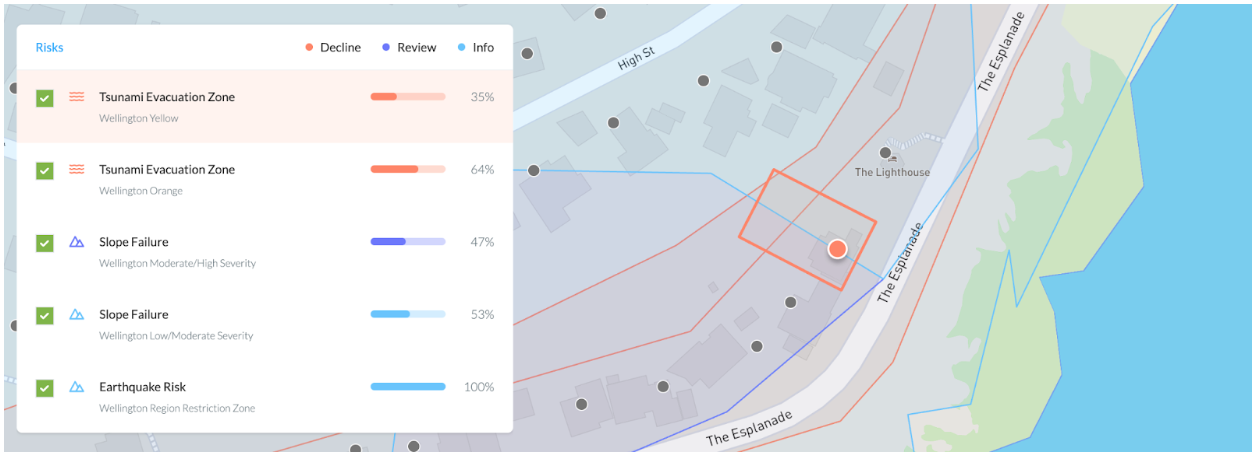
In order to remain a sustainable and successful insurance provider we choose to focus on certain types of houses, and this means that there are some locations where we can’t provide cover, and certain risk exposures such as flood or land instability that are just not our bag.
We are constantly updating our business and underwriting rules, so just because we say no today, doesn’t mean that it’s a no forever.
You also need to know that we cannot sell you something that isn’t right for your situation either. So if your property does not fit our product we’ll decline to provide cover, and we don’t mean any offence by this.
The cost is the cost
A number of factors go into calculating the total cost of your home insurance, including location, age of the property, and other things like government-imposed levies. Our award-winning insurance technology computes the insurance cost, and we rely on that to run our business. The premiums need to be set at a level that allows the insurer the margins to continue to pay claims and reinsurance costs. In short, the cost is the cost.
Learn more about how the insurance risk component of your insurance cost is calculated
It’s 100% your choice whether or not to accept the insurance cost we offer. You can ring or email and challenge a cost but ultimately it’s out of our hands as the system has spoken. You need to know though that we work incredibly hard to maintain competitive premiums for our customers. We do this by continually investing in our technology for efficient processes, negotiations with our insurer, constantly refining the rules that determine how risky our portfolio of houses is (ultimately the more aggregated risk we take on, the bigger our premium pool needs to be).
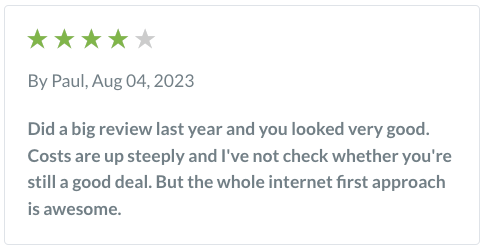
Our efforts to keep premiums competitive have been confirmed by feedback from our customers and also by financial resource websites like Moneyhub.
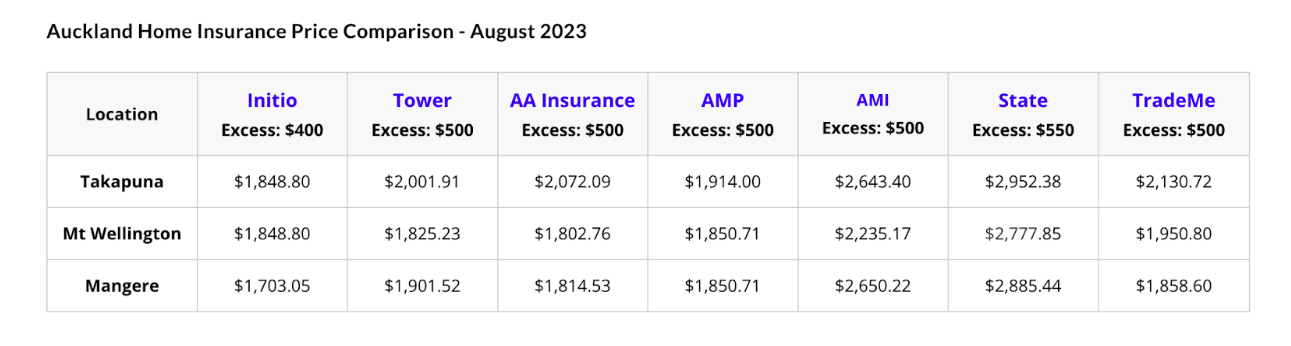
Source: Moneyhub
It’s simply not possible to be the most competitive all of the time, and we implore our customers to take a long and holistic view of their insurance that takes account of things like support (can you get you easily get ahold of your insurer), claims responsiveness, ease of use, technology and overall confidence in your provider.
It’s worth bearing in mind that not all policies are built the same, so just comparing price vs price doesn’t quite cover it. We highly recommend using our comparison tool if you want to see how we stack up when you also take the policies into consideration.
An Unapologetic Philosophy
Our philosophy is blunt but honest: “We are not for everyone”. Our model isn’t all things to all people, and that’s intentional. We’re looking for customers who align with our ethos – those who want a superior digital service.
While we understand some may expect more traditional customer service methods, we respectfully suggest they may be happier elsewhere. This is not a dismissal, but a candid admission that our service model may not suit everyone’s expectations.
In sum up, initio is unyieldingly committed to delivering our unique brand of customer experience, one that is unabashedly shaped by the needs of modern, digital-savvy customers. While our approach may not resonate with everyone, we are firm in our refusal to compromise on the affordability and efficiency that our model provides.
To our customers who find value in what we offer, we welcome you wholeheartedly. To those who don’t, we don’t hesitate to say: “We are not for you” And that’s how we maintain the balance that allows us to continue delivering what we believe is the optimal blend of service and affordability in today’s market… all driven by our technology.
Digitally savvy, human touch; The heart of initio
Since 2011 we have been redefining insurance. We are creating an insurance experience that customers love! At initio, we are all about creating better digital experiences for buying and managing insurance exclusively online. We’re best known for being the first insurance provider in New Zealand to quote and bind an insurance policy online. We consider ourselves to be the challenger brand to the domestic insurance market in New Zealand and as such we are on a mission to redefine the way insurance is managed and delivered to customers digitally.
At initio, we’re not just hiring; we’re on the lookout for thinkers, creators, and lively souls eager to influence the next chapter of insurance for our clients. If you’re brimming with creativity and ready to make an impact, you’re in good company.
Award-Winning Workplace
Yes, you read it right; we’ve got a brand-new accolade. initio has been named one of the Best Insurance Companies to Work for in Australia and New Zealand in 2023! If you want to be part of a company that’s officially recognised as a brilliant place to work, one that truly looks after its staff, then look no further. Come join our award-winning team and let’s transform those brilliant ideas into something that shines even brighter.
Open Positions
Here’s a sneak peek at our roles currently on offer. Can’t find the perfect role just yet? Keep swinging by – new opportunities land faster than you can say “Cheeseburger Fridays.”
Picking the right insurance excess can be tricky. Excess is the money you pay when something goes wrong, like a broken window or water leak. Let’s make it simple.
High or low excess?
If you pick a high excess, you pay less money every year for insurance. But, if something happens, you will have to pay more of your own money to fix it. On the other hand, a low excess means you pay more for insurance every year, but less when something goes wrong.
This balancing act can feel like a complex puzzle when choosing an excess that’s affordable at claim time, and working out the risk of actually having a claim. So, let’s help untangle this decision-making process.
Balancing insurance cost against excess
When deciding on an excess, people typically weigh-up the total cost of insurance against potential claim scenarios. If no claims are made, a higher excess results in financial savings. However, should a claim arise, the policyholder would bear a larger portion of the cost.
It’s also really important to know that an excess is applied per incident. For example, if a tenant stains the carpet and breaks a window during the course of their tenancy, you’ll likely pay more than one excess. Learn more about multiple excesses.
How do insurance companies decide how much?
The excess versus premium reduction calculation is one that insurers work on diligently, with a lot of analysis going into determining the reduction in premium versus the quantum of claims. In simple terms, they look at how often bad things happen and how much it costs to fix them.
The balance of risks and cost reduction is not always satisfactory to policyholders. For instance, there’s a growing sentiment that insurers should provide more substantial savings to policyholders willing to take on higher excesses, but in reality, it all comes down to the numbers.
The underwriting factor
The constraint in adopting a more aggressive approach to your excess lies in the underwriting process. It all boils down to the mathematical balance between the money coming in and the money going out. Analysts run comprehensive research, looking at claims data and applying hypothetical excesses, and take account of the risk landscape at the time.
From a policyholder perspective, we see the focus often leans towards insuring against significant events, such as major damages to property, and it is this type of property owner that chooses a higher excess (i.e $1,150 +).
In other words, insurance is really good for big events like fires or earthquakes. Some people who are more worried about these big events should choose a higher excess. This way, you’ll only pay when really big stuff happens, as it implies not claiming for smaller incidents. It’s really about covering events that could cause significant financial stress, or even ruin.
In the case of landlords or rental property owners, particularly those with a more extensive portfolio, we see that there is a trend taking on higher excesses of $1,150 or $2,000. Our highest excess option for landlord or owner occupied properties is currently $2,000.
Spreading the risk
If we take a practical example of an Auckland house with a $700,000 replacement value. If you choose the lowest excess of $400, the insurance would cost around $2,000 per year. But if you pick a $2,000 excess, this reduces the premium to around $1,500, saving $500 upfront.
But remember, should you have a significant claim, such as a $10,000 kitchen damage, you would have to pay an extra $1,600 in excess. Meaning that you are around $1,100 worse off when factoring in the original premium saving.
If you tend not to have claims and have a history of this then a $2,000 excess might work out for you over the long term, so long as you have the ability to fund the excess should you need to claim.
We often hear customers talk about ‘self-insurance’ and selecting a high excess is a form of this, as effectively the homeowner is sharing more of the risk of loss with the insurer. Over time the premium saving can accumulate into a significant amount. And while with a high excess you take on some of the risk, you’re covered for the big events – where an excess of $2,000 might not seem so daunting.
Your Circumstances Matter
The decision on choosing the right insurance excess often hinges on personal circumstances, whether you are a landlord or a homeowner. Newer landlords and homeowners, for example, may lean towards caution and choose a lower excess to mitigate immediate financial burdens. On the other hand, seasoned landlords might opt for higher excesses, balancing potential out-of-pocket costs with lower premium payments. The choice ultimately depends on your individual tolerance for risk and your financial flexibility. Homeowners should consider their home maintenance track record, the age of their property, and any recent renovations that could impact the likelihood of filing a claim.
Data helps
Understanding the probability of filing a claim can also guide your decision. For both landlords and homeowners, estimating potential damage is often challenging. However, insurers, equipped with extensive datasets, can provide valuable insights. For instance, if you own 10 properties, whether they are rental units or include your primary residence, statistics suggest that you can expect at least one claim of a reasonable nature each year. This aggregated data helps in assessing risk and making more informed decisions about your insurance excess and premiums. Homeowners can benefit from reviewing local crime rates, weather patterns, and historical claim data specific to their neighborhood to better understand their unique risk profile.
Navigating the world of insurance excess need not be a daunting task. Whether you’re a landlord managing multiple properties or a homeowner safeguarding your personal haven, leveraging data and understanding your personal circumstances can lead to more confident and strategic insurance choices.
Useful links: