Search results for: {search_term_string}/get-quote/house-insurance-calculator
Insurance for a non-rented second home on your property
Is it only used as extra space for your household?
If you have two dwellings on your property and the second one is used only by you or your family—without being rented out—it’s important to have the right insurance to cover both spaces.
What counts as an extension to your own home?
If the second unit/home is;
- Used like a sleepout for members of your immediate family, such as teenagers or elder family members.
- And you all predominantly share meals and/or facilities OR
- Used as a hobby room such as an art or music room OR
- Used as a home office space, then
It’s considered as an extension to your home and counts towards the one home unit/dwelling.
What insurance do you need?
For this setup, you only need one home insurance policy, which will cover both your main home and the second dwelling under the same policy. This ensures protection for:
- Your home and any structures used as part of your home for residential purposes on the property
Get covered today
With initio, you can get a quick quote and buy insurance online in minutes, making it easy to ensure your home and second dwelling are fully protected. Getting a quote and buying insurance online with us is easy, but our cover is anything but basic. We offer comprehensive protection to ensure you’re fully covered.
Need help? If you’re unsure about what policies are right for your situation, contact us to make sure you’re fully protected.
Get covered today with initio – Quick quotes, easy online cover.
Not quite what you’re looking for? Maybe some of these other scenarios suit you better:
- Do you have a second dwelling on your property that you rent out?
- Renting out part of your home short-term
- Renting out a second dwelling solely for short-term stays
- Second dwelling on your property that your family lives in
- Renting out two dwellings on your property

How to calculate your sum insured
Your rebuild sum insured is one of the most important parts of your house insurance policy. It determines the maximum amount payable if your home needs to be rebuilt after major damage.
This guide explains what sum insured means, how to calculate it correctly, and why market value is not the right number to use.
Quick summary
-
Your sum insured should reflect rebuild cost, not market value.
-
Include demolition, fences, pools and other structures.
-
Add a buffer for rising building costs.
-
Minimum and maximum limits are based on your floor area.
-
All sums insured include GST.
-
You are responsible for selecting the correct amount.
What is sum insured?
Sum insured is the amount it would cost to fully rebuild your home to its current size and standard, using today’s building costs. It is not:
-
The market value of your home
-
What you paid for the property
-
The land value
It should reflect rebuild cost only.
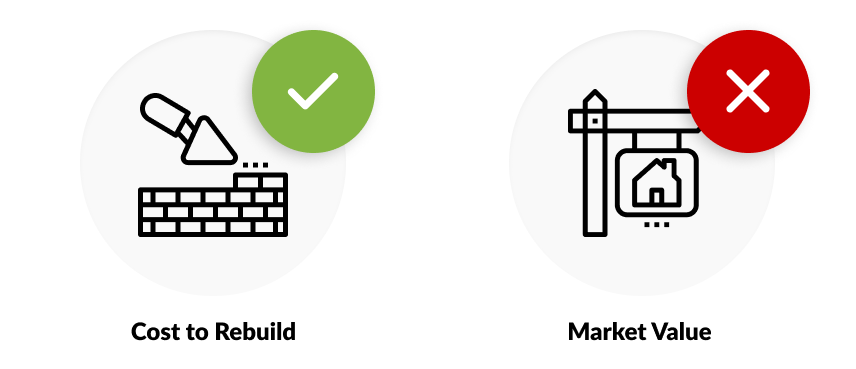
Rebuild cost vs market value
Market value includes land and location demand. Rebuild cost only covers construction.
Example: Under-insured vs over-insured
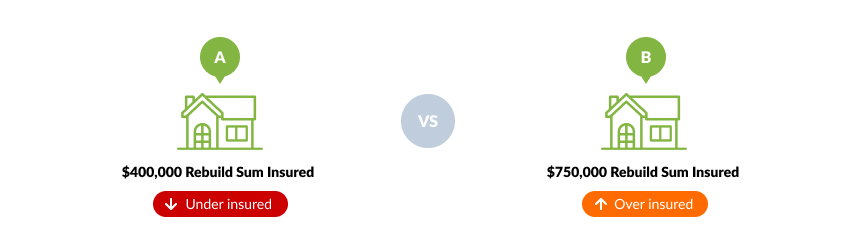
Imagine two neighbours with identical homes that would cost $500,000 to rebuild.
-
Neighbour A insures for $400,000 using a rough estimate of $2,000 per square metre.
-
Neighbour B insures for $750,000, thinking market value is the right number.
After an earthquake:
-
Neighbour A receives $400,000 and is $100,000 short.
-
Neighbour B receives $500,000 (the rebuild cost), but has paid higher premiums than necessary.
Getting it right avoids both financial shortfall and overpaying.
What should be included in your rebuild sum insured?
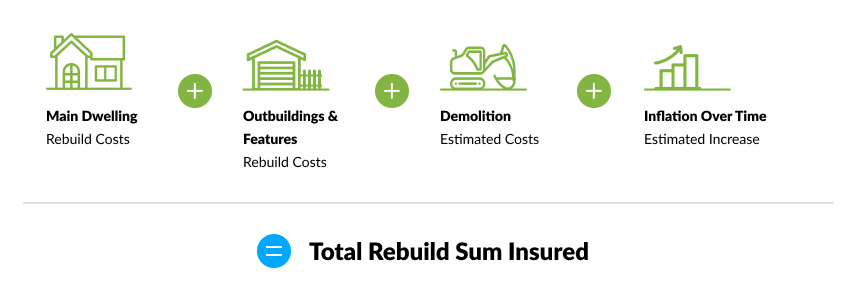
When calculating your sum insured, include:
-
The house itself
-
Fences
-
Swimming pools
-
Retaining walls
-
Other permanent structures
You should also factor in:
-
Demolition and debris removal
-
Professional fees
-
Inflation and rising building costs
Adding a reasonable buffer can help protect against cost increases over time.
Why is there a minimum and maximum sum insured?
When selecting your sum insured, you will see a minimum and maximum value range.
These are calculated based on:
-
The floor area of your home
-
Any declared outbuildings
Minimum sum insured
This reflects the lowest realistic rebuild cost per square metre for a basic home. It helps prevent serious underinsurance.
Maximum sum insured
This reflects the upper realistic rebuild cost based on floor area.
Selecting a figure above this will not increase your payout. It may only increase your premium.
If your situation genuinely requires a higher amount, contact our support team to discuss your circumstances.
💡 Building costs vary depending on materials, design and location, but most homes fall within the provided range.
Does my sum insured include GST?
Yes. Any nominated sum insured on an initio policy includes GST.
Before confirming your GST preference, ensure your selected amount includes the GST component.
How can I estimate my rebuild cost?
If you are unsure where to start, you can use the Cordell Sum Sure Calculator.
It uses council data, floor area, and building details to estimate rebuild costs. You can compare this estimate with your own assessment.
You may also wish to consult:
-
A registered builder
-
An architect
-
A quantity surveyor

Cordell Rebuild Calculator
Who is responsible for setting the sum insured?
While we can provide guidance on how our products work, we are not qualified to value homes.
You are responsible for determining the correct rebuild sum insured for your property.
If your calculated amount falls outside the available range, please contact our support team.
Frequently asked questions
Should I insure for market value?
No. Your sum insured should reflect rebuild cost, not market value.
What happens if I under-insure?
Your maximum payout will be your selected sum insured, even if rebuild costs are higher.
What happens if I over-insure?
Your payout is capped at the actual rebuild cost. You may pay higher premiums without receiving additional benefit.
Do I need to include demolition costs?
Yes. Rebuilding after major damage includes demolition and debris removal.
Related Articles
Check your replacement sum insured .. its important
Its been almost a year since our rental property insurance and holiday home insurance policies started converting from an open ended cover based on size to a specified replacement sum insured. A year on we continue to stress the importance of insuring rental properties and holiday homes correctly.
In the event of a major loss it is crucial that your sum insured is an accurate reflection of the actual cost to replace your property.
Just a reminder; the replacement sum insured is the amount it would cost to replace your property with modern equivalent construction materials, and should include the costs of demolition, professional fees, inflation and site improvements such as fencing, swimming pools, landscaping, retaining walls and driveways. As one could imagine this is a very difficult figure to calculate without a knowledge of materials costs and building techniques. This is why we encourage rental property insurance holders to get professional advice from a valuer or at the very least use an online replacement calculator such as Cordel: Online replacement calculator
Having fielded many queries from landlords, rental property insurance and holiday home insurance holders we have some myths to bust:
1. The government valuation (GV) has nothing to do with the replacement value of the dwelling
2. The market value or purchase price of your property has NO bearing on the replacement value.
3. Demolition and removal of debris is very expensive.
4. Building techniques and compliance are NOT the same as when your dwelling was first constructed. Local authorities may not allow you to build ‘what you had’.
Always feel free to contact us if you have any further queries. Initio online insurance is a specialist rental property insurance, landlord insurance and holiday home insurance provider.
My Mortgage
My Mortgage & Initio have teamed up to provide clients with house and contents insurance, and dedicated claims management when you need it. You can get a quick quote below, and cover can be started online.
Is the cause of damage covered?
Is the cause of damage covered?
Not always. Home and Contents insurance policies typically exclude the repair of a fault, defect, or deteriorating building component. These are considered maintenance issues, not insurable events.
Insurance is designed to cover the result of something going wrong, but not the cause of damage itself. For example, an old pipe decays and eventually bursts, causing water damage to the house. Homeowners often expect that all of the costs to have this fixed will be covered, but this is not always the case.
House insurance policies generally have an exclusion for faults or errors in items. A common exclusion a homeowner would find in their policy is:
You are not covered for loss, cost or expense arising from the fault, defect, or omission on:
- design, plan or specification, or
- workmanship, construction or materials.
However, this exclusion applies only to the property directly affected, It does not apply to resultant damage and accidental loss to other parts of the property.
So, when is the cause not covered? (Examples)
- Rusted pipe bursts and causes water damage throughout the house – Insurance will cover all the costs of repairing the water damage, e.g., carpets, walls, and redecorating. However, the costs to repair and replace the rusted pipe are not covered. This is deemed a fault in the materials due to the old age of the piping. The homeowner is responsible for this cost. An insurance policy is not a property maintenance cover and homeowners are therefore expected to pay for the costs of fixing faulty or old materials at their home.
- Leaking hot water cylinder valve causes water damage to downstairs ceilings and walls – Insurance will cover the builder’s costs of repairing the walls and ceilings that have been water-damaged. It’s important to note here that many policies have a hidden gradual damage limit of between $1,000 and $3,000. However, the homeowner will need to pay for a new valve and the labour costs of installing it.
To learn more about Hidden Gradual Damage, read our detailed guide
When is the cause of the damage covered? (Examples)
The crucial factor when working out what is covered, is determining the specific cause of the loss. If the cause is external to the house and is not related to the direct failure of something in the home (a water pipe for example) then everything, including the cause will be covered.
- An overnight freeze in temperature causes a water pipe to crack – Water damage occurs to the walls and flooring. Insurance will cover the cost to repair all of the resulting damage, and it will also cover the cracked pipe because the crack was caused suddenly by freezing. The cause of the loss isn’t the pipe failing on its own — it’s the sudden low temperatures. Because of this, the pipe itself is treated as resultant damage.
- A wind storm blows part of the roof off the house, rain follows, causing water damage – Again the key difference here is that the damage has been caused by something external and unrelated to the roofing itself. All damages including the repair to the roof and the subsequent water damage will be covered by a house insurance policy. If the roof had simply started leaking by itself (which is relatively common for older houses with original roofs), the the cost to repair the water damage (eg new gib ceiling and insulation) would be covered by house insurance but the repair to the roof would not.
- A power surge causes both the switchboard to catch fire, and it damages appliances – All damage is covered by insurance as the cause of the loss was not a faulty switchboard but rather an electrical spike that was an external event.
Articles of interest
Can I hold my tenant responsible for damage?
The answer is, it depends. There are circumstances where a tenant is considered liable, but this can be a little murky.
Let’s have a quick look at some key parts of the 2019 Residential Tenancies Act for insights into how you may experience it as a landlord.
Three things in the act that seem clear on paper.
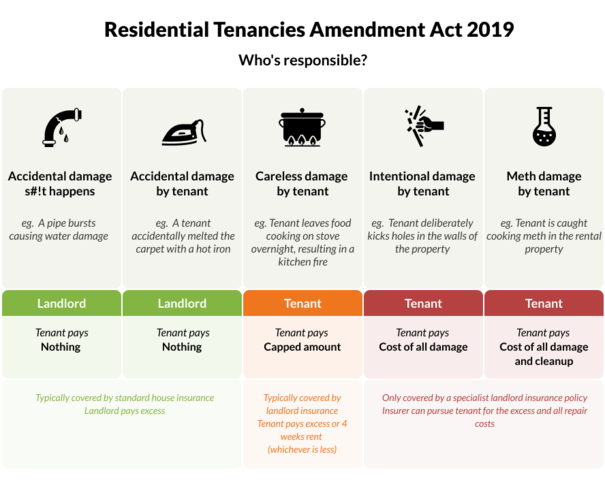
1. A tenant can be held fully responsible for intentional damage
A tenant who intentionally causes damage can be held liable, and the landlord can ask them to pay for the damage. This seems like common sense.
If the landlord has insurance cover for deliberate damage, they can lodge a claim with their insurance company. The insurer will pay for repairs, and try to recover the costs from the tenant later down the track (if it’s possible).
2. A tenant can be held partially responsible for careless damage
If a tenant has ‘carelessly’ caused damage they can be held responsible, but only up to a maximum of the landlord’s insurance excess, or four weeks of rent (whichever is less).
But what is considered careless? We’ll get to that shortly.
In this case, the tenant can share in with the benefits of the landlord’s insurance cover.
3. A tenant cannot be held responsible for accidental damage
If a tenant accidentally causes damage the act considers that sometimes; these things just happen, and the damage is the landlord’s responsibility.
However, this falls into the same problem. It’s often not crystal-clear whether damage is ‘careless’ or ‘accidental’, nor is it something the landlord and tenant may easily agree on.
Many things that would ‘sensibly’ be considered careless, have been ruled by the Tenancy Tribunal as accidental – such as knocking over and leaving a hot iron to melt into the carpet.
So it’s a good idea to read through some recent Tribunal decisions – this may be helpful for future tenant discussions.
A case of melted carpet
The 2019 changes to the act are still relatively fresh and we could still see its interpretation change. This 2020 example gives an indication of the Tribunal’s approach to the difference between careless and accidental damage.
Braziers v Guttman 2020
A landlord (Braziers) took their tenant (Guttmann) to the Tenancy Tribunal to recover damage.
The landlord alleged a patch of carpet was melted, and claimed the cost of carpet replacement from the tenant for $772. The tenant admitted the carpet was melted when they accidentally knocked over a hot clothes iron.
To avoid any liability the tenant needed to prove that they didn’t carelessly or intentionally cause the damage, and that it was a reasonable accident.
The tribunal decided the carpet damage was accidental in nature, and did not have enough ‘careless’ elements to render otherwise. There was no liability against the tenant for repair costs or excess, and the landlord would need to pay for the repairs themselves, or through their insurance (and pay the excess).
Full details of the case: Braziers Ltd v Guttmann [2020] TT 4251455
Accidental Tenant Damage vs Careless Tenant Damage
As we’ve mentioned, the Act’s definition of the difference between accidental and careless damage could be better, and we are now seeing the results of this coming through the Tenancy Tribunal process. Here’s our overview:
Accidental damage is something caused by the tenant, but outside their control (for example, tripping and putting a knee through a wall).
Careless damage is caused through lack of attention or concern for the consequences (for example, leaving a stove on while you go to do something else).
But ultimately these guidelines will be up for subjective judgement. We expect to see more disagreements between tenants and landlords over who’s liable for damage. If you’re a landlord that’s applying to the Tenancy Tribunal to see what they think, you should be prepared to prove that damage was caused intentionally – or at least carelessly to avoid paying an excess.
What’s our position on all this?
We believe a clearer division between what is accidental and careless tenant damage is needed. If no clear interpretation can be made then ideally all tenant damage – whether careless or accidental – should be treated as the responsibility of the tenant (up to the smaller of the excess or four weeks rent).
This will save a lot of time and arguments. However, based on recent cases the Tenancy Tribunal doesn’t quite see it the same way.
Why can’t the tenant use their own insurance to pay for the damage?
That’s a good question.
In the past tenants were considered completely responsible. If the tenant had their own contents insurance the landlord could rely on this to pay for damage by the tenant. Almost all contents insurance policies will include the tenant’s liability to at least $1 million for accidental damage.
For many landlords, confirmation of contents cover became a condition of tenancy; if the tenant accidentally burnt the house down, the landlord’s insurance company could get the money back from the tenant’s insurance company.
Then a couple of big things happened.
1) Court of Appeal decision on Holla v Osaki
This landmark ruling established that landlords and their insurance companies could no longer recover the costs of damage from tenants. In this case, it was $216,000 worth of damage caused by the careless action of the tenant leaving an unattended pot cooking on the stove.
2) Residential Tenancies Act 2019
This act reversed the effects of the Holla vs Osaki decision and brought back some responsibility for tenants who cause careless damage. Responsibility, however, was limited to the lesser of the landlord’s insurance excess or four weeks rent.
It established that the tenant is fully responsible for intentional damage and that the tenant cannot rely on the landlord insurance policy for this. Remember that; as you would expect, a tenant’s contents insurance won’t provide cover for damage that’s intentionally caused.
Related Articles
How do I get a Certificate of Insurance?
The Certificate of Insurance is a document that proves your cover is in place once you’ve purchased a policy. It’s also known as a Certificate of Currency. Banks and finance companies often ask for one when you apply for a mortgage or loan or when you are wanting to draw on the loan.
If you are yet to purchase the home or only looking to make an offer, you would alternatively obtain a “Letter of Intent” rather than a Certificate of Insurance.
Get your Certificate
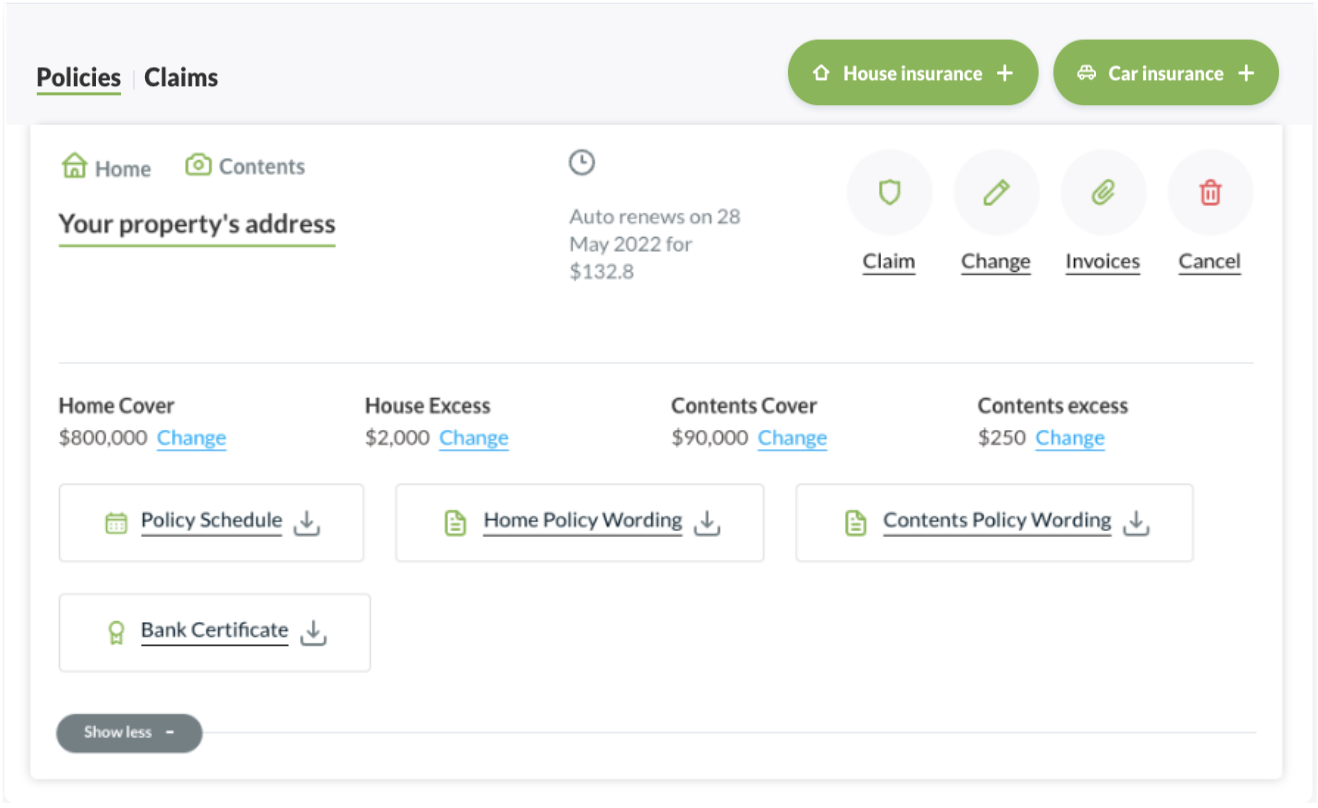
Certificates are available at anytime once you have purchased cover through initio. You can download your certificate directly from your dashboard login. Click the Bank Certificate option on the relevant policy details. A certificate will open which you can save.
If you haven’t yet purchased your policy, please find more information here on how to get started.
Need to change the bank noted on your Certificate?
If you need to change the Interested Party (bank/loan provider) or the Insured Name on the policy, select the “Change” option on the right side-menu of the relevant policy. You can then update the policy and we’ll automatically send you an updated Certificate to your email.
Need to change the dates?
We are unable to alter the inception (effective) date of a policy once it’s been purchased. You can, however, cancel that policy from your dashboard back to the original inception date and re-purchase the policy (from your dashboard) with the correct date. A new certificate will be forwarded within minutes. Our system will also automatically provide you with a full refund for the original policy.
Please find more information regarding changes to a purchased policy on our site here.
Useful Links
When do I need house insurance?
Navigating your dashboard
Confirmation of cover
GRA with NZPIF Insurance
NZ Insurances
The lighter side of insurance claims in 2025
Every year, our claims team sees the serious stuff that reminds you why house insurance and landlord insurance matter: storms, leaks, break ins, big events.
But in between the big moments, there is another side to the story. Tiny humans, runaway trampolines, drones with a death wish, and phones that seem determined to meet every body of water in New Zealand.
This is a light look at some of the more unusual patterns from our 2025 claims data, based on what we saw in the initio book.
House and contents
Tiny humans breaking things

Children do not show up in most claims, but when they do, the stories are very easy to picture.
Looking across our 2025 claims:
- Around 1 percent of all claims mention a child somewhere in the story
- For contents claims, that jumps to roughly 7 percent
- In some towns, around 3 in every 100 claims mention children in the description
On our books, you are most likely to find tiny humans breaking things in:
- Cambridge
- Nelson
- Gisborne
- Palmerston North
- Queenstown
What are they breaking?
- Screens and devices
- Glass doors and windows
- Soft furnishings and carpets
- The odd high value item that probably should not be within arm’s reach
Common themes in child related claims are:
- Accidental damage makes up more than 40 percent of the kid stories
- Followed by water damage from spills and overflows
- And glass breakage, usually with balls, scooters, toys or bikes hitting windows and doors
So while the bulk of our book is still storms, leaks and more traditional events, there is a clear pattern of small people and big repair bills.
Claim spotlight: the mobility scooter vs the glass door
One claim that deserves its own call out: a child driving a mobility scooter into a glass door.
It reads like a scene from a comedy, but it is a real claim with real broken glass and a real clean up.
It is a good reminder that accidents do not always look like the classic storm or burglary. Sometimes they look like kids having a bit too much fun practising to be the next big grand prix driver.
Runaway trampolines
If you own a trampoline, you probably already know it tries to rebrand into an aircraft in any kind of decent wind.
From our 2025 claims:
- Trampolines make up only a tiny slice of all claims, but
- They are roughly 3 percent of all wind and storm claims
Most storm claims are still for roofs, fences and leaks, but about one in thirty wind claims involves a trampoline trying to escape the backyard and live its best life out on the road.
A few of the real descriptions include:
- A trampoline that simply blew away and was never found
- A small tornado lifting a trampoline onto a roof
- Trampolines taking out fences on the way past
For home and contents insurance, it is a useful reminder that the risk in a storm is not just trees and roofing iron. It is anything light enough to take off, so tie things down before the next big blow.
Drones go rogue and fishing gear with a death wish
Ten years ago, it was rare to see drones or motorised kontikis in claims. Now they turn up often enough to be a pattern, even if they are still a small slice of the overall numbers.
A lot of the drones we see are used for fishing, taking lines out past the breakers, which is why they sit neatly alongside kontikis in our claims. Others are doing land based duty, filming the backyard or the farm, and getting into trouble there instead.
In 2025 we saw plenty of examples of drones and kontikis going AWOL, including:
- Drones hit by waves, sinking into the ocean or just lost at sea, never to be seen again
- Drones colliding with power lines or crashing on land
- Kontikis colliding with rocks or other solid objects and coming back broken
- Kontikis filling with water or just sinking and never making it back to shore
Put simply, some of the gadgets people use to fish seem very keen to join the fish.
These claims are still only a small fraction of what we see overall, but they are modern, very Kiwi, and show how quickly new tech turns into new kinds of risk.
New tech, new kinds of trouble
Phones, laptops, tablets and smart devices feature more and more in our claims.

Across our 2025 data:
- Roughly 1 in every 80 claims involves a mobile phone
- Around 1 in every couple of hundred claims involves a laptop
- Tablets and iPads sit a little behind that, but still show up as a clear group
- Robot helpers like robot lawn mowers and robot vacuums appear in a handful of cases
From an insurance point of view, it shows how much value is now sitting in small, fragile devices. For landlords, it is a reminder that tenants are bringing all this tech into your property too.
Landlord and rental property
The everyday chaos
When people think about rental property claims, they often imagine the big scary stuff: major meth damage, fires, floods, or tenants doing a runner.
Those things do happen. But a lot of landlord insurance claims are far more everyday. Think stained carpet, bumped garage doors, lost keys and a few over enthusiastic pets.
Looking across our landlord type claims for 2025 (where the description clearly involves tenants or rentals), most of what we see is surprisingly normal:
- Around four in ten landlord claims on our book are simple accidental damage
- Roughly a quarter are loss of rent only
- The rest is a mix of impact (things hitting the house), malicious tenant damage, and keys and locks
So most of the time, it is everyday life going wrong in small but expensive ways.
Why we care about this stuff
This is a playful look at our 2025 claims, but there is a serious purpose behind it.
Every time:
- A trampoline takes off in a storm
- A child drives a mobility scooter into a glass door
- A drone vanishes into the ocean
- Tenants backing into the garage door
- A phone or laptop ends up in water…
…it tells us something about how people actually live in their homes and rentals.
That feeds back into how we think about house insurance and landlord insurance. It helps us make sure common accidents are covered clearly, that our wording matches real life, and that we can give better tips on how to avoid some of these mishaps in the first place.
Behind every percentage and every claim code, there is usually a very human, very Kiwi story.
Related articles
About initio
Initio Insurance knows New Zealand houses and landlord insurance – it’s all we do. Whether it’s a rental property, holiday home or your main residence, we’ve got the perfect insurance cover for you.
We provide everything you need online – instant quotes, easy cover, and efficient claims. We know your time is valuable, so we get straight to the point.
Why choose initio?
We’re specialists
We’re different because we only provide cover for houses. This means that we understand what matters to you, and you have the important cover you need as a property owner or a landlord. Find out more about the coverage options, including landlord insurance here.
We save you money
We run the entire insurance process online – including quotes, payments, and claims. This means our business costs are lower; savings which we can then pass on to you.
We love being online, but you can always contact us by phone or email. Even better, we don’t send your call to a faceless claim centre; your call will be taken by one of our highly experienced team.
We’re secure
Initio is underwritten by Lumley, a business division of IAG New Zealand Limited, which means if the unthinkable happens and disaster strikes, we’ll always have you covered. Read more about IAG’s financial strength here.
We keep you updated
When you submit a claim, we will confirm the details and keep you informed of its progress. The only real value you see from your insurance cover is at claim time, and that’s why we make it easy.
We send you email reminders when your policy is due for renewal, so you have plenty of time to login to your dashboard and renew your policy before it expires. At any time you can contact the initio team about coverage, a change in circumstances or any other queries.
What do our customers have to say?
Don’t just take our word for it; click the below link to see what our customers think of initio and whether they would recommend initio to their own friends and family.
Client Feedback
What does landlord insurance cover?
If you’re new to the rental property game, you’re probably searching the internet, asking yourself, what does landlord insurance cover? It’s important to find the right policy that covers you if things go wrong – whether it’s tenant-related damage, loss of rent, or unexpected repairs. The last thing you want is to be caught short with the wrong type of policy from an insurance provider that doesn’t specialise in landlord insurance.
That’s where initio comes in. We live and breathe landlord insurance, making sure your rental property is in the hands of a provider that understands the challenges landlords face.
Owning a rental property can be a great investment, but it’s not without risks. That’s why having the right landlord insurance is essential – it helps safeguard your investment from unexpected costs, such as tenant damage, legal claims, and loss of rental income.
What landlord insurance with initio typically covers:
- Loss of rent – Cover for lost rental income if your property becomes uninhabitable due to damage or if tenants leave unexpectedly
- Deliberate damage – Protection against intentional damage or theft caused by tenants.
- Meth contamination – Cover for decontamination costs and additional rent loss during cleanup.
- Landlord contents – Coverage for furniture, appliances, and other items you provide in the rental.
- Replacement cover – Full rebuild protection up to your insured sum.
- Legal liability – Protection against legal costs if your property causes damage or injury.
- Excess-free blocked pipe cover – Coverage to unblock underground pipes without paying an excess.
- Hidden gradual damage – Cover for gradual water damage caused by hidden water pipe/tank leaks.
- Excess-free keys and locks – Replacement of lost or stolen keys and locks with no excess to pay.

Looking for more details?
Head over to our landlord insurance page for some great foundational information and to see how we can help protect your rental. You’ll also find a range of helpful landlord-specific support articles, along with our guide to the fundamentals of landlord insurance, for further reading. If you’re looking for more specific details about initio’s landlord insurance policy, you can download the full wording from our policy wording page.
With the right cover in place, you can rent out your property with confidence – without stressing about the ‘what ifs.’
Useful information
Duty of Disclosure
DECLARATION
To be completed by the insured(s) shown and also on behalf of any other person to be covered by this insurance.
I declare that:
1. All information contained in this proposal and on any attachment is complete and correct;
2. I have disclosed all material facts to Initio;
3. I agree that this proposal shall be the basis of the contract between me and Initio and I am willing to accept the terms, conditions and exclusions of this insurance;
4. I am authorised to complete this proposal on behalf of all people to be covered by this insurance and they give the same declarations.
By signing I authorise the insurer to:
Check our details on the Insurance Claims Register and place our claims information on the Insurance Claims Register which other insurers can access;
Disclose our personal information about this insurance to other members of the insurance industry and/or parties who have a financial interest in the subject matter of this insurance;
Obtain our personal information held by any other party regarding my/our existing and previous insurances.
YOUR DUTY OF DISCLOSURE
You must tell us everything you know (or could be reasonably expected to know) that a prudent insurer would want to take into account in deciding:
a. Whether to agree to insure you
b. if so, on what terms
Examples of what you must tell us include:
a. anything that increases the risk of a claim
b. any criminal offending or convictions
c. any previous insurance claims
d. any refusal by another insurer to insure you on standard terms.
You must also tell us this every time this policy renews and when you make any changes to it. If you fail to do this, we may void the policy retrospectively. You will have no insurance at all. When in doubt, disclose. We treat all information confidentially
CHANGE IN CIRCUMSTANCES
You must tell us about any material changes in your circumstances after the policy starts and during the policy period
PRIVACY
The personal information you provide in this proposal will be held by Initio and IAG.
Our collection of this information is part of your duty of disclosure at law to us, and is compulsory
If you fail to provide it, we may choose not to insure you.
You have rights of access to the personal information, and correction of it, under the Privacy Act 1993.
REPLACEMENT SUM INSURED
The ‘replacement sum insured’ above represents the total replacement value of your dwelling and improvements (eg driveways, swimming pools, fencing etc). Initio & IAG do not accept any responsibility for the accuracy of this value. You are responsible for determining and accepting this value. An insurance valuation or using an online replacement value calculator will provide you with a more accurate replacement value.
Non Disclosures
Disclosure vs. Declaration
Where do I disclose additional information?
Please include all relevant details in your online application form. If there’s anything not covered in a specific question, you can disclose it in the final question: “Is there any further information likely to affect the acceptance of this insurance?” Select Yes and a text box will appear where you can record your disclosures.
Landlord insurance for multiple rentals
Help with adding more than one property to your cover
If you own more than one rental property, you might be wondering how landlord insurance for multiple rentals works. With initio, it’s simple – you can manage all your insured rentals under one dashboard, add new properties when you’re ready, and keep your cover consistent across your portfolio.
If I want to add more than one property, do I need separate quotes and invoices?
You can buy your first policy online, then add more properties from your initio dashboard by selecting the “House insurance +” button. Here’s a step-by-step guide to navigating the initio dashboard.
Each property usually needs its own quote, so the right details and cover apply to that address. If you own a block of connected flats or units (up to 8 units) on standard residential leases, you could look at our Multi-Unit Rental policy, which covers the whole block under one policy.
Can I pay with a different account for each of my rental policies?
If you’re paying monthly, initio can only hold one card per account to cover all monthly policy payments. To use a different card for a specific monthly policy, you’d need to set up a separate initio account under a different email.
If you’re paying annually, you can choose a different card for each policy at the time you buy it.
Learn more here: Common Queries and How monthly insurance works.
“When managing landlord insurance with multiple rentals, it’s a good idea to review each property’s cover once a year. Different homes can have different risks – like flood zones, tenant types, or rebuild values – so checking that your sum insured and excess still make sense helps ensure you’re not under- or over-insured. Keeping your details up to date also means any claims can be processed faster and without surprises.”
If you get stuck while adding another property or managing multiple rental insurance, help is only a click away. You can chat with Chad, our friendly digital assistant, directly on the initio website for quick answers and step-by-step guidance. Just click on the ‘help’ button at the bottom of the screen to get started. If you’d prefer to talk to a real person, our support team is always happy to help – just head to our contact us page to get in touch.
Related articles
- Help when your quote isn’t straightforward
- What can be insured under our Multi Unit Rental Policy?
- How property use affects your cover
- Are you thinking about becoming a Landlord and renting your home?

How does monthly insurance work?
Monthly insurance cover means that it is renewed and paid for each month. It’s a month-to-month policy that automatically renews and is charged to your credit card on the same day each month.
How can I pay monthly?
You can choose to either pay monthly or annually when you first purchase a policy. Our monthly payment is only available with a visa debit or credit card payment. We don’t offer a monthly direct debit from your bank account.
For details on switching between monthly and annual payments, check out our article on ‘Switching Payment Frequency‘.
Will you tell me if my monthly insurance payment changes?
Yes, we’ll let you know in advance if your monthly payment is going to change thirty days prior to any payment.
Your total insurance cost will typically change on the anniversary of your policy (i.e the day and month you first started the cover). This means that your monthly payment will remain the same for the year. The exception being that if there is a government levy change (for example Fire & Emergency New Zealand levy rate change) that is mandated to be applied from the effective date of your next monthly renewal.
Each month we will send you an email confirming the renewal of your policy. In that email, if the next month’s payment is going to be different (i.e its the anniversary renewal) we’ll let you know.
Your initio dashboard will also show you the date and amount of your current and next months payment.
When will my card be charged?
When you first purchase your policy the first payment will be withdrawn from your card on that day. All following monthly payments will be withdrawn from your card the day your policy renews (your chosen renewal date).
For example, if you buy a new policy on the 1st of January and the start date of the policy is the 5th of January, you’ll initially be charged for the first month on the purchase date, ie 1st Jan. All future monthly payments starting from the February renewal will then be withdrawn on the 5th of each month.
What if I need to change my card details?
You can change the card that’s used for the payments at anytime. To do so, please login to your initio dashboard and choose “credit card” from the “account” menu in the top right corner of your dashboard. Here you can enter the new card information and any future payments will automatically default to the new card. You can also see what card is currently registered for your payments on this screen.
What if my monthly payment fails to go through?
We’ll make four attempts in total to process the payment, you’ll receive an email notification each time — whether the payment succeeds or fails. We’ll include when the next transaction attempt will be on our email correspondence, so you can ensure funds are available at the right time.
Prior to the fourth and final Attempt:
- You can contact us prior to the final fourth attempt to request the payment to go through at an earlier preferred time. You can also trigger an earlier payment re-try by updating your credit card details kept in your initio dashboard — updating this field (even with the same card info) will automatically trigger an immediate re-try of any outstanding monthly payment.
- Get in touch with your bank if the payment has missed despite the funds being available, in some cases your bank may have put a hold on transactions for security reasons.
- Cover remains in place pending the successful payment within this time.
After the fourth and final Attempt:
If the premium remains unpaid after the final fourth attempt, the policy will lapse. Cover then ceases back to the date of the initial missed payment.
We are unable to re-activate the original policy once it has lapsed. To re-instate the cover at this time, please do so by beginning a new policy from your initio account (dashboard) using the ‘+’ options.
What if I want to use a different card for each policy?
If you are purchasing annual insurance, you can use a different card for each and every purchase. If you are purchasing monthly insurance, we are only currently able to facilitate one card for any monthly payments under your account. If you wish to use a different card for a monthly policy, you will need to set up a new initio account using an alternative email address for any policy to be paid via the new card.
What if I want all my monthly policy payments to be aligned on the same day of the month?
The monthly due date automatically aligns with the original inception date of the policy. Should you wish to change a policy’s monthly due date you would need to replace it with a new policy, effective on the preferred date. Once the new policy is in place, you can then cancel the original policy, any unused portion of that policy will be automatically refunded.
Why does the cost of insurance change?
There are a number of reasons why your house or car insurance premiums can change each year. Some of the more common reasons are:
- Change in the costs of materials and labour, which makes repairs to houses and cars more expensive (Covid supply chain issues put pressure on materials costs)
- Increased in the frequency and severity of weather events (Auckland Floods 2023, Nelson Floods 2022, Napier floods 2023 & 2021, Auckland tornado 2021 to name a few)
- Government earthquake levy changes
- Fire Service levy changes
- Increased re-insurance costs due to the way international insurers view New Zealand’s natural disaster risk (NZ is one of the highest risks in the world unfortunately)
- For cars, the main driver may have had birthday or an accident which changes the risk and in turn changes the premium (up or down) at the next policy anniversary renewal.
Related articles
How can I pay my premium?
How does monthly insurance work?
Switching payment frequency
Can I pay with direct debit?
First Lane
With First Lane you can insure your rental property, house or holiday home insurance online. Enter your property details to get an instant quote, if you like what you see you can start cover online with payment by credit card or bank transfer.
Float Mortgages
Award winning insurance
Initio recently became a winning 5 star award provider in the 2022 IBNZ (Insurance Business New Zealand) insurance awards and we couldn’t be more proud.
How did we win?
Our winning formula is our smart claims platform, which empowers customer self-service for home, contents, and car insurance. It does this by:
- reducing the number of people involved in domestic insurance transactions
- providing an extra level of customer control with our online dashboard
- every feature, site update, and logic change is made with our customers in mind
- never losing sight of how the end user interacts with our technology
- creating the easiest and most frictionless insurance experience in New Zealand.
Where others have failed, we’ve been able to provide integration and tools that enable partners to get house insurance quotes instantly. We do this by providing customers with their premium and insurability profile of a property in less than six seconds. What’s more, the technology is scalable. This means our customers have the flexibility to adjust the quote based on their unique needs. Currently, initio generates more than 40,000 automated domestic insurance quotes per day.
How were winners determined?
- Technology providers nominated their solution. They explained why it stands out and what makes it the best in the market.
- IBNZ then reached out to brokers. Asked them to rate their overall satisfaction with the insurance technology providers they dealt with.
- The top-scoring technology and software providers were then named 5-Star Award winners.
We’re incredibly proud to come away with this recognition from the industry. Discover just how impressive our software is for yourself by generating your own instant quote today and starting your own journey with initio. You won’t be disappointed.

Initio wins 2025 Insurance Innovator Award
We’re proud to share that initio has been recognised as a 5-Star Insurance Innovator in the 2025 Insurance Business New Zealand (IBNZ) awards. This award celebrates the companies that push the industry forward with real innovation, delivering meaningful results for customers.
Why this award matters
For us, innovation isn’t about shiny technology for the sake of it. It’s about using smart digital tools to make insurance simpler, faster, and smarter for homeowners and landlords across New Zealand. That’s why being recognised by IBNZ is special. Their judging looked not just at new ideas but also at proven results – how those ideas genuinely improve outcomes.
In 2024, we rolled out major improvements to our platform:
- Smarter online quoting that allows customers to compare cover and buy a policy in minutes
- A more intuitive dashboard where policyholders can manage their insurance 24/7
- Faster claims processing supported by real-time updates and better data sharing
- Behind-the-scenes risk technology that reduces friction for customers while keeping cover accurate and fair
Each of these developments was designed with one question in mind: how does this make life easier for our customers?
Smart insurance for smart people
Our customers are busy people who want insurance to just work – without the jargon, paperwork, or hold music. That’s why we’ve built a platform that puts control in their hands. The award validates that our approach, removing complexity and giving transparency, is working.
For example, being able to update your policy online, lodge a claim, or instantly access documents via your client dashboard isn’t just a “tech feature.” It means less stress when something goes wrong, quicker answers, and confidence that you’re in control.
What it means for our customers
Recognition from IBNZ is encouragement to keep going. But the real win is for our customers. Because every innovation we introduce is about:
- Saving time – no waiting on hold or posting forms
- Clarity – cover explained in plain language, upfront
- Confidence – knowing you can rely on us at claim time
- Fairness – technology that helps us keep pricing sharper and more accurate
Our customers sit at the front of every decision we make. This award highlights that focusing on them, rather than outdated processes, leads to better outcomes.
Looking ahead
We’re proud of the recognition, but we see it as a milestone rather than a finish line. Innovation never stops, and we’ll continue to improve how we serve New Zealand homeowners and landlords.
Complex insurance, made simple.
Try it for yourself. Start by getting a quote
Related articles
- Initio named MoneyHub’s favourite home insurance quote platform for 2025
- Great at insurance, even better to work for
- Award-winning innovation. Smart Claims wins 2024 Canstar award
- Technology you can trust
- Awards we’ve won
Initio Collaborates with Bachcare
To Offer Unique Insurance Product for Holiday Homeowners
New Zealand insurance provider, initio, is excited to announce an alliance with Bachcare, the country’s leading holiday home management company. This unique partnership will provide an innovative insurance product meticulously tailored for holiday homeowners.
Initio, in conjunction with Bachcare, will provide instant online coverage for holiday homes, including those that are also partially rented out. The extensive coverage includes not only holiday homes, but also primary residences, contents, vehicles, and rental properties. With initio’s customer-friendly online platform, obtaining comprehensive insurance coverage for your holiday home is quick and easy.
Initio stands out from competitors due to its forward-thinking approach and unwavering focus on customer satisfaction and simplicity. With initio, you can get a quote in 5 seconds by simply entering the property address. Once insured, customers can also update their insurance cover on the fly with the live policy dashboard.
Smart Claims enhance the experience
To provide an even better customer experience, initio recently upgraded its innovative Smart Claims platform. Having proved its worth in handling claims during severe weather events earlier in the year, this platform brings a new level of efficiency and transparency to the claims process. With features like tailored questionnaires for different types of loss and real-time claims tracking, this technology provides a more streamlined and personalised claims experience. The recent upgrade enhances the comprehensive insurance coverage initio provides, making the process of filing and tracking claims for holiday homes even easier and more convenient.
Specialised Holiday Home cover
Initio developed their specific holiday home insurance product around a decade ago, realising that there were no dedicated holiday home insurance products available from competitors. Rather, competitors simply offered a regular house and contents policy that would often not meet the requirements of the holiday homeowner. Initio understands the unique insurance requirements of holiday homeowners and has meticulously designed their policies to cater to these needs. Whether homeowners use the holiday home for personal enjoyment, or as a rental, initio provides the necessary insurance coverage to protect their investment. With their unique feature of instant online cover in either of these scenarios, holiday home owners can get unparalleled peace of mind.
“We are thrilled to be collaborating with Bachcare, providing an exceptional insurance product that has been designed for holiday homeowners,” said Rene Swindley, CEO at initio. “Our innovative approach and commitment to excellence align perfectly with Bachcare’s mission of providing customers with the best possible experience”.
More about initio & Bachcare
Initio is a pioneering insurance provider based in New Zealand, committed to revolutionising the insurance industry. They offer comprehensive coverage to meet the unique needs of homeowners, covering holiday homes, primary residences, contents, vehicles, and rental properties.
Bachcare is New Zealand’s leading holiday home management company, offering an array of holiday homes throughout the country, focusing on exceptional service and enabling homeowners to maximise returns on their holiday home investment.
How do I buy my first vehicle policy?
So you have just insured your property with us. Awesome! But you are wondering how to add insurance for your vehicle? This guide will walk you through the essential steps: getting a quote, customising your cover, disclosing necessary information, and making your payment.
1. Get an instant quote
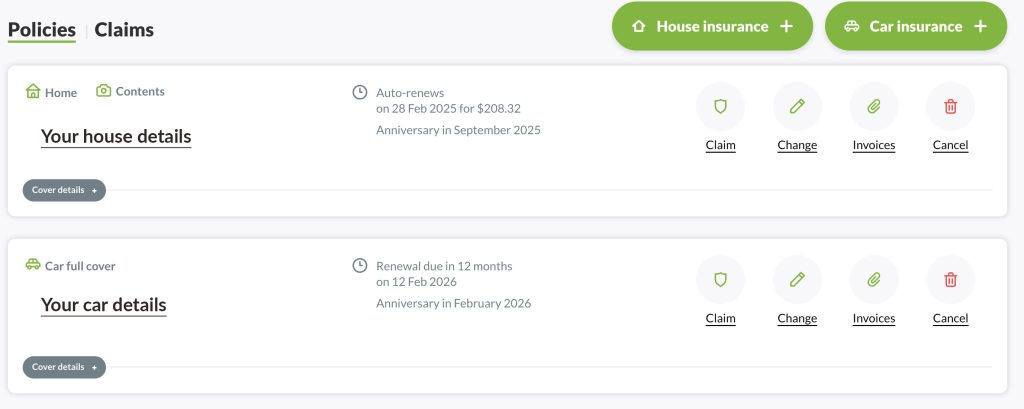
When you purchased your insurance policy for your property, you would’ve been introduced to your initio dashboard. Within a few moments of your home product purchase, we would have provided you with login information for your initio dashboard. You will need to login to your dashboard to begin the process of getting vehicle insurance. This is because we only offer vehicle insurance to customers who have a property insured with initio.
Simply click on the green “Car Insurance +” button, which takes you to a page asking for your vehicle registration number.
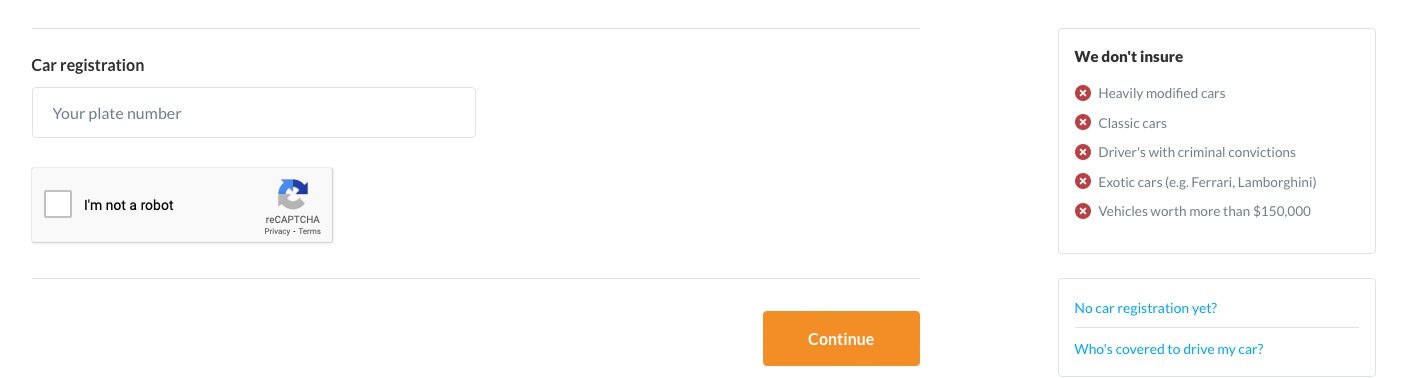
2. Get a quote
Enter your vehicle’s registration number to continue. If you have a brand new vehicle that has not been registered yet; email our team, they can assist you further.
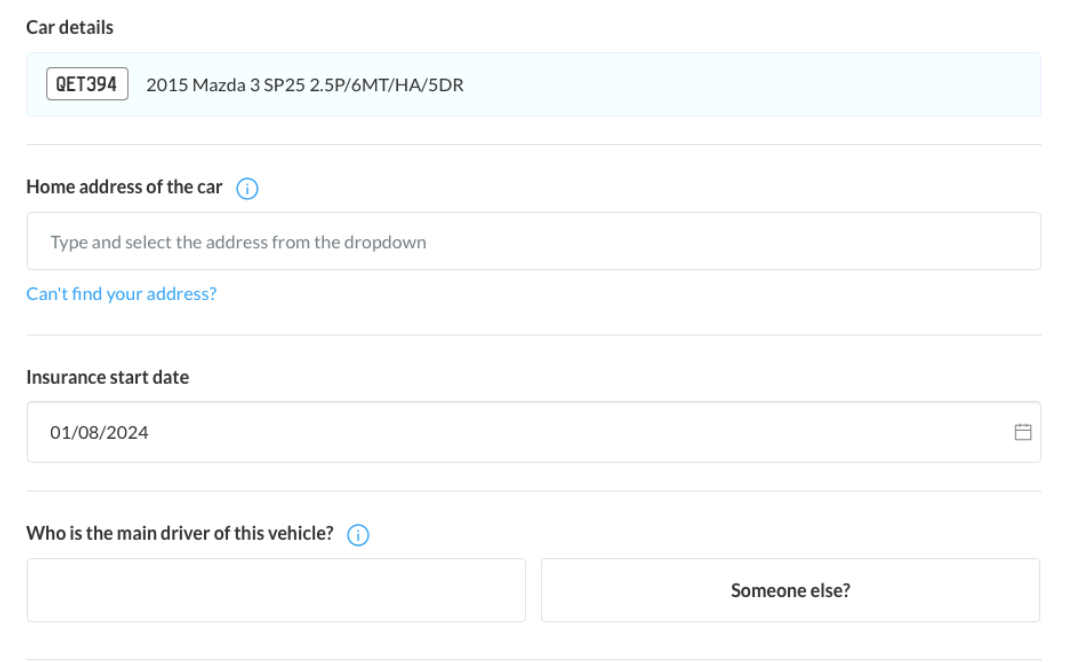
3. Enter your details
Enter the details above to proceed to the next step. This information helps us understand where the car will be parked overnight and during the day, who the main driver is, and when you’d like the insurance to start.
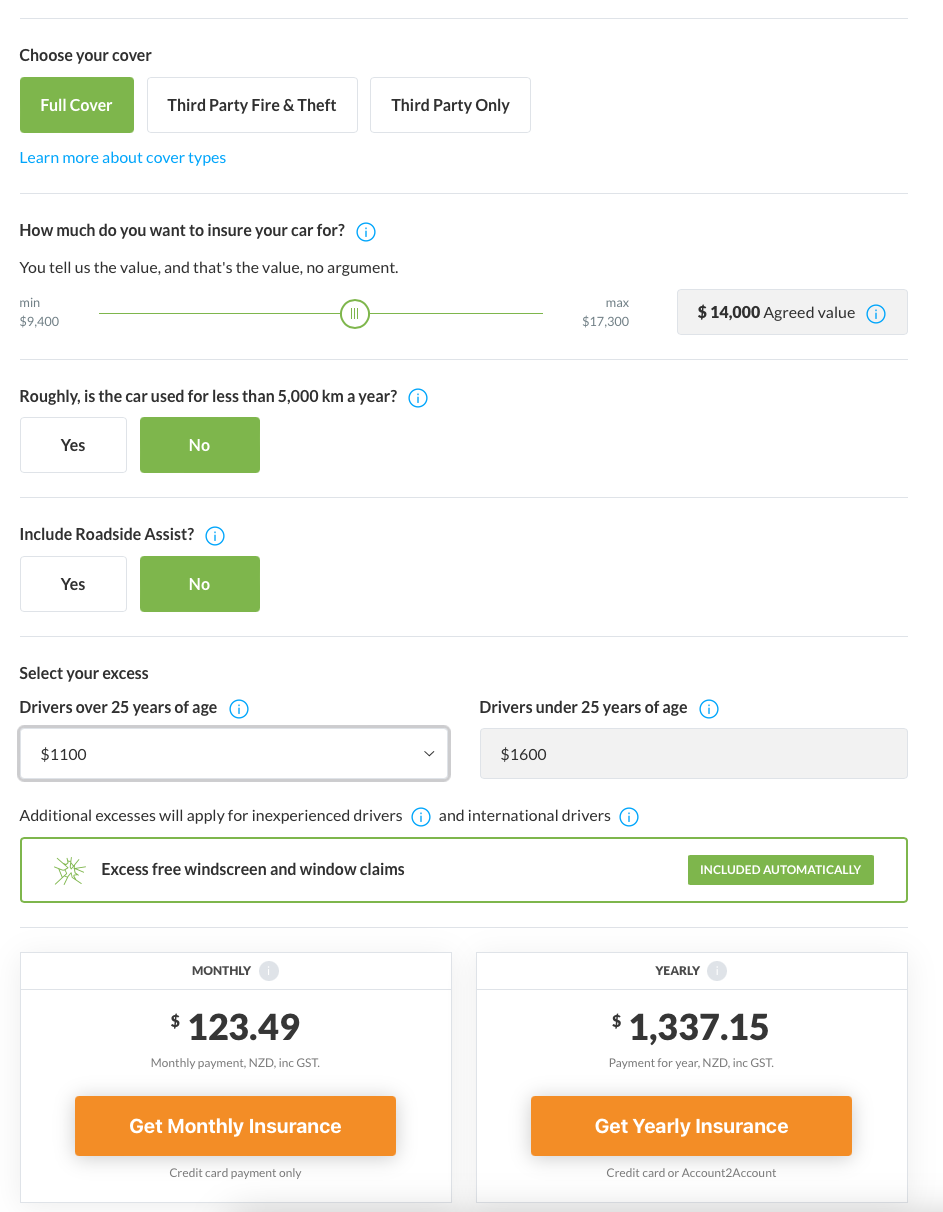
4. Select vehicle cover, customise quote & select payment option
For our vehicle insurance, we offer the following which include different policy extensions and exclusions:
- Comprehensive Full Cover
- Third Party – Fire & Theft
- Third Party Only
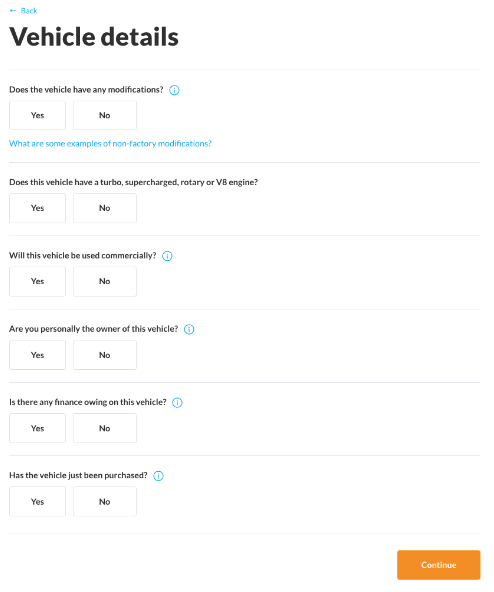
5. Enter vehicle details
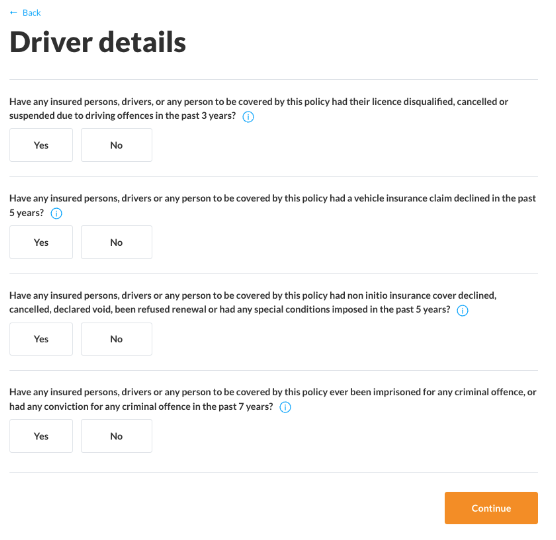
6. Complete driver details
7. Sign the application form
To sign the application form, use your device keyboard to type your name in full (as the person completing the form) in the space provided.
8. Review and make payment
Once you have customised your insurance policy, you will need to select a payment option. For more information regarding our payment options, please refer to our support page, here.
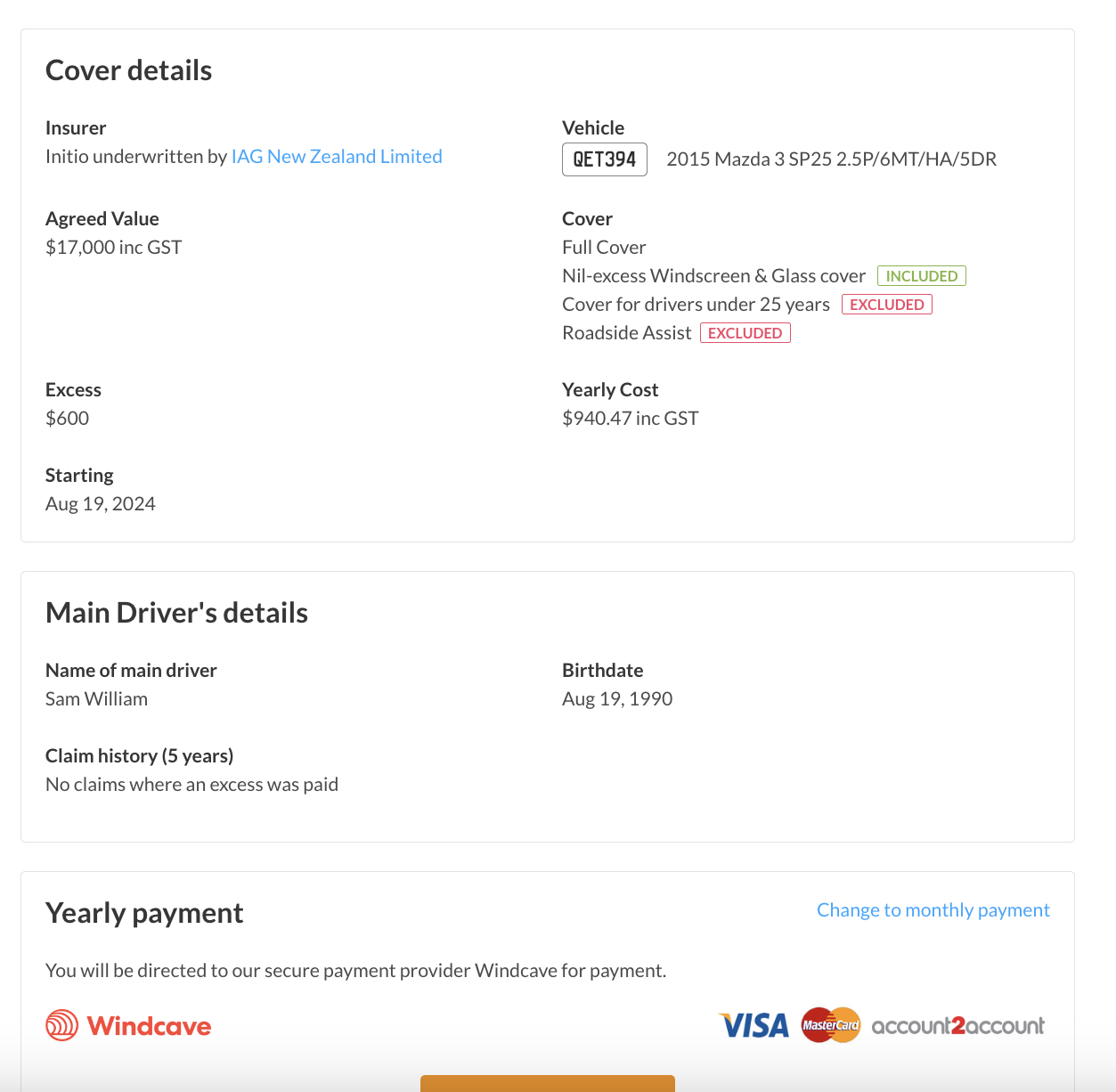
There you have it! We will instantly email your confirmation documents.
Useful links
Initio wins Deloitte Fast 50 ‘Fastest Growing Services Business’
Initio has been named the Fastest Growing Services Business in the 2025 Deloitte Fast 50 for the Central North Island region.
The Deloitte Fast 50 recognises high-growth New Zealand businesses that are scaling rapidly through innovation, technology, and strong market demand. A few weeks after the regional results, initio was also ranked 28th nationally across all New Zealand companies in the 2025 Deloitte Fast 50.
Quick summary
-
Initio named Fastest Growing Services Business (Central North Island, 2025)
-
Ranked 28th nationally in the Deloitte Fast 50
-
Recognised for strong growth as a New Zealand-only insurance provider
-
Growth driven by digital-first insurance and technology innovation
-
Backed by IAG NZ investment and underwriting support

The Fast 50 celebrates Kiwi businesses that are shaking things up – growing fast, breaking barriers, and doing things differently. So, to be recognised in that crowd means a lot.
What is the Deloitte Fast 50?
The Deloitte Fast 50 is an annual programme that celebrates the fastest growing companies in New Zealand, measured by revenue growth over a three-year period.
It highlights businesses that are:
-
Scaling quickly
-
Innovating within their industries
-
Building sustainable growth models
-
Contributing to New Zealand’s economic landscape
Being recognised in the Deloitte Fast 50 signals strong demand, operational strength, and market confidence.
Standing out as a New Zealand-only insurance provider
What makes this recognition particularly significant is that initio operates solely within New Zealand.
Unlike many companies in the Fast 50 that have international markets or offshore expansion strategies, initio focuses entirely on Kiwi homes and properties. Growth has been driven by serving the local market with a digital-first insurance experience built specifically for New Zealand conditions.
This shows there is strong demand for:
-
Simple online insurance
-
Real-time quoting
-
Fully digital policy management
-
Technology-led underwriting
Ranked 28th nationally
Following the regional announcement, Deloitte released the national rankings. initio was placed 28th across all New Zealand businesses in the 2025 Fast 50.
Ranking nationally reinforces that this growth is not just regional momentum, but part of a broader shift toward smarter, technology-driven services.
Growth powered by digital insurance innovation
initio’s growth has not been about speed for its own sake. It has focused on removing friction from insurance.
That includes:
-
Instant address-based quoting
-
Automated underwriting
-
Online policy management through the dashboard
-
Digital claims processes
-
AI-powered support tools
The result is insurance that works quickly behind the scenes, so customers do not have to wait on hold, fill in long forms, or deal with paperwork.
Technology backed by people
Strong technology alone does not drive sustainable growth.
The real momentum comes from the team building and improving the platform every day. From software development to claims support, the focus remains on making insurance simpler, clearer, and easier to manage.
Recognition from Deloitte confirms that a technology-led, customer-focused model can scale successfully in New Zealand.
IAG NZ partnership supports future growth
initio’s partnership with IAG NZ strengthens the foundation for continued growth.
With IAG NZ’s underwriting support and investment, initio can:
-
Expand product offerings
-
Continue enhancing its digital platform
-
Introduce new features and tools
-
Maintain high service standards while scaling
The partnership supports long-term growth while preserving the digital-first experience customers expect.
What this means for customers
Awards are encouraging, but the real outcome is improved service.
Growth enables:
-
Faster platform improvements
-
Broader product options
-
Stronger underwriting support
-
Continued investment in technology
The focus remains on protecting Kiwi homes and properties with simple, modern insurance.
Thank you to our customers and partners
This recognition reflects the trust of customers, the support of partners, and the dedication of the initio team.
Growth is not an end point. It is momentum.

Related articles
Smart strategies for premiums, excess and payment timing:
Smart moves, part II

In the second part of our interview with experienced investor Graeme Fowler, we unpack how insurance decisions can impact your bottom line, especially when it comes to excess, premiums, and payment timing.
How do you decide on the right excess?
“I always choose the highest excess available, usually around $2,000. That helps lower my annual premiums quite a bit. But if you’ve only got a couple of properties, a lower excess might make more sense.”
Graeme treats excess like any other business decision: it comes down to scale and risk tolerance. For those with larger portfolios, absorbing the occasional small cost can be a smarter long-term play.
From initio: When quoting with initio, you can select an excess from as low as $400 up to $2,000. The premium updates instantly as you adjust the excess. A higher excess = lower premium, but the right choice depends on how often you expect to claim and what you can comfortably afford to self-fund. Learn more about insurance excess: Demystifying Insurance Excess

What’s your take on how to pay for insurance?
“I always pay annually. Monthly payments might feel easier, but they usually end up costing more. Over a year, you could save quite a bit by paying in one go.”
For Graeme, annual payment isn’t just about cost – it’s also about efficiency. One payment, done and dusted.
From initio: Our quick quoting tool shows the full cost upfront, with a clear breakdown of monthly vs annual payments. Monthly might feel easier, but it comes with a life admin fee – plus, annual is usually better value. And honestly, how much is your time worth? Adjust your excess or add contents and the quote updates instantly. It’s fast, clear, and makes insurance simple.
How do you view insurance as part of your overall investment strategy?
“It’s one of those things that, if you get it right, saves you money quietly in the background. If you get it wrong – or ignore it – you’ll know about it quickly.”
Graeme treats insurance like any other portfolio tool: it should be optimised, not just set and forgotten. Managing excess, timing payments smartly, and locking in renewal rates all contribute to a more efficient portfolio.
From initio: With our digital platform, you can manage all your policies in one place – tweak cover levels, update payment settings, and renew when it suits you. We also send early renewal reminders and show any pricing changes upfront, so you can stay ahead of known levy increases.
Coming up next in the Smart Moves Series:
Common landlord insurance mistakes – and how to avoid them.
Want the quick version?
We’ve pulled together the key takeaways from this series into our Landlord Insurance Fundamentals Guide—including a bite-sized version of our interview with Graeme Fowler. It’s a great place to start if you’re after a practical overview of insurance essentials for NZ landlords. Read it here
Related support articles:
Frank Risk
Reduce your insurance costs by insuring online, and know that Frank has got your back with support and claims management.
Get a quick quote and start your cover
Vega
Are Renovations or Extensions to my home covered?
Renovations may or not be covered by our house insurance depending on whether it involves structural or cosmetic work.
Cosmetic Renovations
Cosmetic renovations with no structural changes to your house are covered, and you don’t need to disclose this.
Examples of cosmetic renovations include re-painting, installing new carpet or replacing a toilet. If you’re unsure if your works are cosmetic, send us an email to [email protected] with full details of the works.
Structural Changes
If your renovation involves any kind of structural alterations to the property, construction-related losses won’t be covered by your standard house insurance policy. Any work that involves removing cladding or roofing will not be covered by your initio policy and will require a contract works insurance.
A Contract Works policy is required to insure the work and your home for construction related losses. This might include losses following water leaking in through exposed cladding or structural damage caused by the work itself. For our guide on when Contract Works cover is required, see here.
If you need contract works insurance, we’ve partnered with Builtin to offer you a suitable solution. Like initio, BuiltIn are underwritten by IAG so this means that you will have the same ultimate underwriter for the house and contract works risk, which is important. You should insure the scope of works (and the existing home with built in for construction perils). The contract works cover and your initio policy work together to cover standard and building risks during the period of construction.
Examples of structural changes include re-roofing, removing a load-bearing wall or an extension onto your home. If you’re doing work but you’re not sure if it’s structural, email [email protected] with full details of the scope.
Related Articles:
Compare vehicle insurance policies
Insurance or maintenance?
Knowing just how far the cover goes is one of the most important things to consider with insurance. Knowing what can and can’t be covered means you can better prepare and plan for the unforeseen.
In general, insurance is there to protect you from the unforeseeable events beyond your control. While you can carefully select your site, carefully plan and build your property, and carefully select tenants, there are other things like storms, disasters, or simply the unexpected that can go wrong.
What follows is a breakdown of need-to-knows when considering insurance and risk in general.
What Insurance Is:
Most insurance policies follow the same form – cover is provided for “sudden and accidental” events causing loss, or something very close.
Sudden in this context means something not gradual. A tree falling on the shed is a sudden impact, while sunlight fading a carpet is a slow gradual process.
Accidental means an unintended result. In using a sledgehammer to break down a wall during renovations, you intended to cause damage to the wall. The neighbor’s car coming through the wall on a Tuesday afternoon? Less expected, and certainly not intended.
A pattern begins to emerge on what is and is not insurable. Insurance is protection against those sudden, unforeseen events which pose a risk to your investment.
What insurance isn’t:
Insurance is not designed to be a maintenance plan. Neither is it designed to remove the responsibility of looking after your property.
All properties suffer some kind of damage over time. Furniture fades, paint gets worn down, and carpets turn lackluster after so many years. These all have to be fixed and maintained, but it is a predictable, gradual process that causes the damage.
Not taking care of the property also means that there will be more damage. For example, not fixing a broken roof means that it is expected and predictable that rain will cause water damage.
What now?
When you understand what insurance does and does not cover, you can better manage your investment.
This is just the summary of how insurance is intended to work, and for more details you can see our cover page and policy wording.
Changes to the cost of home insurance from October 2022
Some important changes will affect what you pay for home and landlord insurance.
The two changes are:
-
Earthquake Commission cover (EQC)
-
Insurer premium
We explain these changes below:
Changes to Earthquake Commission cover
From 1 October, all New Zealand homeowners will be affected by the Government’s Earthquake Commission (EQC) changes, which are intended to keep insurance affordable in high seismic regions:
- EQC cover increase
The natural disaster cover you receive from the government is doubling from a cap of $172,500 to $345,000 per dwelling. Your insurer pays for the repair or rebuild costs when the natural disaster damage exceeds this cap. - EQC levy increase
For most homes, the levy is increasing from $345 per year to $552. Some homes will not see the full levy increase due to their lower insured value. Your home insurance spend includes this EQC levy, which we collect on behalf of EQC. - EQC changes affect everyone
All insurers have to implement this change. Homeowners throughout New Zealand (regardless of their insurer) will be affected by this change when they start or renew a home insurance policy from October 2022.
This means that the new levy will be applied when your home or landlord insurance policy next renews (either annually or monthly). This is an increase of up to $207 per year or $46 per month.
* all figures referred to in this email include GST
Learn more about what the EQC is and how it works

Changes to insurer premium
Your insurance spend is made up of both government levies (EQC, Fire & Emergency NZ) and insurer premium. The insurer premium is what we use to pay claims.
We insure thousands of houses in every region of New Zealand. Due to an increase in risk posed by natural disasters and weather events, we have needed to raise the insurer premium.
This means that at your next policy anniversary, after 1 October 2022, your home or landlord insurance cost will change.
Learn more about why premiums increase

Together, as homeowners we buy insurance to get comfort and protection should something go wrong – it’s that simple.
Protection does, however, come at a cost. We’ve spent the last 12 years using our technology to keep premiums down, and we are not letting up.
We are homeowners too and when it comes to insurance, getting responsive cover for the right price is the most important thing. That’s exactly why we exist.
We’ve always been on a mission to provide easy, value for money insurance with exceptional claims service – and that’s what we will continue to do.