Search results for: {search_term_string}/house-flip-insurance/house-insurance
As winter approaches in New Zealand, ensuring your home is ready to handle the colder months is crucial.
Not only can a well-prepared home offer more comfort, but it can also help you avoid common winter hazards, reduce your energy bills, and prevent potential damage. Here’s a practical checklist for homeowners to get their homes winter-ready.
1. Maximising home insulation and warmth
Enhancing your home’s insulation is key to staying warm and efficient during winter. Here are crucial updates to consider:
- Quality curtains: Choose thermal or lined curtains to significantly reduce heat loss through windows, a common escape point for warmth.
- Flooring insulation: Add rugs or carpets over hardwood or tile floors for extra warmth. Consider investing in underfloor insulation for long-term benefits.
- Roof insulation: Ensure your roof insulation is sufficient and in good condition to prevent heat from escaping upwards, thereby maintaining a warmer home environment.
- Draft excluders and door stops: Use draft excluders or door stops to seal gaps under doors, particularly external doors or those leading to infrequently used rooms.
- Keeping doors closed: Keep doors shut to unused rooms to help contain heat in occupied areas, making heating more efficient.
- Additional sealing and weatherstripping: Seal any cracks or gaps around windows and doors with weatherstripping or caulking to further prevent heat loss.
2. Fireplace safety
If you have a fireplace, ensuring it is safe and ready for use is essential:
- Chimney cleaning & inspections: Have your chimney inspected and cleaned to prevent chimney fires and carbon monoxide buildup.
- Keep your wood dry: Store wood in a dry, covered area to avoid moisture, which can lead to more smoke and less efficient burning.
- Use a wood moisture meter: To ensure your firewood burns efficiently and safely, use a wood moisture meter. Firewood should ideally have a moisture content of less than 20%. Properly prepared wood reduces the risk of chimney fires, thereby preventing potential damage and insurance claims.
3. Smoke alarms and CO2 monitors
Smoke alarms and carbon monoxide detectors are vital year-round, but especially during winter when the use of fireplaces and heaters increases:
- Test and replace batteries in all smoke alarms and carbon monoxide detectors.
- Install carbon monoxide detectors near any fuel-burning appliances.
Ensure that there’s at least one smoke alarm on each level of your home, including the basement and near sleeping areas. Regularly testing and maintaining these devices can be a lifesaver, preventing catastrophic events and the associated costs and claims from fire or gas-related incidents.
4. Managing slippery decks and concrete
Slippery decks and walkways can be a hazard as frost and moisture accumulate. Here are some tips to prevent slips and falls:
- Apply anti-slip coatings to decks.
- Use sand or salt to improve traction on concrete paths and steps.
- Regularly clear away leaves and debris, which can become slippery when wet.
These measures not only ensure safety but also help prevent accidental damage to the property, reducing the need for repairs.
5. Maintain a healthy indoor temperature
Keeping your home at a healthy temperature during winter is essential for comfort and health. The World Health Organization recommends a minimum of 18°C in living areas, with higher temperatures advisable for homes with elderly residents, children, or anyone with health issues. Consider the following to maintain a healthy indoor temperature:
- Use timers on heaters to warm the house before you get up or before you return home.
- Seal gaps and drafts in windows and doors to keep warm air inside.
- Consider using a programmable thermostat for better temperature control.
Maintaining a proper temperature helps prevent issues like burst pipes and the structural damage caused by freezing and thawing, which are common winter insurance claims.

Additional tips
- Inspect your roof: Check for any damages or leaks and repair them to prevent water damage.
- Gutter cleaning: Clear your gutters and downspouts to ensure water can freely flow away from your home, preventing icicles and ice dams.
- Prepare an emergency kit: Winter storms can come unexpectedly. Have an emergency kit with essentials like flashlights, batteries, water, and non-perishable food.
These proactive steps not only make your winter more comfortable but also protect your home from potential damage, reducing the likelihood of having to file an insurance claim.
Useful links
Each year initio sees a significant rise in claims during the winter months. Traditionally winter is time of the year when we see the most storms, flooding and water damage. Winter is also when we spend the most time indoors. Not surprisingly most residential house fires occur during winter.
Kitchen fires make up about a quarter of all house fires – they commonly start from unattended cooking and can quickly spread. Use our handy checklist to improve the safety of your tenants and rental house from storm damage and house fires this winter.
- Clean the guttering and keep it clear of debris.
- Ensure any outside structures, such as trampolines and children’s play structures are secured to prevent them flying into your house during a storm.
- Keep trees trimmed and remove any overhanging branches. This will help to keep the gutters clear and prevent branches breaking off and damaging your home.
- Check window joinery and replace or repair any loose latches.
- Check the roofing, and arrange for loose tiles or iron to be secured
- Clean chimney flues annually and make sure heat pumps are serviced and cleaned regularly to prevent fires and ensure heating sources are operating efficiently.
- Consider installing safe and efficient heating sources. Tenants may even be happy to pay more rent in exchange for a heat pump.
- Consider removing curtains from kitchen windows as these provide an excellent fuel source for fire.
- Insist that tenants use camping type gas cookers outside only. When used indoors, these are both a fire hazard and health risk.
- Test smoke alarms at each property inspection. If tenants are removing the batteries considering replacing with a newer model that has a 10 year sealed battery.
- To reduce the risk of electrical fires, check power points for overloading. Where necessary consider installing additional power points. Faulty power boards are a common cause of fire.
- If your house has downlights installed prior to 2012, check that the ceiling insulation has the correct spacing around the lights to prevent overheating and fire.
While having good landlord insurance is an essential ‘safety net’, it is always best to be proactive in protecting your investment. Be sure to implement this checklist so that you can look forward to a trouble free winter.
Here’s a simple list of losses that are and aren’t covered by Initio’s home and contents insurance policies.
Note this is not an exhaustive list but some of our more popular claims. Please refer to our full policy for more details.
Covered:
✅ Car crashes into front fence.
✅ Burglary.
✅ Candle is left burning unattended, curtain catches alight and the whole house burns down.
✅ Washing machine discharges into a full sink and floods the laundry and hallway.
✅ Child draws on bedroom walls with permanent marker.
✅ Tree falls on house in a storm and damages spouting and roof.
✅ Wind catches french door: bends frame and breaks glass.
✅ Frozen pipes cause pipes to crack and burst.
✅ Teenagers jostling each other in the bathroom and accidentally knock toilet over.
✅ Hot pot placed on kitchen bench and laminate top melts.
✅ Fence is blown over by high winds.
✅ Someone accidentally drives their car through the back wall of the garage.
✅ Bath is accidentally left running and it overflows.
✅ Car accidentally drives into garage door, bending it and knocking it off the runners.
✅ Laptop dropped and broken (owner occupied home with replacement contents only).
✅ Electric storm causes appliances to blow.
✅ Tenant is aggravated about being evicted and attacks the house with a golf club, leaving numerous holes in walls and smashed windows.
✅ Cellphone accidentally dropped in the toilet and no longer works (owner occupied home with replacement contents only).
✅ A full bottle of shampoo is accidentally dropped on the shower base and causes a crack. The shower is immediately turned off and a replacement shower base is installed.
✅ Potential buyer requests a methamphetamine test be completed prior to the sale of a rental property. Results come back positive and property requires cleaning. Total claim is under $30,000.
✅ Seal on a hot water cylinder fails as it’s old and brittle. Water slowly drips onto chipboard flooring causing it to swell and disintegrate, joists are damaged also. The replacement hot water cylinder seal is not covered, but the damage to the flooring is covered.
✅ Skirting boards appear swollen and wet behind a bookshelf, carpet is wet also. The cause is found to be a nail put through a PVC pipe years ago It has slowly rusted out, leaving a pin-prick hole which has been leaking for a week or two before it’s noticed. The repair to the pipe is not covered, but the water damage is.
Not Covered:
✖ Pot plant rots carpet.
✖ Roof tiles come loose over a period of time.
✖ Broken window glass that is not over excess amount.
✖ Tenant leaves house dirty and needs to be cleaned.
✖ Cat messes on carpet at various intervals and it isn’t cleaned properly. Stains & odour remain.
✖ Tenant leaves behind rubbish and insured has to pay to dump it.
✖ Tenant leaves behind personal belongings and insured has to pay to dump it.
✖ Shower base is cracked and water gets through, soaking the floorboards and joists.
✖ Sealer breaks down around a bath and water soaks through over a period of time.
✖ Oven elements rusted due to insufficient cleaning and maintenance.
✖ Damage caused by insects, rodents or vermin (other than possums)
“All claims are different and they are assessed on their own merits and facts. The above does not imply a guaranteed approach to all such claims”.
If you’re not sure what everything in your insurance policy means, our guide on how to read an insurance policy walks you through in a simple, easy-to-follow way.
Articles of interest
A landmark Court of Appeal ruling means landlords are now unable to recover the cost of any damage accidentally caused by tenants
AMI Insurance had been attempting to recover a $216,413.28 repair bill since March 2009, after a house it had insured was gutted by fire when a pot of oil was left unattended on high heat. Initially AMI applied to the High Court, but the tenants Kenji & Tieko Osaki argued successfully that the case should be heard by the Tenancy Tribunal.
When the Tenancy Tribunal ruled for AMI, the case went back to the District Court which reversed the decision, saying that the Property Law Act 2007 applied in this case and that the Osaki’s were not liable. Consequently, the High Court (in August 2014), and yesterday the Court of Appeal upheld this finding.
Under the Property Law Act, commercial tenants have immunity if there is inadvertent damage, and in this case the court ruled that this immunity applied to residential tenants as well.
The decision leans toward a “consumer protection” angle, in that:
- The court’s approach was to evaluate the “source of money” used to pay the premiums, reasoning that the insurance premiums form part of the market rent.
- The court also noted the imbalance of negotiation between an ordinary tenant (without a solicitor to advise) and a commercial lease where both parties will have legal advice.
Comment
Does this create a precedent?
It may do, but it is difficult to say without knowing if the judgement will be appealed or seeing any more similar cases before the courts.
Will insurance premiums for Landlords increase?
Probably, but not by a lot. Firstly, it is hard to say how many of these claims are concluded with the insurer recovering from the tenant, as usually the insurer only attempts recovery where the tenant was negligent, reckless or malicious in some way.
How will this impact the cover I have for my property?
The decision means that the excesses and any underinsurance will not be recoverable from the tenant, so it’s a good reminder to check that your sum insured is sufficient for your properties.
Note also that as the Initio is effectively insuring the tenant, the tenant is unknown, and the general market may require more information on the tenants before providing cover, or require a more robust tenant vetting process.
We understand that most landlords who have taken the steps to insure their property will have good practices in place, but another reminder to take care when selecting tenants.
As a Landlord how should I respond?
It is interesting that the Court of Appeal noted that insurance premiums form part of market rent. The obvious conclusion is that the tenant should pay the increased premium (and bear in mind that the tenant’s insurance premiums will reduce as they have no need to cover their liability to the landlord).
Alternatively, the commercial model could be applied, whereby the tenant pays the premium in addition to the rent as a condition of the lease. This approach is yet to be tested in the courts.
Will be there be an appeal?
AMI responded to the media: “At this moment we are still considering the significance of the outcome, most importantly for our customers, and are establishing a working group to look at the consequences.
While we must accept the Court’s decision we find this difficult to reconcile with the powers in the residential Tenancies Act for the Tribunal to order a tenant to pay a landlord money by way of damages or compensation for any breach of the tenancy agreement.
This is now a matter for parliament to address, and we are also considering how we can raise the matter into that arena.”
This article includes some of our opinion based on technical experience in the insurance market, we recommend you seek formal legal advice if you are seeking advice on how this impacts your specific situation and risk.
Lawn mowers (and other domestic garden appliances like a hedge trimmer) are covered as standard under our contents insurance. Lawn mowers do not need to be listed as specified item to be covered.
This also includes ride-on lawnmowers (as long as they are used personally at your house). If your ride-on lawnmower is used to make income, it’s deemed commercial use and cannot be covered under a domestic contents policy.
To learn more about our comprehensive replacement contents cover, see here.
Related articles
If you’ve never heard of an alluvial fan, you’re not alone. But if you’re a property owner in areas like Otago-especially around Queenstown, Wānaka, or the hills outside Dunedin – it’s worth understanding what they are, and why they matter when it comes to risk and insurance.
So, what exactly is an alluvial fan?
An alluvial fan is a fan-shaped area of land that forms when a stream or river flows out of steep hills and onto flatter ground. As the water slows down, it drops the rocks, gravel, and debris it’s carrying, spreading them out in a wedge or fan shape.
Over time, these deposits build up. What you end up with is a sloped surface that looks like solid ground-but is actually built by repeated flooding and debris flows.
They can seem like ideal building sites – but come with natural risks
Alluvial fans are often appealing places to build. They tend to be well-drained, slightly elevated, and offer good views. But because they form where water and debris naturally spread out from hills or mountains, they can also be exposed to certain natural hazards.
In some weather conditions-like heavy rainfall or rapid snowmelt-water, sediment, and debris can flow down from the hills and move across the fan. These events don’t happen often, but when they do, they can be unpredictable and may impact homes or land on the fan surface.
Two main types of risk
Not all alluvial fans behave the same way. The Otago Regional Council explains that there are two main types of activity:
- Debris flows – Fast, muddy flows full of rocks and tree branches. These often come down in a thick slurry and can arrive with little warning.
- Flood flows – More like a typical stream flood, but they can still move quickly and change direction across the fan.
Both types can damage homes, shift land, or block roads and driveways.
How does this affect your insurance?
If your home sits on or near an alluvial fan, insurers may see it as a higher-risk location. This can affect things like:
- how much risk is covered for natural hazards like flooding or landslips
- whether any exclusions apply
- your excess for certain events
For insurance providers like initio, it’s important to understand the land a home is built on – not just the house itself.
How to check if your property is affected
Otago Regional Council has online maps and documents that show where alluvial fans are located. These are most common where hill country meets valley floors-often in popular places for lifestyle blocks or rural subdivisions.
If you’re not sure, you can contact the council or check their hazard database. It’s a good step to take before buying, building, or renewing your cover.
The bottom line
Alluvial fans are one of those natural features that seem minor-until they’re not. Understanding where they are and how they behave helps property owners and insurance providers make better decisions.
If your home is in a fan area, it doesn’t mean you can’t get cover – but it does mean the property requires a customised insurance solution. As an online insurance provider, initio isn’t able to offer the bespoke cover required.
Based on information from the Otago Regional Council
Learn more about alluvial fans at orc.govt.nz
Related articles
Yet again initio.co.nz has featured in the New Zealand Property Investor Magazine. The magazine produces an annual rental property insurance comparison. A table in the magazine compares providers of rental property insurance; among other things comparison is made against
1. Landlord insurance extensions such as malicious damage, loss or rents, landlords contents.
2. The insurer and its related financial strength
3. Price (ie premium)
In the main initio.co.nz ranked favourably on all levels of cover. The initio policy extensions provide our clients with robust landlord insurance cover, some of the best in NZ. We encourage you to have a look at the magazine for yourself article for yourself in the August 2013 edition of the New Zealand Property Investor.
for the Second year in a row, as well as providing extensive cover, the NZ property investor magazine verified that that initio.co.nz premiums are the most competitive Rental Property Insurance premiums in New Zealand (at time of publishing).
We have ALWAYS said that buying online benefits our customers. Its paperless, its paid for online, and its efficient …. which means our customers benefit with insurance premium savings.
Landlord insurance for your rental property online with initio.co.nz
Have a Compliment or Complaint?
At initio, we’re committed to providing you with excellent service and support. Your feedback is important to us, so whether you’d like to give a compliment or make a complaint, we’d love to hear from you.
For a Compliment
It’s always nice to hear a compliment firsthand, so if we’ve done a particularly great job send us an email and let us know.
For a Service or Claims Complaint
Step 1: If you haven’t already discussed your service complaint or claim complaint with the person you’ve been dealing with at initio, please talk through your concerns and we’ll try and resolve it within 3 business days.
Step 2: If you are not satisfied you can make a complaint by contacting our Complaints Manager.
Our Complaints Manager will review your feedback and then work with you, and the insurer of the policy (if a claims complaint), to find a solution.
| Phone |
Email |
Post |
To speak to our Complaints
Manager, phone us on: |
To email your complaint, send
it to our Complaints Manager |
To send your complaint by
letter, post it to: |
| 0800 763 929 |
[email protected] |
The Complaints Manager
PO Box 319, Hamilton 3204 |
Once you’ve lodged a complaint, we will:
- acknowledge your complaint within 5 business days.
- provide the contact details for the person who will be handling your complaint.
- contact you if more information is required.
- approach all complaints with an open mind, listen, and treat each complainant as an individual and with courtesy and respect.
- try to resolve your complaint quickly.
- send you a written decision, as soon as practicable – always within 10 days of us having the information necessary to consider your complaint.
- confirm what steps you can take to escalate the complaint if you are still unsatisfied.
Step 3: If you are not satisfied with the outcome from Step 2 above you can write directly to the underwriter, and we will help facilitate this.
Initio insurance policies are underwritten by IAG New Zealand Ltd
The Manager Customer Resolutions IAG
Private Bag 92130
Auckland 1142
Lodge a complaint online here: Making a complaint (iag.co.nz)
Email: [email protected] copying in initio [email protected]
Step 4: What should I do if I am not satisfied after making a complaint and working through the initio internal complaints process?
If you feel your complaint is not resolved to your satisfaction or you are unsatisfied with the response or resolution, you can contact Insurance & Financial Services Ombudsman Scheme (IFSO). IFSO is a dispute resolution scheme of which we are a member. This service will cost you nothing and is an independent service that will help investigate or resolve the complaint. You can click here to find out how to make a complaint to Insurance & Financial Services Ombudsman Scheme.
You can contact IFSO at:
Your relationship with Initio and IAG
The insurance policy contract is provided and distributed online by Initio and is underwritten by IAG New Zealand Ltd. The contract of insurance is between you as the insured party and IAG New Zealand Ltd, as the insurer (registered with the Reserve Bank of New Zealand). When you sign up for insurance cover through us; Initio provides the technology, platform, policy support, and claims management and IAG provides the insurance cover, and also the final decision on complex claims and claims under review as part of a complaints process. Claims are facilitated by initio, but it is IAG that is ultimately paying claims and deciding on complaints.
We can not insure properties that are owned under a Body Corporate. Our cover is designed for domestic residential houses that have a single owner. Under a Body Corporate there is a manager that collectively is responsible for insuring all the units on behalf of each owner. This is common where there’s a large number of living units such as an apartment block.
We can only cover residential houses, or multi-unit rentals where the ownership is not under a Body Corporate.
Relating articles:
Does initio insurance provide cover for damage caused by pets?
Yes, your policy provides cover for sudden and accidental damage caused by pets.
Key considerations for pet damage claims:
- Sudden and accidental event: The damage must result from a specific, unexpected incident.
- For example, if your tenant’s dog was accidentally locked inside the property for a short period and caused significant damage to doors, walls, or carpet during a stress event, this could be considered a sudden and accidental occurrence.
- Policy excess:
- Your policy excess applies per incident. If the damage involves multiple unrelated incidents, separate excesses would apply.
What’s not covered:
- Gradual damage: For instance, ongoing urine damage that damages a floor is not considered sudden or accidental.
- Cumulative general wear and tear: Scratches on wooden flooring caused over time.
- Incidents over a period of time: Any damage that occurs gradually or as a result of ongoing circumstances.
Conclusion
When assessing pet damage, ask yourself: “Is this wear and tear, or a one-off, sudden event?”
Buy landlord insurance online
MORE INFORMATION:
More information about if the cause of damage is covered
How to claim for accidental damage
Can more than one excess apply to a claim?
It’s the stuff of nightmares. The family car is booked in for a Warrant on Tuesday, but you still have to do the Monday school run.
Everything runs to plan until a distracted driver rear-ends you at the lights. Will your insurance still cover the damage?
Don’t worry, your insurance company won’t automatically decline your claim just because your WoF expired.
The government requires a WoF on cars to keep people and roads safe. It means a certified mechanic has confirmed the vehicle is safe to operate on our roads, including safety features, and mechanical components like tyres and brakes.
While a WoF is a legal requirement, we’ve all been in the position where you simply forgot, or just have to get through another few days before you can get it to the workshop.
When would your claim be declined?
If you make a claim on your car, and your insurance company discovers it doesn’t have an active WoF (they can easily find this), they will want to find out:
1. Was the cause of the accident an issue with the car?
2. Would the issue have been resolved by a WoF check?
Your claim could be declined if it’s proved that an issue with the car was the cause of the accident. This could be bald tyres with no tread causing you to spin out, or tattered brakes meaning you couldn’t stop in time to avoid a collision.
These are obvious causes that are easy to pick up. If the issue is something less obvious, your insurance company might determine whether the issue would’ve been picked up by a WoF. If it would’ve, your claim could be declined. These are all reviewed on a case-by-case basis.
What if the cause was not an issue with the car?
Generally, most accidents don’t involve an issue with the car, so it won’t affect the ability to make a claim.
If your car wasn’t being operated at the time of a crash, there’s no reason to deny your claim as the lack of warrant has nothing to do with the damage. If someone else reverses into you and caves in your front bumper while your car is parked, that’s hardly your fault and nothing a warrant would prevent so you won’t be pinged.
Remember not to drive your car if you notice an issue, and fix it as soon as you can. This way if you have an accident and forgot about your WoF, your insurance coverage is still valid.

Related Articles:
Renewing your annual insurance policy with initio is easy and keeps your home protected. When it’s time to renew, we’ll send you an email with all information on how to view the cost and to renew your policy. In the email, you’ll find instructions and a button to log in to the initio dashboard. Just follow the steps, and you’ll be all set! Remember to renew before your cover expires.
Steps to renew your policy
1. Sign in to your initio dashboard
Login to your account (button on the top right-hand side of the homepage). Complete this within 30 days, before your policy expires.

If you’ve forgotten your password, click the “Forgot my password” option to reset it. Simply follow the instructions to complete the process.
2. Click the “review & confirm” button
- Once logged in, navigate to your existing policy.
- Click the “Review & Confirm” button to start the renewal process.
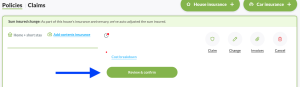
3. Review or update your insurance cover
- Carefully review your current insurance cover.
- Update the sum insured, excess and the other details to ensure your policy matches your current needs.
4. Confirm your details and make payment
- Verify all your personal and policy details.
- Proceed to make the payment to finalise the renewal.
After you’ve renewed
Once you’ve completed the renewal process, your updated policy schedule and receipt will be saved to your initio dashboard as well as emailed to you. We recommend checking your summary to ensure all details are correct and the coverage meets your requirements.
Continuous policy management
Enjoy the flexibility of managing your policy online:
- Make changes anytime: You can adjust your excess, sum insured amount, or type of insurance anytime through your dashboard.
- Easy claims process: If you need to make a claim, simply login to your dashboard and follow the steps. You will receive instant claim updates via email and through your dashboard.
Why renewal is important
Renewal is not just a routine task; it’s an opportunity to reassess your coverage and make sure it aligns with your current needs. Most importantly, it’s to make sure you stay insured. You should also ensure the sum insured accurately reflects the cost to rebuild your home. If you’re unsure about the rebuild value, read our Re-build value guide.
Viewing and customising your renewal options
To check the costs and options for renewing your annual policy without committing right away, our system makes it easy. Instead of sending traditional invoices, we provide a “Review & Confirm” button. By clicking this button, you can view the upcoming year’s costs and explore alternative options, such as different sums insured and excesses. This process is obligation-free, allowing you to review and customise your options at your convenience. You can return to this page and finalise your decision whenever you’re ready.
Got a monthly policy?
In this situation, you don’t need to do anything. On the annual anniversary of your policy we will send you an email letting you know of any upcoming price/changes. You only need to let us know if you DON’T want to proceed with the cover. We also recommend using this opportunity to review your policy. You can, however, do this any time throughout the year using the change option, which can be found on your dashboard.
We hope you enjoy the freedom and convenience of managing your insurance online with Initio. If you have any questions or need assistance, our support team is always here to help.
Policy record is showing as “not active” or has lapsed?
If the record for the cover has lapsed and is no longer available to renew, you can re-instate cover by taking out a new policy. Use either the “home insurance +” or “vehicle insurance +” options on your initio dashboard.
Contact us
Useful links
Effective July 1, 2024, the Earthquake Commission (EQC) transitioned to the Natural Hazards Commission, also known as NHC Toka Tū Ake, under the new governing legislation, the Natural Hazards Insurance Act 2023. This Act replaces the Earthquake Commission Act 1993.
What does this mean for homeowners? If you’re paying your natural hazards cover levy it will ensure any new claims for natural hazards damage that occurred on or after 1 July 2024 will be managed under this new Act. Everything will remain the same when the time comes to make a claim. Below is a summary of the key changes taking place from July 1st.
Continuity of role and responsibilities
Despite the name change, the organisation’s role remains unchanged: to support New Zealand in preparing for and recovering from a variety of natural hazards. These hazards include earthquakes, tsunamis, landslips, volcanic activity, hydrothermal activity, as well as storms and floods. New Zealand is one of the only countries in the world with access to residential land insurance, provided by the Natural Hazards Commission. This cover, called NHCover, is generally a contribution to repairs, and you can’t buy extra land cover through your insurance provider.
The NHI Levy gives you access to NHCover
Anyone with a valid private insurance policy that includes fire coverage pays the NHI levy through their private insurance premium. This levy grants access to NHCover, which provides the first layer of protection for your home and certain areas of land under and around it.
Making a natural hazards claim from July 1, 2024
What does this mean for making a claim? The new Act will apply to claims for natural hazard damage to residential properties occurring on or after July 1, 2024. Any damage occurring before this date will be covered under the Earthquake Commission Act 1993.
Claims handling process
How will claims be handled? NHC Toka Tū Ake will continue to delegate the handling of NHCover claims to private insurance providers, so that you have a single point of contact. For initio customers, this means that your NHCover claims will be handled by our underwriter, IAG New Zealand Limited. You will still lodge your claim to initio online and we will still be your point of contact for your NHCover claim unless you choose to engage with IAG New Zealand directly.
If you need to make a claim or have questions about your cover, please contact us.
Useful links
Your contents cover depends on the type of insurance you have with initio. Some policies include it automatically, while others give you the option to add it. If you’re unsure about your current cover, you can check your initio dashboard.
You can add contents cover anytime. The minimum sum insured is $60,000, but you can choose a higher limit—up to $350,000.
Landlord insurance (rental property)
Your policy automatically includes contents cover for landlord chattels (items left at the home for tenants to use). This provides up to $20,000 of cover, which is a standard part of our landlord policy and cannot be removed. However, you can increase the cover anytime, up to $60,000.
Holiday home insurance (including homes sometimes let out)
Contents cover is included for items usually kept at the holiday home – like furniture, TVs, and general homeware – up to $20,000. This is a standard part of the policy and cannot be removed, but you can increase the cover anytime, up to $220,000.
Note: Personal items you take with you – such as phones, cameras, and handbags – aren’t covered under your holiday home policy. Instead, these are covered under your contents insurance policy for your usual residence.
Making changes to your contents cover
You can adjust your contents cover anytime through your initio dashboard using the “Change” option.

Get a quote
Looking for more information?
What contents items do I need to specify?
What contents are covered for market value?
How do I add contents insurance to my policy?
Contents calculator
Is my lawnmower covered under my contents insurance policy?
Winter Checklist 2023
As the winter months approach, it’s important to be prepared for the potential risks that come with the season. At initio, we’ve observed a significant increase in claims during winter, mainly due to storms, flooding, water damage, and residential fires. With this in mind, we’ve compiled a comprehensive checklist to help you enhance the safety of your rental property and protect your tenants this winter:
Clear and Maintain the Guttering:
Regularly clean and clear the gutters of debris to ensure proper drainage. This preventive measure helps minimise the risk of water damage caused by overflowing gutters during heavy rainfall.
Secure Outside Structures:
Ensure that any external structures, such as trampolines and children’s play equipment, are securely fastened to prevent them from being dislodged and causing damage during storms.
Trim Trees and Remove Overhanging Branches:
Trim tree branches that hang over your property and keep them well-maintained. This practice not only helps keep the gutters clear but also reduces the risk of branches breaking off and causing damage to your home during strong winds.
Check and Repair Window Joinery:
Inspect window joinery and promptly repair or replace any loose latches. This ensures that windows can be securely closed, preventing drafts and maintaining a warm interior during the colder months.
Assess and Secure the Roofing:
Regularly inspect the roof for loose tiles or iron sheets, and promptly arrange for their repair or replacement. This preventive action helps safeguard your property against water leaks and structural damage.
Clean Chimney Flues and Service Heat Pumps:
Annually clean chimney flues and ensure that heat pumps are serviced and cleaned regularly. This proactive maintenance prevents the risk of fires and ensures that heating sources operate efficiently, providing a safe and comfortable environment for your tenants.
Consider Installing Safe and Efficient Heating Sources:
Explore the possibility of installing safe and energy-efficient heating sources, such as heat pumps. Tenants may be willing to pay a higher rent in exchange for the added comfort and reduced utility costs.
Remove Curtains from Kitchen Windows:
Consider removing curtains from kitchen windows as they can serve as a potential fuel source for fires. Opting for blinds or window treatments made from fire-resistant materials can be a safer alternative.
Promote safe cooking practices:
Insist that tenants use camping-type gas cookers outdoors only. Indoor use of such cookers poses both a fire hazard and a health risk.
Test Smoke Alarms Regularly:
Regularly test smoke alarms during property inspections. If tenants are prone to removing batteries, consider replacing them with newer models that have sealed 10-year batteries, minimising the chances of non-functioning smoke alarms.
Check Power Points for Overloading:
Inspect power points for overloading, as faulty power boards are a common cause of fires. Install additional power points where necessary to distribute electrical loads evenly and reduce the risk of electrical fires.
Verify Ceiling Insulation around Downlights:
For properties with downlights installed prior to 2012, check that the ceiling insulation has the appropriate spacing around the lights. This step helps prevent overheating and potential fire hazards.
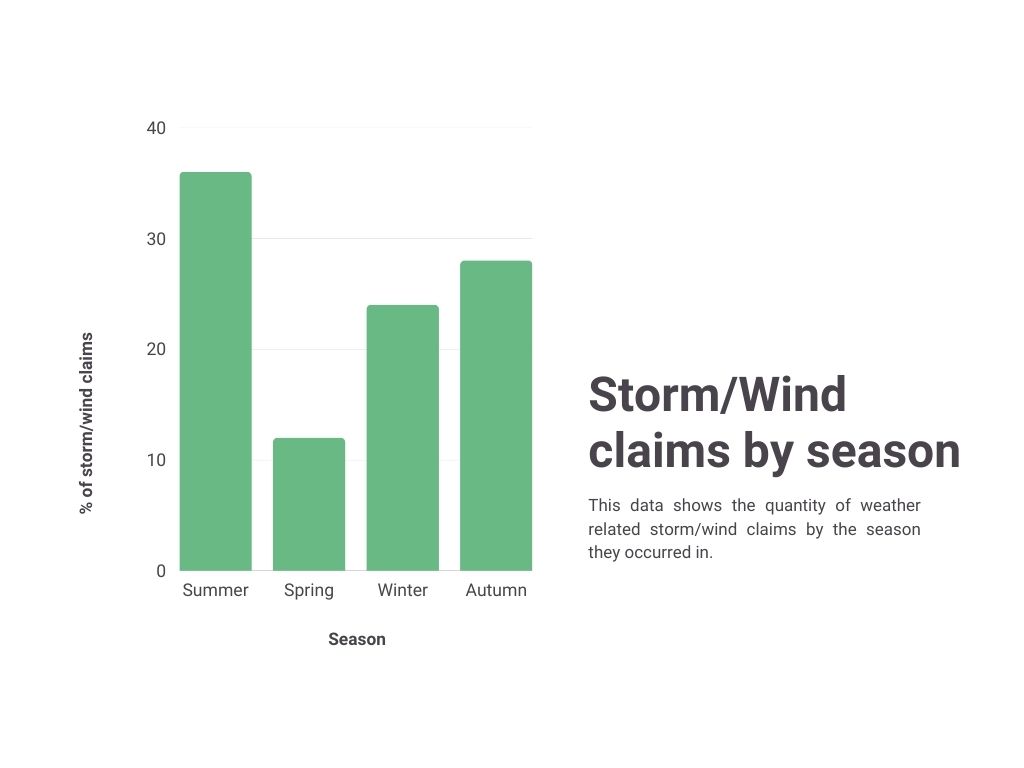
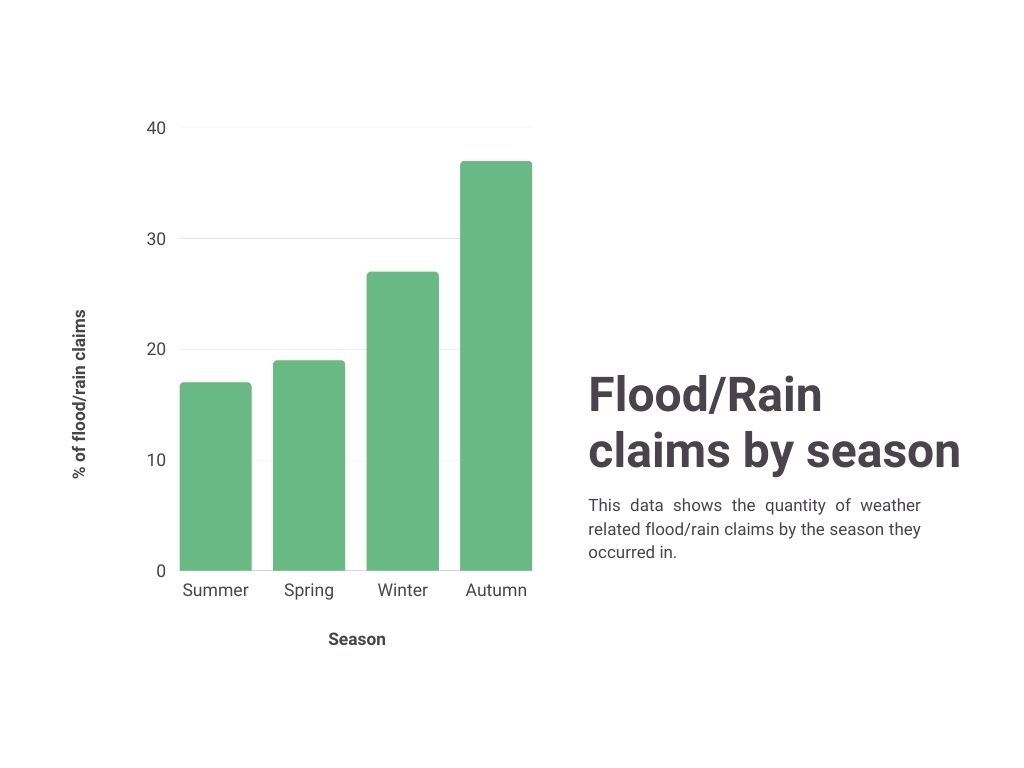
As you can see in the below graphs, Autumn is when we experience the most Flooding & Rain claims compared to other seasons. It’s also the second highest month for Storm & Wind related claims. So, it’s the perfect time of year to go through the checklist mentioned above to make sure you and your property stay safe.
While having comprehensive landlord insurance acts as a ‘safety net’, it is always best to be proactive in protecting your investment. By implementing this checklist, you can ensure a trouble-free winter for both your property and tenants. Stay ahead of the risks and enjoy the peace of mind that comes with a well-prepared and secure home.
If your insured property becomes vacant or unoccupied there are some things to be aware of.
Unless you’ve let us know and we’ve agreed with you otherwise, the below standard conditions will apply to your cover. Let us know if your property is going to be vacant for an extended period of time beyond the 60 days.
Rental Property
Your cover stays the same if your rental property is unoccupied for up to 60 consecutive days.
If your tenant has moved out and you’ve decided to sell the property, there’s no need to make any changes to your landlord policy.
After 60 days of being empty, your cover remains in place, but a $5,000 standard excess will apply to all claims until it’s sold or someone moves back in.
We encourage fitting security systems to your property. If you make a claim for a break-in and have a professionally installed alarm* or security system then the unoccupied excess reduces to $1,000.
Owner-occupied House
Cover for your house also remains unchanged for the first 60 days that it’s unoccupied.
If it’s empty for more than 60 consecutive days your policy is reduced to cover:
- Fire, explosion or lightning damage.
- Damage from natural disasters (i.e. earthquakes, tornadoes etc).
After 60 consecutive unoccupied days, you still have cover for the big risks but theft or vandalism won’t be protected. This is because empty houses are sitting ducks for theft and vandalism. We encourage you not to leave your home empty for over two months wherever you can.
Holiday Home
We expect holiday houses will be empty more often, so our conditions are more lenient. Holiday homes can be empty for more than 60 consecutive days and your cover will remain standard, as long as you can meet the following criteria:
- House is inspected inside and outside by you or a nominated person at least every 60 days
- The house and its grounds are adequately maintained
- Mail is cleared regularly
- Water supply is turned off
- Doors are locked and windows are secured
If you can’t meet these then a standard $5,000 excess will apply to your policy. If it’s fitted with a professional alarm* this reduces to $1,000 when you claim for a break in or burglary.
*Systems which include surveillance cameras only do not meet this criteria – the system needs the ability to provide an external alert (audible or direct to a monitoring company).
What if my home is already vacant when looking for insurance and will stay vacant?
We can consider cover for vacant homes on a case-by-case basis. When you complete your application, you’ll need to disclose this under the question: “Is there any further information likely to affect the acceptance of this insurance?”
Select Yes and provide the full details in the space provided, along with any other disclosures.
This guide is intended to be a quick reference to vacant houses. We recommend reading the full policy wording for the full details of the coverage.
Accidental damage is irksome, someone or something has damaged your property and it needs to be made right. Don’t worry, that’s what you’ve got home and contents insurance for and we’re here to help.
IMPORTANT: If your house is unsecured, unsafe or vulnerable to more damage, get a professional to make the house safe and we can work through the costs together later.
If you think your claim will be under $5,000, here’s what you need to do:
- Take photos of the damage.
- Get a quote to repair any damage.
- Log in your dashboard on the initio website and click on ‘Make a Claim’. Fill in the form and attach your photos and quotes.
- We’ll email or call you within one business day.
If the damage is severe, we might need an assessor’s opinion, here’s what you need to do:
- Log in to your dashboard on the initio website and click on ‘Make a Claim’. Fill in the form and attach any photos you’ve taken.
- We’ll email or call you within one business day.
FAQ’s:
- Can I use my own repairer or do initio have approved repairers that I must use?
You can use any repairer you like, as long as their costs are reasonable and you’re happy with the standard of work, then we’re happy.
- Who will pay my excess: me, or the person who damaged my house?
This is case-by-case. If a tenant caused the damage accidentally, then we cannot hold them responsible. However, if a neighbour accidentally drives through your fence, then we’ll probably be able to get the money back from their insurance company and your excess will be reimbursed to you.
“All claims are different and they are assessed on their own merits and facts. The above does not imply a guaranteed approach to all such claims”
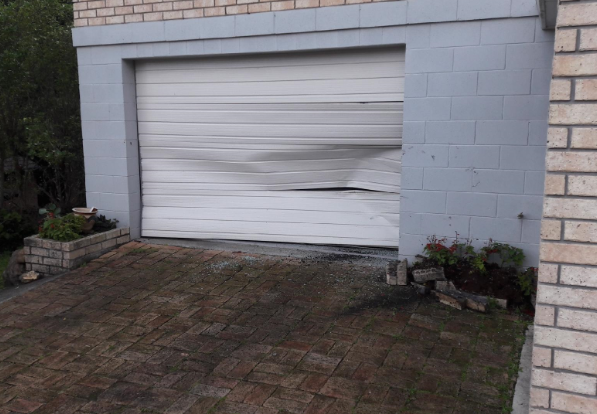
A stranger accidentally reversed their car into this garage door, damaging not only the door, but block work too. Initio worked with the property manager and repairer to get the door replaced and brickwork repaired efficiently and with as little fuss as possible to the tenants. Best of all, Initio didn’t charge an excess and recovered the costs from the driver.
Related articles
You can buy a policy today, and for a future effective date within the next 30 days. We’ll ask you to enter a cover start date on the initial quote page before proceeding to the application form.
Purchasing a new house
If you’ve purchased a house, you should set the cover start date as the same day as the settlement date for the purchase. This means your insurance will start when you own the house. We are unable to provide cover prior to the day you become the legal owner.
Changing your insurance company
If you’re changing to initio from another insurer, it’s a good idea to set the cover start date on your new initio policy to the day that your existing policy expires. This way, there is no period where you are not insured.
Ready to get your journey started with initio?
Get a quote
Related articles:
Recreational Features
Recreational Features are defined as any tennis court or permanently fixed swimming pool or permanently fixed spa pool including its ancillary equipment and pump(s).
Recreational features are automatically covered by the policy, but are limited to a combined limit of $45,000 for all recreational features.
We can increase the standard limit by agreement, if you wish to increase the standard limit for any recreational feature, please request an increase by sending the details to [email protected].
What about a spa pool that’s not permanently fixed? Spa pools that are not permanently wired or permanently plumbed are covered under contents insurance rather than home insurance.
Retaining Walls
A retaining wall is a structure that holds land in place to prevent the earth from sliding or eroding away. A retaining wall differs from a garden wall, as a garden wall is purely aesthetic and serves no purpose in protecting the structure of the land.
Retaining Walls are automatically covered by the policy with a combined limit of $25,000 for all retaining walls.
NHI (previously EQC) provide some indemnity for retaining walls and their support systems that are necessary for the support or protection of the house or insured land (including the main access way) if they are within 60 metres of the house. For NHI claims involving damage to retaining walls, the settlement will be calculated on the basis of either the cost of repair or the ‘indemnity value’. The indemnity value of damaged property takes into account the age and condition of the damaged structure and will likely be lower, than its replacement value.
The initio policy pays for damage to retaining walls by earthquake, volcanic eruptions, hydrothermal activity tsunami and landslip as a ‘top up’ cover. This means that NHI will pay out the indemnity value of the damaged retaining wall and that initio covers the additional cost, up to the replacement value, limited to the specified value or the standard policy limit of $25,000 if no prior value has been agreed.
We can agree to increase the retaining wall limit for you. To so, we will need some additional information to review the limit. If you wish to have the limit reviewed, please provide the following information to our support team (for each retaining wall);
- Location
- Height
- Length
- Age
- Construction Type
- Current Condition
- Replacement Value (and how it was calculated)
- Details of previous losses and /or claims
- If there is shared ownership, if so, what is the ownership structure (ie cross-lease, easement)
- Confirmation that code of compliance and/or council consents have been obtained where required.
Please send the above details along with a photo, and where relevant a copy of the plans, or engineers report to [email protected].
Related Topics
Tiny homes
Tiny homes, as the name suggests, are smaller and more affordable houses, typically less than 15 metres long. They are becoming increasingly popular in New Zealand.
Portable tiny homes
If your tiny home or similar portable house is on a trailer or wheels, we can’t cover it under our initio house insurance policies. If the home can be moved, even if you don’t intend to move it, it is considered closer to a caravan than a permanent dwelling. In this case, we recommend speaking with an insurance provider that offers caravan insurance products.
Permanently situated tiny homes
We can consider cover for a tiny home if it is permanently fixed to the land, connected to local services, and fully self-contained.
It will also need either a Code of Compliance or a Certificate of Acceptance. In simple terms, the home must meet the definition of a compliant residential dwelling to be covered under our policy.
More recently, we can also consider tiny homes that have only received a Code Compliance Certificate at the manufacturer’s site, provided they have since been permanently sited with minimal site works.
Homes under 70 m² that no longer require council consent (as at January 2026)
Under new government regulations, some new homes under 70 m² no longer require building consent. If the home meets all council conditions for this exemption, it can still be considered for cover with initio.
Key conditions include (this list is not exhaustive):
- the home is a single-storey, standalone dwelling
- the net floor area is 70 m² or less
- the design is simple and complies with the Building Code
- the work is carried out or supervised by licensed building professionals
- the local council is notified before construction starts and once it is complete
- the home meets Building Code performance requirements, including structure, fire safety, durability, and moisture control
Not sure if your tiny home qualifies?
If you’re unsure, email us at [email protected] with a few details about the home, or apply online.
When applying, answer “yes” to the question “is there any further information likely to affect the acceptance of the insurance?” and include details about the home, along with any other relevant disclosures.
Get a quote/apply
As a landlord, you work hard to provide safe and comfortable homes for your tenants. But were you aware that a significant portion of rental-related claims stem from criminal activity?
In 2023, 14% of the claims we processed at initio were related to criminal actions, such as malicious damage, methamphetamine contamination, and burglary. These incidents not only cause stress and financial strain but also unexpected expenses for landlords.
Burglary and theft
As a part of the criminal activity, 30% were related to burglary and theft. This can be a common issue, especially when a rental property is occasionally vacant, making it an easier target due to the absence of people within the home.
Your property being empty for over 60 consecutive days will change your policy terms, and a higher excess of $5,000 will apply if you need to make a claim. You can reduce this excess to $1,000 with an audible alarm system that’s professionally installed. This helps especially if there’s damage because someone tried to break into your home. If you’re expecting your property to be vacant for reasonably long periods – beyond 60 days, get in touch with us.
Just over 41% of burglary-related claims we received last year were related to theft of copper piping, plumbing, or hot water cylinders!
Not only does this result in stress for landlords to replace these items, it also results in a hefty bill to cover, as well as a potential loss of rent. The average cost for the accepted claim, relating to repairs for our clients last year was just over $8,000.
Our policy offers an automatic benefit for malicious damage, or theft by tenants. 41% of rental-related claims were paid out through our automatic benefit. You can enhance property security with locks and lighting to deter burglars. Consider installing surveillance cameras or alarm systems and maintaining your property adequately. This will help it look lived in as well as deterring unwanted activity.

Malicious damage
Of all the rental-related claims we received throughout 2023, 24% were related to malicious damage. Such damage can occur throughout a tenancy, but we saw 31% of these claims stemming from eviction. In this stressful scenario, landlords face the dual challenge of evicting a tenant as well as addressing significant property damage. These types of claims result in an average claim cost of just over $9,000 – an expensive, and unexpected type of bill!
Fortunately, our landlord cover offers an automatic benefit of $25,000 per event, for claims resulting from malicious damage caused by tenants. Make sure you conduct thorough tenant screenings through reference checks, credit checks and tenancy tribunal history. Also, establish clear lease agreements to minimise risks of eviction-related damage.
In the event that a key is lost or stolen, you can take action and replace it, and Initio’s policy has a benefit designed exactly for this! This will help minimise the risk of someone returning while it might be vacant. With our landlord policy, we offer an excess-free keys and locks benefit – where we cover up to $1,000 for the replacement of keys and locks.
Methamphetamine contamination
While not common, this is a costly issue. Across all the criminal activity-related claims that occurred in rental properties in 2023, just over 11% of these claims were related to methamphetamine contamination. While this represents a small percentage, it is the most costly and widespread type of incident to affect your rental property, with an average cost of just over $20,000. Since your property cannot be tenanted when this sort of situation occurs, you as a landlord, will also suffer from loss of rent, another cost that heavily affects you.
Initio’s landlord cover includes an automatic benefit of $30,000 for methamphetamine contamination which will cover the testing, and cleaning costs in the event of a contamination taking place. We also offer an automatic benefit of $20,000 for loss of rent, which can be increased. We are prepared to cover you for this criminal activity as we understand the costs – and time it can take until your property is thoroughly cleaned.
Regular property inspections can help detect early signs of drug-related activity. Also performing reference checks, as well as tenancy tribunal history will help determine in the early stages if they will be good tenants.
Arson
While we only saw one claim relating to arson last year, it can also be the most expensive rental crime-related claim we pay for. This is because a house fire causes extensive damage, which can affect the overall structure of your property. To mitigate this risk, install smoke detectors and fire extinguishers. You could also provide a fire blanket, an invaluable tool for smothering fires. It’s a good idea to have fire safety equipment easily accessible, offering tenants a quick solution to douse flames before they spread.
Check your sum insured
In tough times, lowering your sum-insured to reduce your premium might seem appealing. However, this could lead to ‘under-insurance,’ a risky strategy that could backfire if significant damage occurs. Insurance is there to put you back in the position you were in before any mishaps, and cutting corners on your sum-insured might leave you short when you need support the most. We have seen the occasional customer not having their property fully insured for the right amount. This creates large amounts of stress, so we always recommend reviewing your sum-insured yearly, at the renewal of your insurance policy.
Initio, your partner in landlord insurance
Initio is dedicated to helping New Zealand landlords safeguard their rental properties against unforeseen events. By understanding the potential criminal activities, or accidents, that can impact your investment, you can take proactive steps to protect it. With our comprehensive landlord cover, you can enjoy peace of mind knowing that your property, and your financial well-being, are protected.
Let initio be your partner in navigating the challenges of rental property management. Our goal is to provide the protection and support you need to ensure your rental homes remain safe, secure, and profitable.
FOR MORE INFORMATION
ARTICLES OF INTEREST:
The statistics presented in this article are based on a comprehensive analysis of claims data from initio for the calendar year of 2023, spanning our entire rental claims portfolio. Please note that all figures are approximate and have been calculated to provide a representative view of the claim trends during this period.
As a landlord, you work hard to provide safe and comfortable homes for your tenants. But were you aware that a significant portion of rental-related claims stem from criminal activity?
In 2023, 14% of the claims we processed at initio were related to criminal actions, such as malicious damage, methamphetamine contamination, and burglary. These incidents not only cause stress and financial strain but also unexpected expenses for landlords.
Burglary and theft
As a part of the criminal activity, 30% were related to burglary and theft. This can be a common issue, especially when a rental property is occasionally vacant, making it an easier target due to the absence of people within the home.
Your property being empty for over 60 consecutive days will change your policy terms, and a higher excess of $5,000 will apply if you need to make a claim. If you’re expecting your property to be vacant for reasonably long periods – beyond 60 days, get in touch with us.
Just over 41% of burglary-related claims we received last year were related to theft of copper piping, plumbing, or hot water cylinders!
Not only does this result in stress for landlords to replace these items, it also results in a hefty bill to cover, as well as a potential loss of rent. The average cost for the accepted claim, relating to repairs for our clients last year was just over $8,000.
Our policy offers an automatic benefit for malicious damage, or theft by tenants. 41% of rental-related claims were paid out through our automatic benefit. You can enhance property security with locks and lighting to deter burglars. Consider installing surveillance cameras or alarm systems and maintaining your property adequately. This will help it look lived in as well as deterring unwanted activity.
Malicious damage
Of all the rental-related claims we received throughout 2023, 24% were related to malicious damage. Such damage can occur throughout a tenancy, but we saw 31% of these claims stemming from eviction. In this stressful scenario, landlords face the dual challenge of evicting a tenant as well as addressing significant property damage. These types of claims result in an average claim cost of just over $9,000 – an expensive, and unexpected type of bill!
Fortunately, our landlord cover offers an automatic benefit of $25,000 per event, for claims resulting from malicious damage caused by tenants. Make sure you conduct thorough tenant screenings through reference checks, credit checks and tenancy tribunal history. Also, establish clear lease agreements to minimise risks of eviction-related damage.
In the event that a key is lost or stolen, you can take action and replace it, and initio’s policy has a benefit designed exactly for this! This will help minimise the risk of someone returning while it might be vacant. With our landlord policy, we offer an excess-free keys and locks benefit – where we cover up to $1,000 for the replacement of keys and locks.
Methamphetamine contamination
While not common, this is a costly issue. Across all the criminal activity-related claims that occurred in rental properties in 2023, just over 11% of these claims were related to methamphetamine contamination. While this represents a small percentage, it is the most costly and widespread type of incident to affect your rental property, with an average cost of just over $20,000. Since your property cannot be tenanted when this sort of situation occurs, you as a landlord, will also suffer from loss of rent, another cost that heavily affects you.
Initio’s landlord cover includes an automatic benefit of $30,000 for methamphetamine contamination which will cover the testing, and cleaning costs in the event of a contamination taking place. We also offer an automatic benefit of $20,000 for loss of rent, which can be increased. We are prepared to cover you for this criminal activity as we understand the costs – and time it can take until your property is thoroughly cleaned.
Regular property inspections can help detect early signs of drug-related activity. Also performing reference checks, as well as tenancy tribunal history will help determine in the early stages if they will be good tenants.
Arson
While we only saw one claim relating to arson last year, it can also be the most expensive rental crime-related claim we pay for. This is because a house fire causes extensive damage, which can affect the overall structure of your property. To mitigate this risk, install smoke detectors and fire extinguishers. You could also provide a fire blanket, an invaluable tool for smothering fires. It’s a good idea to have fire safety equipment easily accessible, offering tenants a quick solution to douse flames before they spread.
Check your sum insured
In tough times, lowering your sum-insured to reduce your premium might seem appealing. However, this could lead to ‘under-insurance,’ a risky strategy that could backfire if significant damage occurs. Insurance is there to put you back in the position you were in before any mishaps, and cutting corners on your sum-insured might leave you short when you need support the most. We have seen the occasional customer not having their property fully insured for the right amount. This creates large amounts of stress, so we always recommend reviewing your sum-insured yearly, at the renewal of your insurance policy.
Initio, your partner in landlord insurance
Initio is dedicated to helping New Zealand landlords safeguard their rental properties against unforeseen events. By understanding the potential criminal activities, or accidents, that can impact your investment, you can take proactive steps to protect it. With our comprehensive landlord cover, you can enjoy peace of mind knowing that your property, and your financial well-being, are protected.
Let initio be your partner in navigating the challenges of rental property management. Our goal is to provide the protection and support you need to ensure your rental homes remain safe, secure, and profitable.
Get a quote in seconds
FOR MORE INFORMATION
ARTICLES OF INTEREST:
The statistics presented in this article are based on a comprehensive analysis of claims data from initio for the calendar year of 2023, spanning our entire rental claims portfolio. Please note that all figures are approximate and have been calculated to provide a representative view of the claim trends during this period.
In all circumstances you will pay for your insurance cover in advance. You can cancel your insurance policy at anytime through your Initio dashboard, and you will receive a refund for any unused insurance premium. e.g if you insure a house from 1 January and you cancel the cover 6 months later, you will be refunded 50% of total premium you paid.
Initio is committed to refunding premiums and levies you have paid. We will do this on a pro-rata basis. This means that if you choose to cancel a policy after its commencement we will refund you the days of cover you have paid in advance.
Initio will not charge you an administration fee if you choose to cancel your cover. Our objective is to make it easy for you to start cover with us and to cancel cover with us.
During the refund process (through your initio dashboard). We will inform you of the exact dollar amount that will be refunded to you before you decide to proceed with the refund.
You have the ability to cancel or amend your policy online 24 hours a day, 7 days a week. You can backdate your refund up to 30 days in the past or the date the policy incepted (or last renewed), whichever is earlier. This is in the interests of being able to backdate a policy cancellation so that it aligns with the settlement date of a previously sold property.
Once a refund is due to you, it will be refunded within 5 working days of receipt of your request.
We reserve the right to make a refund in the same manner and the same currency used to pay for the insurance when it started. Refunding the amount to the credit card you used to purchase your insurance is our default method of refund. If you paid via Account2Account we will request your bank account number and then make payment to this account. If you paid via online EFTPOS, the refund is processed back to the same bank account used for the original purchase unless requested otherwise in advance.
How to claim for intentional vandalism by tenants
Found intentional damage at your rental property? Don’t worry, your Initio landlord insurance policy covers up to $25,000 of intentional damage by tenants. If you’ve found holes in walls, smashed windows, graffiti etc, please follow our below steps.
What you need to do
- Take photos of the damage – it helps us if scale is provided in the photos, take both close up and pulled back photos
- Get a quote to repair any damage – a room-by-room- itemised quote will speed up the settlement process
- Login to your initio dashboard and select ‘Make a Claim’ on the property. Complete our smart claims process and attach your photos and quotes.
- Hold tight. We will email or call within a business day to tell you what happens next.
- Consider applying to the tenancy tribunal for vacant possession, and to recover any uninsured losses.
Remember the more information the better. We will require other documents such as:
- Tenancy agreement
- The most recent 3 inspection reports
- Tenant references & application
- Anything else you think is relevant
This can help us determine when damage occurred, and speed up our claims process for you.
What will we cover?
The intentional damage caused by the tenant is covered. However, bear in mind that insurance is designed to help you recover from unexpected sudden losses, but does not cover damage that has occurred throughout the tenancy. Like all insurance, an excess will apply to each damage incident.
If there has been damage from one event – such as an out of control tenant party – all the damage could be covered under one excess. However, if any of the damage has occurred throughout a tenancy, multiple excesses will apply.
When do Multiple Excesses Apply?
What won’t we cover?
House insurance covers sudden and unexpected events. We understand that there can be other areas of damage or neglect to your property. Unfortunately, insurance cannot cover everything!
- Rent arrears
- Wear and tear
- Rot or other gradual deterioration
- Rubbish removal
- Cleaning costs
- Gardening costs
- Repairs under excess
- Removal of tenants belongings
Some of your ‘uninsured losses’ can be claimed back via the tenancy tribunal.
FAQ’s
Am I covered for loss of rent?
If the home is so badly damaged that it is deemed ‘uninhabitable’, you might be entitled to loss of rent. ‘Uninhabitable’ means unable to be lived in. For example, no access to kitchen or bathroom facilities, water or electricity. There is no cover for loss of rent if the repairs are just cosmetic (carpet/painting/plastering etc).
Will initio send an assessor?
If damage is significant and needs further examination we may get an assessor to your property. Usually, if the damage is likely to be under $5,000 then we are happy to proceed based on photographs and formal written quotations.
What is my excess?
Your standard policy excess will apply. This amount is chosen when you first purchase your policy. If you can’t remember, check your policy schedule which you can find on your dashboard.
Can I use my own repairer or does initio have companies I must use?
You can use any repairer or supplier you like as long as their costs are reasonable. Please make sure you are happy with the standard of work they provide.
My first three months at initio
Change is as good as a holiday they say, so after nearly a decade at my previous company, I made the leap, dusted off my CV, stumbled my way through the interviews and signed the contract with initio. But now I had to actually meet new people – ugh. And then there were the considerations around what to wear. Nothing screams that you’re a giant dork like being the only person wearing corporate attire when everyone else is in trendy sneakers & tee’s. The first morning of my new job, after a restless night worrying about everything and nothing probably ranked a solid eight on my anxiety scale. About the same as when I’m not sure whether someone is going for a handshake, high-five, hug, or kiss on the cheek, and I guess wrong. But the good news is that I’ve gotten through the first three months here at initio and I’ve now been here long enough to gather my thoughts about what it’s like to work here and the way it operates. So here are my first impressions;
They have some incredibly smart people working here.
When I say smart, I mean IT smart, which means they’re right at the top of the intelligence pyramid and they keep using words I don’t understand. This is because one of initio’s strengths is digital technology, so we have a very switched-on ‘dev’ (developer) team. They are responsible for keeping our frictionless digital insurance platform in tip-top shape by performing constant updates as well as upgrades. This has meant that I’ve learned I didn’t know quite as much as I thought I did when it comes to the IT realm. To quote a classic movie; ‘You keep using that word. I do not think it means what you think it means’. Yes, that actually happened to me. That experience also ranked pretty highly on my anxiety scale.
Additionally to our talented IT team, our claims and support departments also have smart and savvy team members. Their skills, knowledge and all-around commitment to providing the best service out there are second to none. In fact, I’m surrounded by awesome people who have accepted me into their fold and made me feel right at home.
Positive vibes in spades
I can honestly say that I’ve never worked for a company that’s more committed to creating a healthy company from the inside out. By this, I mean that staff are provided with an incredibly generous and supportive environment which then means that as an employee, we are more willing to go the extra distance for initio. This positive internal culture is nurtured by weekly yoga, a strong social game and rewarding our staff when initio achieves various goals we set for ourselves. This is all great news for our customers who then talk to happy, helpful initio team members.
We’re focused on why we do business
I’ve heard repeatedly since I started working here that initio wants to turn what people think about insurance on its head. Some of the giants in the insurance industry can make their customers jump through hoops when it comes time to pay claims. Initio believes that we should be able to pay (uncomplicated) claims out just as quickly as we get paid for the premium. We’re proud of the fact that we’ve been able to deliver on this for a few simple claims already.
Don’t be suspicious of their affordable pricing.
Talking to my friends and family about my new job would usually lead to us jumping on initio’s website to generate a quick house insurance quote (… which because of those uber-smart people I mentioned, only takes about 5 seconds). They would always ask me ‘why is it cheaper?’ and I initially didn’t actually have a good answer. I’ve since learned that initio is on a mission to offer affordable insurance but with the essential bells and whistles homeowners need. In a nutshell, they save costs by keeping everything online. Customer policies, invoices and all communications are all managed online via the client dash. This in turn means no humans quadruple handling things, not to mention unnecessary printing or postage costs. These efficiency savings are passed on to their customers through their affordable pricing structure.
So there you have it, my first few months in a nutshell. All of the above points are just my humble opinion of course, but I can honestly say that my friends have asked me ‘are you glad you changed jobs?’ and my answer has been an emphatic ‘Yep, so much happier!’.
By Megan Fisher, initio Marketing Manager
Found intentional damage at your rental property? Don’t worry, your Initio landlord insurance policy covers up to $25,000 of intentional damage by tenants. If you’ve found holes in walls, smashed windows, graffiti etc, please follow our below steps.
What you need to do
- Take photos of the damage – it helps us if scale is provided in the photos, take both close up and pulled back photos
- Get a quote to repair any damage – a room-by-room- itemised quote will speed up the settlement process
- Login to your initio dashboard and select ‘Make a Claim’ on the property. Complete our smart claims process and attach your photos and quotes.
- Hold tight. We will email or call within a business day to tell you what happens next.
- Consider applying to the tenancy tribunal for vacant possession, and to recover any uninsured losses.
Remember the more information the better. We will require other documents such as:
- Tenancy agreement
- The most recent 3 inspection reports
- Tenant references & application
- Or anything you might think is relevant
This can help us determine when damage occurred, and speed up our claims process for you.
What will we cover?
The intentional damage caused by the tenant is covered. However, bear in mind that insurance is designed to help you recover from unexpected sudden losses, but does not cover damage that has occurred throughout the tenancy. Like all insurance, an excess will apply to each damage incident.
If there has been damage from one event – such as an out of control tenant party – all the damage could be covered under one excess. However, if any of the damage has occurred throughout a tenancy, multiple excesses will apply.
What won’t we cover?
House insurance covers sudden and unexpected events. We understand that there can be other areas of damage or neglect to your property. Unfortunately, insurance cannot cover everything!
- Rent arrears
- Wear and tear
- Rot or other gradual deterioration
- Rubbish removal
- Cleaning costs
- Gardening costs
- Repairs under excess
- Removal of tenants belongings
Some of your ‘uninsured losses’ can be claimed back via the tenancy tribunal.
FAQ’s
Am I covered for loss of rent?
If the home is so badly damaged that it is deemed ‘uninhabitable’, you might be entitled to loss of rent. ‘Uninhabitable’ means unable to be lived in. For example, no access to kitchen or bathroom facilities, water or electricity. There is no cover for loss of rent if the repairs are just cosmetic (carpet/painting/plastering etc).
Will initio send an assessor?
If damage is significant and needs further examination we may get an assessor to your property. Usually, if the damage is likely to be under $5,000 then we are happy to proceed based on photographs and formal written quotations.
What is my excess?
Your standard policy excess will apply. This amount is chosen when you first purchase your policy. If you can’t remember, check your policy schedule which you can find on your dashboard.
Can I use my own repairer or does initio have companies I must use?
You can use any repairer or supplier you like as long as their costs are reasonable. Please make sure you are happy with the standard of work they provide.
Related Articles:
As 2025 comes to a close, we want to take a moment to reflect on some of the ways we’ve helped our customers this year. It’s been a year of quick claims and responsive support at initio – all driven by our core values of customer satisfaction, speed, and making insurance easy. From fast claim resolutions to lightning-quick answers on our support lines, 2025 showed what our team and technology can do to take care of you when it matters most.
Ways we’ve helped our customers with their claims
When it comes to insurance claims, we know you want a swift, clear outcome. In 2025, our claims team made sure “waiting around” was rarely part of the experience. Many claims were sorted out within just a day of being lodged – yes, some were literally resolved overnight. A large number of others were wrapped up within the first week. Nearly half of all claims were resolved within 30 days, with many settled much sooner. Our approach is all about fast assessments and clear communication, so you’re never left hanging.

Speed doesn’t mean we cut corners, even on the tough cases. Big or small, every claim got the same careful attention. We handled hundreds of claims even during the busiest periods (think wild weather weeks and the holiday rush) without breaking stride. And while most claims were everyday-sized or moderate, we also helped customers through some major events – including a few very large claims like house fires and water damage. Those high-value claims were supported just as promptly and compassionately as a cracked window or a burst pipe. Whether it was a minor accident or a serious loss, we followed the same straightforward process and kept our customers informed at each step.

Several clear patterns stood out in our 2025 claims data.
Vehicle glass claims (like damaged windscreens) made up about 12% of all claims. These are the everyday mishaps many drivers run into, and they are usually simple to assess and settle quickly.
Water damage was another common claim type, at around 10% of total claims. While it was not the biggest category by volume, it had a much bigger impact on cost, making up roughly 27% of total payouts. Problems like hidden leaks and burst pipes can get worse fast, so acting early really helps.
At the more serious end, accidental fire claims were uncommon, at about 1% of claims in 2025. But when they happened, they were often significant, accounting for around 12% of total claim costs. It’s a strong reminder that the right cover, plus a responsive claims team, matters most when something major goes wrong.
We also saw how external events can cause short, sharp spikes in claims. 29 April was our busiest claims day of the year, lining up with a bout of severe weather that brought heavy rain and strong winds to parts of the country. As you’d expect, that drove an increase in weather-related claims, with customers reaching out for support when it mattered most.
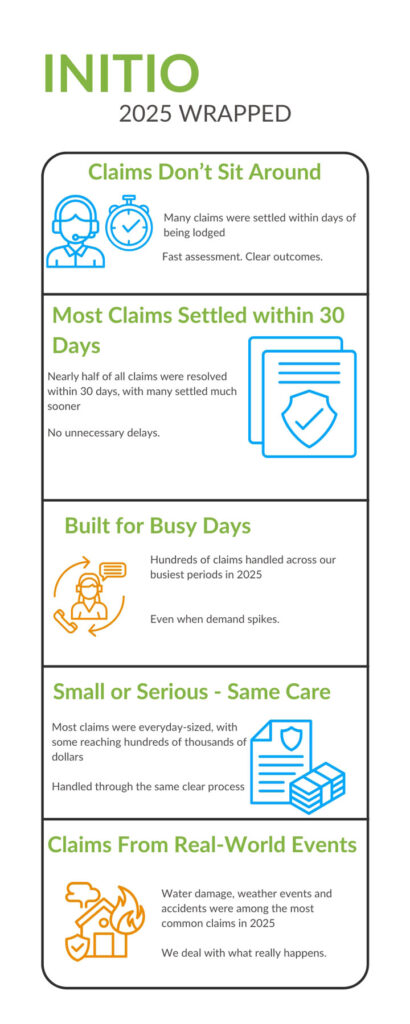
This year, we saw claims for just about everything under the sun (and rain). The most common claims by number were the ones you might expect – accidental damage around the home, car-related mishaps, and weather events. Life happens, and sometimes that means a stray cricket ball through a window, a parking-lot fender bender, or a blustery storm knocking over a fence. These everyday issues kept us busy, but that’s exactly what we’re here for.
Support when you need it
Our commitment to speedy, helpful service wasn’t just on the claims side. The initio customer support team had a standout year in 2025 as well, making it easier than ever for you to get the answers or help you need. We handled over 22,000 customer enquiries throughout the year – and we did so with an emphasis on being both quick and effective. In fact, most customer questions or issues were resolved within about an hour. A huge portion (over 90%) were solved in a single interaction, meaning one call or message was all it took to sort things out. No endless email chains, no multiple phone transfers – just one conversation and you’re sorted. “No follow-ups needed” became a bit of an unofficial motto for us this year, and we’re proud of that.
We also made sure you could reach us in whatever way suits you best. The majority of our customers chose to contact us online – whether by email, live chat, or through their initio dashboard – and they got the same friendly, professional care as if they’d called us on the phone. Of course, whenever a phone call was preferred or needed, we were right there too. Real people, real help, every time. We know sometimes you just want to hear a reassuring voice on the other end of the line, and our phone support team was ready whenever those moments came.
Chatbot Chad played a big part in that easy, quick support experience too. In 2025, Chad handled nearly 3,000 conversations and sent over 7,000 messages, helping customers get answers fast when it suited them. Chad achieved a 95% answer rate, and the vast majority of customers rated their experience with Chad highly, showing that self-serve support can still feel genuinely helpful and human.
Despite handling thousands of enquiries, we didn’t let quality slip during busy seasons. Even in our peak months, response times stayed consistently quick and our service stayed personal. We like to say we’re “built for busy days” – and in 2025, we proved it, delivering the same care and speed no matter how high the volumes got.

Looking back at these highlights, what makes us happiest is knowing each number represents a customer who got the help they needed and could move forward with peace of mind. Thank you for trusting us with your insurance in 2025 – we’re truly honored to have helped you through everything from everyday hiccups to life’s big storms. We’re excited to keep that momentum going into 2026, with even more improvements on the way to make things faster, easier, and smarter for you. From everyone at initio, we wish you a safe and happy New Year. Here’s to a bright 2026 ahead!
Related articles
By Maryanne Twentyman
A Waikato insurance specialist is warning of a “serious legal loophole” for property owners who may not know potential tenants are on home detention.
The managing director of online property insurance company Initio, Rene Swindley, said the recent case of a North Shore woman who faced charges after burning a neighbouring property, highlighted a serious issue for home owners who could “fall short” of insurance requirements.
“As things stand, there is no legal responsibility for tenants to disclose to their landlord that there is anyone living at the address that is serving home detention,” he said.
Mr Swindley believed that non- disclosure could cause complications for property owners if they tried to claim on their insurance. “Material non-disclosure is one of the leading reasons why insurance claims are declined”
The matter was a “grey area” according to Mr Swindley, who said every claim would be considered on a case by case basis. “not every insurer would decline the claim – it comes down to a question of additional risk. And while the issue was yet to be tested, the Auckland case had attracted global attention with property investors and insurers alike left pondering the “what if” scenario.
“If the details weren’t declared for an insurer, it could prejudice a client’s claim and make it difficult to get a speedy settlement at least. The onus is on the person to disclose. Its about doing all your checks, including doing regular property inspections”
Mr Swindley agreed with comments from Property Owners Federation President Andrew King, who believed information about home detention orders should be made available online so that property owners were able to protect their investment.
“This is certainly not something we hear about a lot, but it is something that can have devastating consequences,” Mr King said. He believed owners should be notified if a potential tenant was on home detention to help “effectively manage” the tenancy. But the corrections department said there was no legal requirement for home detainees to tell property owners about their situation.
Mr Swindley said property owners had an obligation to inform their insurer of any information that may affect the insurance, but it was almost impossible to do this if information regarding tenants on home detention was withheld. “We suggest that landlords incorporate this notification process into their regular property inspection and review programme”