Despite tighter laws and more public awareness, methamphetamine remains a serious problem in New Zealand. Not just for law enforcement and health agencies, but for landlords, property managers and homeowners too.
Meth in Aotearoa: the facts
New Zealanders are consuming 27.5 kilograms every week, based on nationwide wastewater testing at the end of 2024, an increase of 96% from records in 2023.
That equates to an estimated $28 million in social harm every single week.
We remain in the top four countries globally for meth use per capita:
Australia
United States
Czech Republic
New Zealand
These aren’t just distant statistics. For property owners, meth contamination can mean costly clean-ups, extended vacancies, and insurance stress.
Recent events underscore the ongoing issue. In April 2025, Customs officers seized an estimated 90.7 kilograms of methamphetamine in two separate incidents at Auckland International Airport. These seizures prevented an estimated NZ$95 million in potential harm and cost to New Zealand.
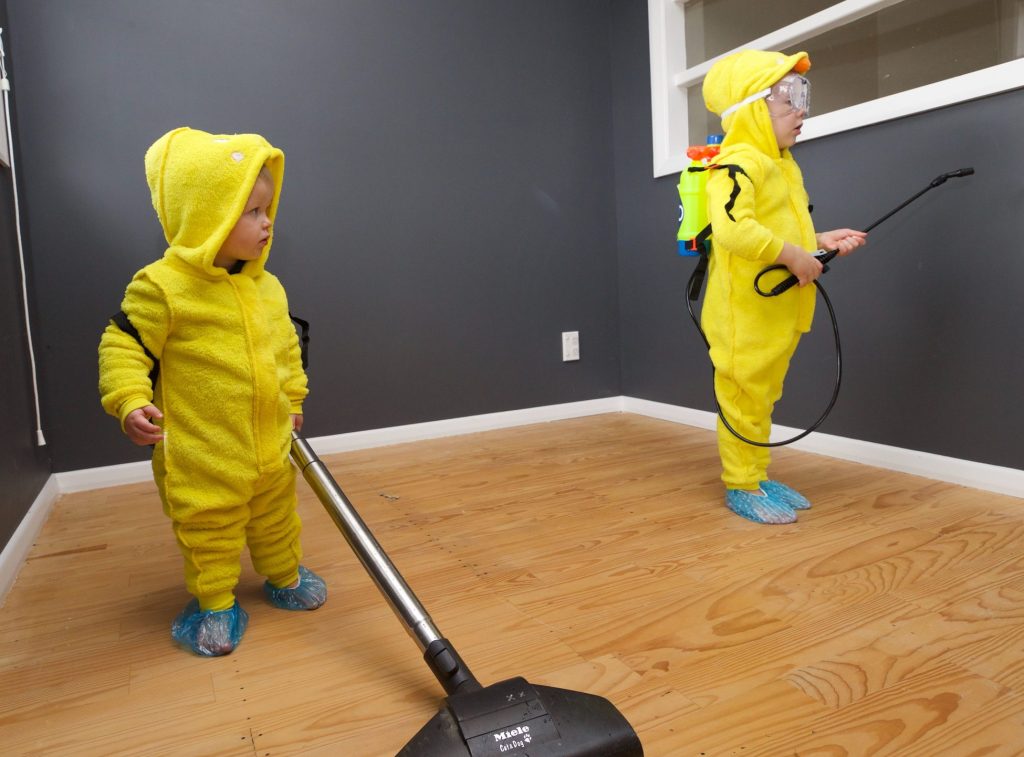
Meth is usually smoked inside, which leaves behind chemical residue. This residue can settle on walls, ceilings, carpet, and furnishings. If contamination levels are high enough, the home may be considered unsafe to live in until it has been professionally decontaminated.
How does insurance handle these claims?
With initio, meth claims are covered under our Landlord / Holiday Home policies:
Cover is up to $30,000, with a $2,500 excess.
From 2023 to now:
The average claim we’ve settled is $24,800
Just under 20% of those claims hit the $30,000 limit
The average duration of a claim is 120 days
Typical cost breakdown
A meth claim isn’t just about one thing. Even minor contamination can lead to significant costs. The $24,800 average usually covers:
Remediation (replacement of contaminated soft furnishings such as carpet and curtains etc)
Loss of rent
So, does NZ still have a meth problem?
Yes. While it might not make headlines as often, the data paints a clear picture. For landlords, it’s still a risk worth understanding – and preparing for.
Initio is pleased to announce that replacement contents insurance cover is available online. This means NEW for OLD replacement of your property’s contents. When you use our quote calculator to obtain a premium for your property you will also be given the choice of increasing your contents insurance cover [from $20,000 current value which comes for free] to either $60,000, $90,000 or $120,000. This cover is especially important for those of you who own holiday homes.
For our existing clients, the option to increase your contents cover is available when you renew your policy. Feel free to contact us if you would like to discuss your contents insurance.
All the same great benefits are extended to the contents cover as they are the home itself, including deliberate damage and theft by tenants / guests. Especially for holiday homes that are rented out, this is real risk – and as a property owner and landlord it a risk that is not worth taking.
Major losses to dwellings caused by fire and flood are all to common – just ask us, we have seen and paid significant claims on quite a few. Having been through this process with our clients it is imperative that you do not under-estimate the value of the contents in your property…. It adds up a lot quicker than you think. Have a walk around your property and make a quick list of some of the more significant items, beds, lounge suites, TVs, electronics, bikes, tools. Think about what it would cost to buy these new and to a tally on the cost; this is only the beginning – there are still all your clothes, and the pots and pans to include.
Feel free to call or email the initio team if you would like to discuss your contents insurance. Have a look at the online pricing. As always – with initio you can quote and start your cover online in a mater of minutes.
When you insure your belongings, you pick a total amount of cover for everything. But, some items still have a sub-limit on how much they’re covered for. For the items in the table below, if you think something is worth more than this limit, you can add it as a specified item. The described, specified item will then have a high upper limit in the event of a claim.
If you’ve already got your Own Home contents cover with initio and want to add a specified item, please login to your initio dashboard and use the “change” and then “cover” options to specify any of the below items in your contents cover. More information about making changes to an existing policy can be found here.
The limits on jewellery, watches, bicycles, drones and collections can be increased if you specify a higher amount (for up to a maximum limit of $20,000 per item). The watersport equipment can be increased for equipment but not for any watercraft. For example, a fishing rod valued over $2,000 can be specified but a powered, runabout dinghy over $2,000 cannot. The powered dinghy would require a separate marine policy.
Jewellery & Watches:
$3,000 per item
Camera or Camera Equipment:
$3,000 per item
Bicycles (Present value):
$2,000 per bike
Watersport Equipment (Present value) for any watercraft not powered by motor or sail, eg. surfboard, paddleboard, dinghy, kayak:
(Our contents policy cannot cover any watercraft powered by motor or sail, with a value of more than $2,000)
$2,000 per item
Drone / remote controlled aircraft (Replacement if less than 2 years, otherwise present value):
$3,000 per item
Collections (Stamps, medals, coins):
$3,000 per collection
It’s important to note that some categories of contents are still insured for their present value (read more), so make sure you are specifying the amount for present value or replacement value depending which applies.
As an example, bikes are insured for their present value. If you purchased an e-bike 2 years ago for $8,000 it may only be worth $5,000 today (present value). In the event of a claim, your settlement would be based on the present value, (in this example $5,000). Since this is over the $2,000 policy limit for bicycles, you would need to specify the present value, otherwise the claim would be limited to $2,000.
Since the present and replacement value of items changes over time, we recommend that each year you check the present or replacement values (depending which applies) for your items. If they’re insured for more than their value (replacement or present value, depending on the type of contents), you’re paying extra for no real benefit.
Multiple Items of Jewellery
For any single piece of jewellery or watch, there is a policy limit of $3,000 unless the item is noted as a specified item.
For any jewellery that is not specifically specified there is a maximum payment limit for any one event.
Unless a different maximum payment amount is shown in the schedule, the most we will pay for any event for multiple items of jewellery and watches (that are not separately specified) is $15,000.
For example, if you lose 10 pieces of jewellery in one event, each with a value of $2,000, the most we will pay is $15,000 unless we have previously agreed to increase the limit to $20,000..
Camera or Camera Equipment
Any piece of camera equipment is limited to $3,000 per item unless specified. Please note that our contents policy does not cover items used for earning income. If you use your camera equipment for earning income, you will require a separate commercial insurance.
E-Bikes
We can insure e-bikes on your contents policy provided that they are “pedal operated bicycles with motor assistance” If the motor is the primary source to propel the bicycle then the NZTA considers those to be classed as a vehicle and they would therefore need to be insured under a motorcycle cover. Visit NZTA to learn more. Don’t forget to specify your e-bike if its present value is over $2,000.
Drones / Remote controlled aircraft
The cover is automatically provided under your existing home contents policy for drones and their accessories for up to $3,000, provided the drone is;
only used for personal use (ie. Not commercial/business) and
is operated within NZ Aviation legislation and
reasonable precautions/care are taken when securing and operating the drone
Drones are insured for replacement value whilst they are under 2 years old, present/market value applies for drones over 2 years old.
If you would like to know more, please contact us.
Watersport Equipment
Our contents cover does not cover any watercraft powered by motor or sail, with a value of more than $2,000. Please arrange marine/boat insurance with a relevant provider if required.
Antiques & Works of Art
While it’s not a requirement to list these as specified items on your policy, it is important to disclose them when applying for cover (under the general disclosure question) — especially if you have individual items valued at more than $25,000.
If you have works of art or antiques individually worth more than $25,000, please provide the details when completing your insurance application. Items of this value are considered material information and need to be reviewed by our underwriters before we can confirm cover.
As part of the review, we’ll need copies of the latest valuations, along with details of any security and fire protection measures in place.
Other Valuable Items
Generally, most personal contents items don’t need to be specified separately. Examples include personal medical devices such as hearing aids or insulin pumps, musical instruments, luxury items like handbags or shoes, and electronic equipment for your own personal use. These are covered under your main contents sum insured, with no sub-limit applied.
If you’re unsure whether a specific item is covered or needs to be noted, please check your policy wording or get in touch with our support team for guidance.
New Zealand’s Leading Insurer Urges Government Action on Flood Resilience
New Zealand’s most prominent insurance provider, IAG, has called on the newly formed government to make flood resilience a top priority. This appeal comes in the wake of insurance claims exceeding $1 billion due to the summer storms, including the North Island floods and Cyclone Gabrielle. These figures are second only to the costs incurred by the Christchurch earthquakes.
IAG (initio is backed by this insurance giant), have shared insights from their latest Wild Weather Tracker. This report discloses the settlement of a staggering 51,000 claims related to these weather events. The data reflects high settlement rates across various categories including motor, contents, and home insurance.
The Wild Weather Tracker also sheds light on the rising economic impact of climate change, noting an upward trend in average claim costs. Regions like Hawke’s Bay, the West Coast, and Gisborne Tairāwhiti have emerged as the most affected in terms of weather-related claim costs.
For a detailed view of the November 2023 Wild Weather Tracker, visit IAG’s website.
On the questions of: how does Initio make money? Does Initio charge fees? It is first important to know what type of business initio is:
Initio is an Underwriting Agency of registered insurer IAG. Initio is not an insurance company in its own right. This means that initio has delegated authority from the insurer to establish and manage insurance for houses, contents and cars. In addition, Initio has authority to pay claims on behalf of the insurer.
Initio is a licensed Financial Advice Provider under the Financial Markets Authority of New Zealand. Initio have staff who are Registered Financial Advisors, which enables initio to provide customers with insurance advice specific to their situation.
On the sale of an insurance policy, including its subsequent renewal, initio is remunerated by commission and fees. The commission is a payment that recognises the cost of delivering such functions, administration, and services that would otherwise be a cost to the insurer, and the fee is a transaction and platform fee designed to recover costs associated with transaction processing including bank and payment provider processing costs, credit card merchant charges, and obtaining property risk and vehicle data, and regulated financial advice. For details of charges and remuneration see our disclosure statement, and/or refer to the quote and invoice when transacting with us.
Burglary prevention is as equally important for holiday homeowners and landlords, as it is for one’s own personal residence. Burglary is not just about having your contents stolen; there is also the damage that thieves can cause trying to gain access to the property.
Holiday homes are particularly vulnerable as they are often left unoccupied for extended periods of time.
Landlord Insurance cover is designed to protect you when the worst happens, but as a landlord and property owner there steps that you can take to prevent having to deal with the heartache and distress of someone illegally entering your property, and ultimately having to make a claim on your policy. Here are some tips to prevent opportunistic burglars from targeting and gaining access to your property.
Check window joinery and replace or repair any loose latches.
Consider installing security stays on windows.
Fit deadlocks / deadbolts to all external doors; especially older doors and ranch sliders which can be easier to obtain access.
Install a burglar alarm and advertise the presence of an alarm.
Install exterior sensor lights, or check that existing lights are working correctly
Don’t advertise that you are away; keep the lawns mowed and the mail box clear.
Good security makes people feel safe; it also has the added benefit of retaining good and long term tenants.
Young couple Chris and Jen recently completed every young couples dream and purchased their first home. In a hot property market this is not an easy task. With house prices continuing to rise and larger deposit’s required upfront, getting your foot in the door can seem overwhelming and impossible at times. But after growing up in Zimbabwe where land ownership is fraught with controversy, nothing was going to stand in the way of Jen’s dream.
After looking for a year, Jen and local Hamilton lad, Chris found their perfect first home in the Hamilton suburb, Fairfield. Now that they have accomplished their first property milestone, initio plans to continue to support this couple as they grow their property portfolio. The couple plan to use this home as a stepping stone into something bigger before they find their dream holiday home.
Why do you insure with Initio?
Initio was recommended to us, and we were instantly impressed with the competitive pricing to insure our home and our contents. The sign-up process was quick and easy during the stressful last days of purchasing our home.
Best advise you can give to other first time home buyers?
It’s okay to miss out on the first house you make an offer on. We were lucky securing the second house we made an offer on. Which ended up being twice as good as the first. Look at as many places you can as early as possible and you will soon realise exactly what you’re after. After a while looking we knew from the which places weren’t worth looking at & what suburbs were best. Real Estate Agents websites tend to show listing first before they hit Trade Me or realestate.co.nz, so go to the likes of Lugtons first if you want to possibly get an early viewing. Check out whether you’re eligible for any grants such as the Home Start Grant. The Government is willing to help first home buyers and every little bit helps towards your deposit. A good mortgage broker will break down what you can afford and what your repayments may be. It was a stressful and long process purchasing our first home. But with the help of people like initio, once we found our home – it all happened very quick.
Baxter owned a rental property in Whangamata and employed a property manager to manage the tenancy and inspections. Baxter had model tenants, the property was always kept in good condition, the lawns mowed regularly and rent payments were never missed. Then, in March 2018 the tenant failed to pay rent for two weeks in a row. The property manager went to the house and discovered that the tenant had vacated, possibly weeks earlier and had left behind a mess of rubbish, possessions and a very dirty house, with numerous areas of damage.
Claim Process
Baxter logged into his dashboard on the Initio website to tell them about his damaged house. Because Baxter wasn’t based in Whangamata, he advised Initio that the property manager was the best person to liaise with.
Initio appointed a loss adjuster to the claim, who went to the property, took photographs and obtained quotes to repair the damage. Thankfully the property manager had completed a written and photographed inspection of the property just one month prior to discovering the damage, so the loss adjuster was easily able to differentiate between existing and new damage.
The damage to Baxter’s property was two-fold, the claimable and non-claimable.
Claimable damage:
Graffiti on walls in lounge / dining / kitchen area – It was likely that the graffiti was all completed at the same time, so one excess applied to this event.
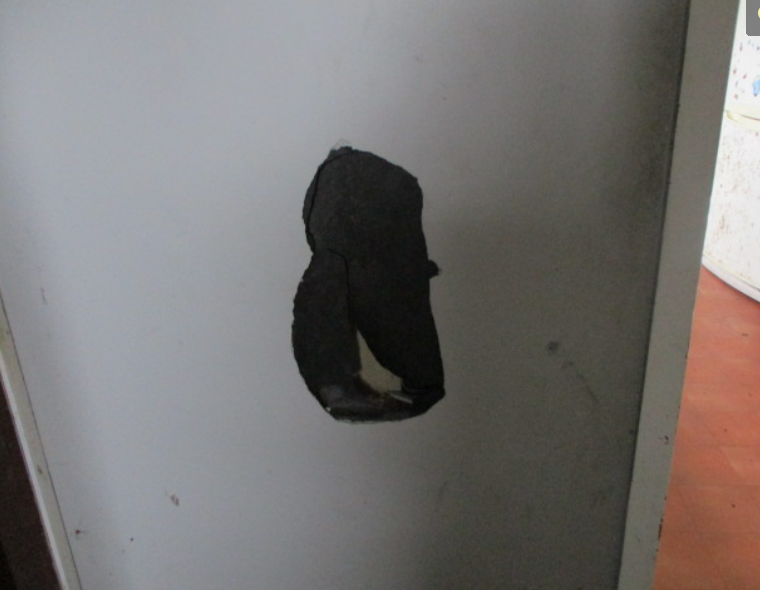
Numerous holes in walls in the kitchen / dining / lounge area – These areas were going to be re-painted due to the graffiti, so the holes were repaired at the same time. No additional excess was applied to this event.
Large tear in the carpet in the lounge / dining / kitchen open plan area – This was one open plan room and so the carpet to the doorway of the room was covered. Another excess was applied as this was unrelated to the graffiti.
Cracked vanity top – The only way to remedy this was to replace the entire vanity, which involved re-tiling around it. A further excess was applied to this one-off event.
Loss of rent – The claimable damages would take approximately three weeks to repair, so Initio paid the lost rental income for this period. No additional excess is charged for loss of rent.
Non-claimable damage:
Rubbish removal, general cleaning, lawn mowing – Whilst there was a cost associated with these issues, they were not caused by a sudden and accidental event, so there was no cover.
Random one-off holes in walls throughout 3 bedrooms – It was not possible to confirm that the holes all occurred in the same sudden event and so an excess would have been charged per hole and therefore there was no point in claiming.
Missing and damaged curtains throughout – As confirmed by the tenancy inspections, the curtains had been removed and damaged at various times throughout the tenancy, so an excess was to apply per curtain which made them un-claimable.
Outcome
Initio deducted 3 x $400 excesses from the repair estimate of $6,500 and cash settled Baxter $5,300 directly to his nominated bank account.
“All claims are different and they are assessed on their own merits and facts. The above profiles do not imply a guaranteed approach all such claims”
Jonathan is a landlord of 12 properties in the Waikato region. Other than a few small glass claims in 20 years he had never lodged a claim. He got a call on a Saturday from a tenant who had been on a holiday for a week. While away a pipe in the bathroom had burst; water had flooded the house damaging carpets. When Jonathan arrived at the property he found the downstairs celling of his two-story property had collapse under the weight of the water pressure. Jonathan contacting a plumber who located the burst pipe and made repairs to stop the water flow.
Claim Process
Jonathan first tried to call Initio but being a weekend was able to find the after-hours emergency number. After hours services advised him to call Jae’s a carpet cleaning company. Jae’s turned up immediately and started cleaning and drying the house. Jonathan made sure he took photos of all areas where he could see that the water had affected. Monday morning he went online, logged into his dashboard and lodged his claim online. In the claim form, Jonathan provided a very detailed description of what had occurred.
The appointed loss adjuster contacted Jonathan to organise a time to inspect the property. The loss adjuster found there was a substantial amount of damage to the property that Jonathan had not been initially aware of. Both first and second levels had water damage to walls, carpets, tiles and the celling.
The damage to the property was consistent with a sudden and accidental loss, which Jonathan had declared. All costs to repair the consequential damage, including removing & replacing wall linings, replacing carpet, relaying tiles and painting were covered under Jonathan’s insurance policy.
Outcome
Jonathan was proactive getting correct advice and taking steps to minimise the damage. The policy responded exactly as he expected – the property was repaired, items were replaced, and it was restored back to the condition it was before the water damage event occurred. The cost of the claim was almost $50,000.
In the event you find yourself in a similar water damage situation to protect your property and minimise damage, call a plumber. In the first instance you need to stop the water flow and make emergency repairs. Make sure you take photos of damaged areas and contact Jae’s to arrange the cleaning and drying of your property. When you work with your insurer to provide detailed information, your claim can be serviced and completed without delays.
All claims are different, and they are assessed on their own merits and facts. The above profiles do not imply a guaranteed approached all such claims.
Insurance is full of jargon, and one piece of jargon that we use often is ‘excess’. Insurers assume that their clients know what an excess is and how it works. This article will give you a clearer understanding of excesses.
What is an Excess?
An excess is the contribution that you are required to make towards your claim. This is deducted from the loss and it is a form of self insurance. At initio you have the choice between a $400, $650, $1,150 and $2,000 excess. If you can afford to contribute more towards claims, and want cheaper premiums, you can take a higher excess. Rather than pay the excess to the insurer, the insurer will usually deduct your excess from the cash settlement or from the first repairer payment it makes. You are then responsible for settling this account directly with the repairer.
Do all losses have the same Excess?
No, not all losses have the same excess. Some policy sub-limits have higher excesses, these will be identified on your policy schedule. For example, while your nominated excess might be $400, the excess for the deliberate damage by tenants extension is $500 for each event.
What do you mean by each event?
An event is defined as an event (yes the policy defines a word with the same word!) or series of events arising from one source or original cause. Where a single claim is made up by multiple events, multiple excesses would apply.
Still confused?
Lets say a dog defecated in multiple rooms of your house. You could look at this two ways; you could say that it is multiple events because the dog relieved himself multiple times (multiple excesses would apply). Or you could say that is is a series of events arising from one source or original cause (being the dog). In this claims scenario we would consider the period of time that the damage took place. If the series of events had been happening over the period of the tenancy then multiple excesses would apply (likely an excess per room). However, if the damage took place in a very short period of time, say the dog was locked inside for a day, only one excess would apply.
To read why an excess per event needs to apply, see here.
Why do I have to pay an excess?
One reason for an excess is to eliminate the administration costs associated with minor or small claims. By making the client responsible for the first portion of a claim, small claims can be avoided. Another reason why insurers charge an excess is to try and prevent fraudulent claims. People are less likely to lodge a false claim when they are responsible for payment of an excess.
If you have any further queries regarding your excess and how it is applied, feel free to send an email with your query to [email protected].
A big decision for landlords is whether to manage their rentals themselves, or pay a property manager to do it for them.
Managing your rental yourself can be more cost effective, but sometimes it can be demanding as attending to requests, queries, and maintenance can be frustrating and time consuming.
What services do Property Managers provide?
To keep your landlord insurance valid, your property manager should meet your landlord obligations so you don’t need to worry about them yourself.
Some of the other main services of a Property Manager include:
Finding new tenants when the house is empty
Assess prospective tenants’ suitability and review reference checks
Collect rental payments from tenants
Carry out regular property inspections to ensure you comply with your insurance policy.
Deal with and look after tenants – answer queries, book tradespeople for repairs, and generally act as a go-to for tenants.
Deal with the legislative ins and outs.
Regular rent reviews
Assess and recommend improvements to your property so that you can attract higher rents and better tenants
Can I give my property manager access to my initio account?
Yes – you’ll keep full control of your initio account as the property owner, but you can add your property manager as an authorised contact to help with day‑to‑day matters. The main login must remain in your name for security and legal reasons, as it allows managing policy details and payments. If you need to make a claim, you’ll need to submit the initial online claim yourself, then you can nominate your property manager within the claim form to assist with claim handling.
Your initio account is for you, the insured property owner. The main login always stays in your name so you can manage your policy, payments, and cover.
While your property manager can’t have their own login, you can add them as an authorised contact for claims. If you need to make a claim, you’ll start the process by submitting it online yourself. After that, you can nominate your property manager in the claim form so they can help manage the claim on your behalf.
This way, you keep control of your account, but your property manager can still support you when it comes to claims.
Can a property manager lodge a claim on my behalf?
Any claim must be initially lodged by yourself as the Insured, part of the claims form includes legal declarations and statements that only you can complete. You can, however, nominate a property manager or another agent as part of the lodgement who you authorise to act on your behalf once the claim has been submitted.
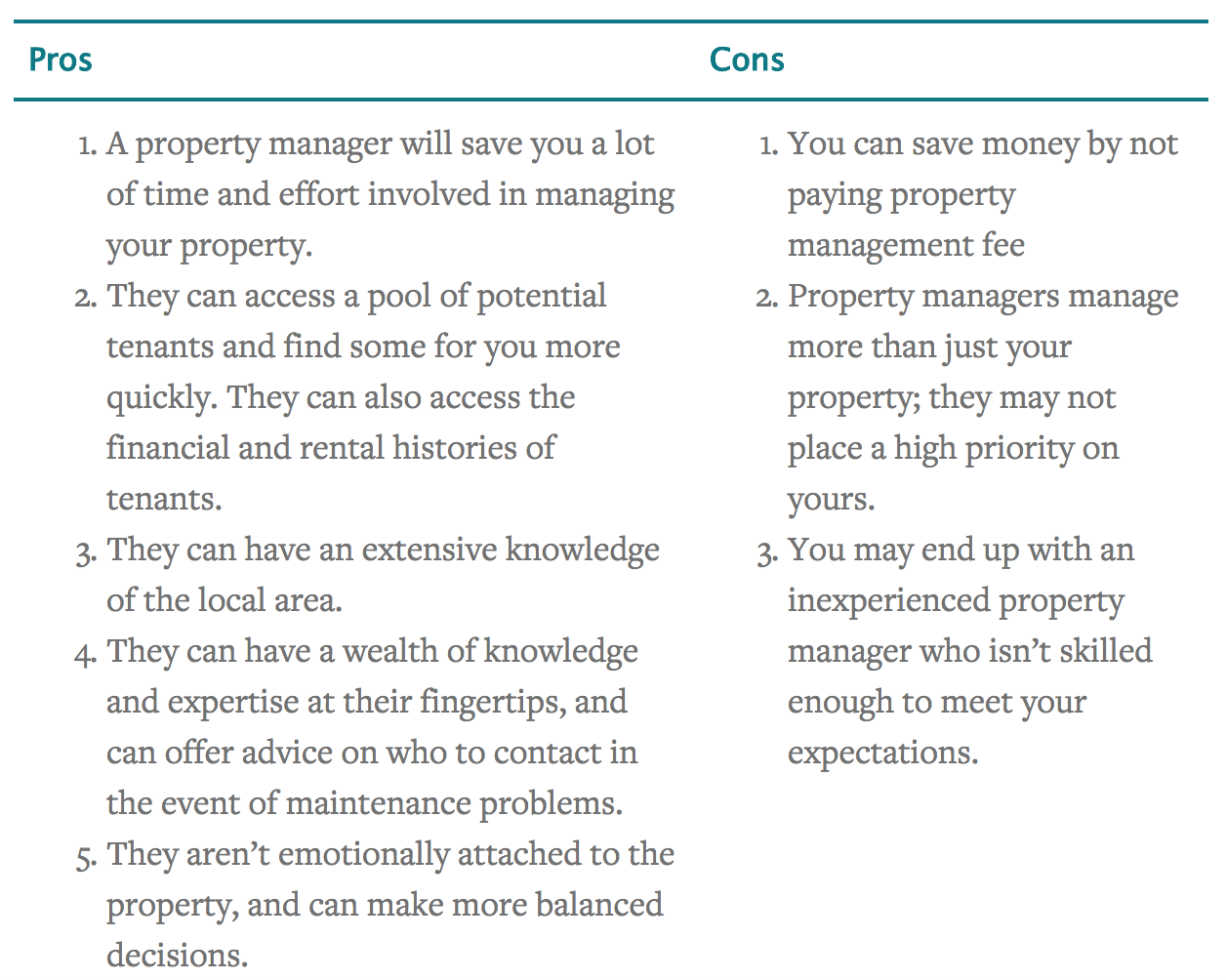
Pros and Cons of using a Property Manager
Pros and Cons of a Property Manager
While self management might save you a property management fee, having the right property manager could mean higher rents and less days unoccupied meaning more rental income.
As a landlord, ensuring the safety of your tenants and property is paramount. Fire hazards pose a significant risk, but with the right precautions, their impact can be greatly reduced.
From an insurance viewpoint, fires accounted for approximately 1% of the total claims we processed in 2023. Although not the most frequent type of claim, their impact is significant in terms of cost, representing 26% of the total value of claims last year. Given the potential financial and personal consequences of fires, investing in preventive measures is undoubtedly worthwhile.
Below are some practical steps you can take as a landlord to minimise fire risks, safeguarding both your tenants and investment. The leading cause of fire is kitchen fires, particularly due to unattended stoves and combustible items left while cooking.
When anyone is faced with a kitchen fire, the immediate confusion and panic can result in uncertainty about how to respond effectively. This uncertainty may cause considerable damage and could even lead to hospital visits. So, the easier you can make it, the better.
All year; Kitchen fire safety
The kitchen is a common site for fires, but you can make it safer with a few measures:
Fire extinguishers: Ensure a fire extinguisher is available in the kitchen and make your tenants aware of its location and how to use it. It’s best placed within easy reach, such as in a cupboard that’s accessible or mounted on the wall close to the cooking area.
Choosing the right type of fire extinguisher: It’s worth noting that not all fire extinguishers are suitable for all types of fires – especially oil fires common in kitchens. Opt for an extinguisher with an F or B rating, designed for grease, cooking oil and fat fires, to ensure effectiveness. Learn more about fire extinguishers
Provide a fire blanket: A fire blanket is an invaluable tool for smothering fires. It’s a good idea to have one easily accessible in the kitchen, offering tenants a quick solution to douse flames before they spread.
Carbon monoxide monitors: They detect harmful gas from appliances, serving as an early warning to prevent fires. Their ability to sense invisible, odourless carbon monoxide can stop potential fires, ensuring the safety of home occupants.
It’s also important to note the impact of placing hot pots directly on wooden or laminate benchtops. Doing so can lead to significant damage, leading to costly repairs and labour. Ideally, stone or stainless steel benchtops offer greater resistance to heat, but these materials might not always be feasible in rental properties, where laminate or wooden benchtops are more common. Although not an immediate fix, considering more heat-resistant materials during renovations could mitigate future damage and maintenance costs. This foresight can enhance the longevity and appeal of your rental property’s kitchen.
Summer; Outdoor cooking precautions
BBQs are ideal for bringing people together, yet they can pose a risk of fire if not handled with care. Although you may not directly influence how your tenants use BBQs, you can oversee certain precautions during property inspections. Should the BBQ appear to be in poor condition, it’s wise to discuss its maintenance with your tenants. A gentle reminder about the measures they can adopt to maintain their household’s safety would be beneficial:
Regular Cleaning: Ensure that BBQs are thoroughly cleaned after use. Grease and fat build-up can ignite, posing a fire risk. There’s not always efficient absorbent material in the drip tray and once the BBQ reaches a hot enough temperature, this can lead to them spontaneously igniting. Gas can be turned off, but the fire will keep going because it has more than enough fuel to keep going with the build-up of fats and oils.
Safe Placement: BBQs should be kept at a safe distance from the property. This will prevent potential fires from spreading to the structure itself.
Winter; Fireplace safety
Fireplaces add warmth and ambience but require careful handling of embers:
Use Metal Buckets: Never place fire embers in plastic containers. Always use a metal bucket to prevent unintended ignition.
Install Fire Guards: Sparks can easily escape from fireplaces. A fire guard can help contain these sparks, reducing the risk of fires.
Smoke Alarms
Smoke alarms offer a crucial defence against fires, offering early detection that can save lives and property. Ensure that:
Smoke alarms are installed throughout the property.
Batteries are checked regularly and replaced as needed.
Tenants are aware of the smoke alarm testing routine.
Final thoughts
By taking these steps, you not only minimise the risk of fire in your rental properties but also demonstrate a commitment to the well-being of your tenants. Take preventive measures, such as inspecting fireplaces and managing barbecue safety. Regular maintenance, combined with the right fire safety equipment and tenant education, can significantly prevent fires.
The New Zealand Herald has recently put the spotlight on a major issue affecting houses all over the country, P Labs. Homeowners are forking out millions of dollars to decontaminate P-riddled properties in a crisis that could rival the leaky homes disaster.
In the worst cases, contaminated houses are destroyed. An industry specialist says 40 per cent of homes he tests contain traces of methamphetamine, known as P.
Housing NZ spends about $12 million to $13 million a year on remedial work. Five of its properties were demolished in the 2015 financial year because they were damaged beyond repair. But the problem isn’t confined to poorer areas and has seeped into even the most exclusive streets. A property on the market in a high-end suburb of Auckland was contaminated during a chemical explosion from a suspected P lab in the garage in 2005.
Home Owners and Buyers Association president John Gray said he knew of six homes that cost about $250,000 to decontaminate. Invariably the clean-up ranges from $1000 to a few hundred thousand, with hefty replacement costs for furnishings, curtains and wall coverings too.
From a risk management perspective, as a landlord you should have a systematic process for performing regular checks and meth testing at your property – before, during and after a tenant vacates. The cost of a contamination event at your property could be substantial, however if effective inspections and processes are put in place then this risk can be mitigated. Swab test kits can be purchased online and they provide an indication of contamination. A full laboratory evidential test is required to confirm the exact level of contamination.
On the insurance front – not all insurance policies are equal. It is therefore critical that you check the cover you have in place, specifically relating to P Lab cover. Most insurers do not offer P Lab insurance cover as part of their offer. We are pleased to advise that over the years the Initio has successfully responded to a number of P Lab contamination claims. We are seeing an increase in incidence of these types of losses, and no two P-lab claims are the same and each claim turns on its own set of facts. When receiving a P-Lab claim we take account of the landlords approach to property inspections which at a minimum should be every 6 months (refer policy wording).
A timely reminder that regardless of who your rental property insurer is, you should make sure you have a good risk management in place.
You must tell us everything you know (or could be reasonably expected to know) that a prudent insurer would want to take into account in deciding:
a. Whether to agree to insure you
b. if so, on what terms
Examples of what you must tell us include:
a. anything that increases the risk of a claim
b. any criminal offending or convictions
c. any previous insurance claims
d. any refusal by another insurer to insure you on standard terms.
You must also tell us this every time this policy renews and when you make any changes to it. If you fail to do this, we may void the policy retrospectively. You will have no insurance at all. When in doubt, disclose. We treat all information confidentially
Change in circumstances
You must tell us about any material changes in your circumstances after the policy starts and during the policy period
Privacy
The personal information you provide in this proposal will be held by Initio, 15 Clifton Road, Hamilton, and Lumley (IAG New Zealand Ltd), 88 Shortland Street, Auckland.
Our collection of this information is part of your duty of disclosure at law to us, and is compulsory
If you fail to provide it, we may choose not to insure you.
We may pass on limited information about your property (ie name, property address, period of cover, sum insured) to the organisation if any (eg Bookabach, New Zealand Property Investors Association) that has referred you to us.
You have rights of access to the personal information, and correction of it, under the Privacy Act 1993.
IMPORTANT – Replacement Sum Insured
The ‘replacement sum insured’ above represents the total replacement value of your dwelling and improvements (eg driveways, swimming pools, fencing etc). We do not accept any responsibility for the accuracy of this value. You are responsible for determining and accepting this value. An insurance valuation or using an online replacement value calculator will provide you with more accuracy of replacement value.
Being a landlord comes with unique benefits and advantages. However, there are also risks with having tenants or guests stay in your property.
To best protect yourself and your property, it’s important to know where to look and who to trust. In most cases, you can learn the most from other landlords who have been in business for a long time. Specifically, you’ll want to find landlords in your area, as they are likely to have a good understanding of local laws and regulations. The New Zealand Property Investors Federation is a great place to start and connect with your local property investors association.
Generally speaking, here are some of the top tips for reducing risks:
Everything goes in writing Absolutely everything needs to be in writing. In real estate, it’s commonly said that if it’s not in writing, it doesn’t exist. While it can be tempting to rush a lease agreement to a new tenant, you want to carefully ensure everything is included. From who can live in the residence and what activities are permitted, to when rent must be deposited and how non-payments are handled, only what is written is enforceable.
Get the right insurance
If you wait until an accident happens or a loss has already occurred, it’s too late. Get the right insurance policy in place from the start to protect yourself and your assets. Having a specialist insurance policy like Initio offers means you have the cover you need to protect your property. Click here to find out more about the cover offered by Initio.
Pay attention to the property
Again, waiting until something happens means it’s already too late. Keeping your tenants safe requires you to keep up with property maintenance and ongoing issues. If something is broken or potentially hazardous, have it inspected and take care of it. This allows you to stay on top of anything that comes up before it can develop into more serious damage.
Don’t ignore tenants
No matter how frustrating a tenant might become, you must always listen to them. If they claim something is broken or dangerous, attend to it immediately and take steps to prevent future issues. By not addressing something that a tenant points out, you are exposing yourself to consequences in the future.
Screen tenants
You can avoid many unnecessary risks by screening potential tenants effectively and appropriately. Do they have a job? Can they pass a background check? Do they have any prior history of evictions? These are all important questions to ask and research. When screening tenants, require them to provide you with prior references, ideally from former landlords because they are your best tool for gathering information.
Safeguard your business
While it’s great to get everything in writing, it’s only useful if you properly store and protect that information. If your documentation is in paper form, it’s best to store a digital copy as well. For digital files, it’s best to conduct regular backups and keep all virus software up to date. From an organisational point of view, clearly label all documents and keep files easily accessible.
Handle evictions carefully
Ending a tenancy is a serious matter and should not be started without carefully completing all of the lease and legal steps required. Always consult a lawyer before evicting a tenant and ensure you have all written documentation in place before proceeding. Never threaten a tenant with eviction as a means of getting a rent payment; the regulators and Courts don’t look highly upon landlords threatening tenants.
Develop relationships with tenants
Sometimes it simply comes down to personal interaction. By developing a reputation as an approachable and honest landlord, you can build trust and prevent circumstances from becoming confrontational. When there is a relationship, tenants are less likely to file a formal complaint over a minor matter.
Andrew King, of the New Zealand Property Investors Federation, has written a common sense article on the consequences of meth in rental properties.
The consequences of Meth in rental properties has been escalating over the last few years. Fortunately it isn’t the actual health consequences of meth in rentals (except for those actually consuming the stuff) but uninformed fear of what meth residue can do and the potential for highly expensive remediation if it is discovered in your rental.
Other factors have also meant that rental property owners need to be extremely careful around the meth situation. These include decisions by the Tenancy Tribunal and actions taken by insurers.
Previously the acceptable level of meth was .5 micrograms per 100 square centimetres. If a property contained a higher level than this it was said to be “contaminated”, an emotionally charged word that most people believe means toxic. In other words if you are living in a property over this level you are likely to get sick. However this isn’t true.
To put the level into perspective, imagine a piece of meth the size of a grain of salt divided into 1,000 pieces. The previous level amounted to find one of these pieces per 100 square centimetres. It is an amount that was estimated not to cause any effect on even a susceptible human, with a safety factor of 300 applied on top. In other words it was an extremely conservative level.
Despite this, the fear of meth has led to outcomes such as tenants immediately vacating properties if any level of meth was found and Tribunal awards against landlords providing an unclean and unhealthy property even when the level of meth was less than the acceptable levels.
So it was good that the Ministry of Health (MOH) revised its recommendations and increased the acceptable unmanufactured meth level to 1.5 if there was carpet in the property and 2 if there wasn’t any carpet. They kept the level the same if it could be proven that manufacture had taken place.
The rationale was that the .5 level should remain for manufacturing in a property so that you could be sure that other nasty chemicals that might be involved in the manufacture process are not present.
Although the MOH thought that the higher levels would apply unless manufacture was proven, some local authorities (who actually set the regulations) might take the view that the .5 level would remain unless it was proven manufacture didn’t occur.
To remove any possibility of confusion, the NZ Standards Meth committee decided to include a 1.5microgram level regardless of how the meth came to be in the property.
Both the MOH and NZ Standards Meth Committee recommendations were put into the draft Standard that went out for public consultation.
The final Meth Standard is likely to be released in June and may in fact be released by the time you read this.
At the higher 1.5microgram level, it means that many properties that would have required cleaning previously will no longer need it. Testing laboratories have advised that around 80% of the samples they currently test are less than the 1.5 microgram level.
The higher level will also make it easier for meth cleaning companies to get levels at or below the 1.5 level, so there is an expectation of good improvements through the new standard.
The cost of meth claims for Insurance companies has been increasing, so hopefully this will reduce when new standards are released. Despite this, insurance companies are changing their policies with regard to meth, increasing excess levels and reducing maximum claim amounts.
They are also getting firmer on holding rental property owners responsible for checking their properties. It is advisable to check how you are covered if you are unsure. Consider looking at using Initio, the rental property insurance policy that has a relationship with the NZPIF.
Regarding checking your property, the NZ Standard draft required landlords to know what they were doing if they were conducting their own meth tests, meaning undertaking training. There will also be a list of approved self test kits so that the quality of test gear can be guaranteed.
The draft Standard also contained standard procedures to standardise sampling and cleaning companies plus laboratories. The draft Standard also contained measures to protect consumers against conflicts of interests by ensuring sampling and cleaning companies are separate.
The rental property industry is certainly looking forward to the release of the NZ Meth Standard in June. While there will be steps and procedures that we will need to undertake, it is likely that the existing problems caused by the meth issue will be greatly reduced.
For more information on the New Zealand Property Investors Federation, and how they can benefit you, check out their website www.nzpif.org.nz.
We are excited to announce that initio has been named a finalist for the Underwriting Agency of the Year at the 2018 New Zealand Insurance Industry Awards.
A huge thanks to the initio team, our customers and supporters. Also, congratulations to all the finalists. Especially our friends at Frank Risk Management, finalist for Small-Medium Broking Company of the Year, a category they won in 2016 and 2017; and Rene Swindley (founder of Frank Risk and initio) who is a finalist in the Young Insurance Professional of the Year category. Click here for a full list of the finalists.
2018 has been an exciting year for initio, with lots of new web development making it easier than ever to manage your insurance online. We are very proud of our achievements to date, and this nomination is very gratifying. Winners will be announced on Thursday 29 November 2018.
You can pay your premiums monthly using a debit or credit card. Our month-to-month insurance will automatically renew by charging your card at the renewal date of your policy each month.
If there is ever a change in your monthly premiums, we will let you know. If you need to stop your monthly payments, you can easily login to your dashboard and cancel the policy yourself.
Learn more about how monthly insurance works here.
The cost to rebuild your home is constantly changing. To try and help with changing construction costs and other factors that may affect the rebuild value of your home, each year we auto-update your sum insured.
For Monthly payment policies the auto-update to your sum insured will be automatically applied once per year, at the anniversary of your policy. One month prior to the change we will notify you of the auto-updated sum insured and invite you to login to your dash to change the sum insured to an amount of your choosing. If you change your sum insured this amount will be locked in for the anniversary renewal of the policy. If you do nothing, then at the anniversary renewal (ie the following month) the sum insured will update to the amount we have advised, and new insurance cost will be charged to your credit card.
For Annual payment policies the auto-update will be applied during your renewal process, where you can further adjust the sum insured prior to confirming you renewal and making payment.
A change in sum insured affects the premium you pay. This is because a higher sum insured means more insurance cover, which equates to more premium to cover that risk. At the same time, your cover may have also had a premium rate or levy change. By selecting the ‘change’ icon in your dashboard, initio makes it easy to see how changes to you sum insured affect your premium. Its easy and responsive, and we are here to help if you need assistance.
What things can impact the rebuild value of my home?
Supply chain issues and accessibility of materials.
Changes in the cost of transportation and shipping.
Inflation and interest rate changes.
Changes in the cost of labour and in particular construction related wages.
Cost of waste disposal
Cost of compliance costs (eg council consents, heath and safety, insulation rules)
Accessibility of the the property
This is not an exhaustive list but all of these are contributing to changes in the overall cost of constructing, rebuilding or repairing a home.
Changes in construction costs vary by region too due to the availability of labour, and also local rates.
So what sum insured do I use?
The auto-updated sum insured we do at your policy anniversary is a guide to your sum insured only. It does not account for your unique situation such as renovations or improvements to the home, or the accuracy of the sum insured your originally chose. We are not attempting to recalculate the insured value of your home, and you are responsible for choosing an accurate sum insured. If your sum insured is not right for you, it might not be enough to rebuild your home to the same size and quality.
Because the things that contribute to your rebuild value are constantly changing, it’s almost impossible for you to select a sum insured that will work for the entire annual insurance period. The best approach is to choose a sum insured that reflects the homes approximate rebuild cost and allows for demolition costs, escalation of construction costs and other site improvements (such as retaining walls, pools, sheds, fences).
We strongly recommend that you use your policy anniversary as an opportunity to review the sum insured of your home. You can use the SumSure rebuild estimator to help. This is a simple tool that can provide a quick and easy estimate of your home’s rebuild value, and at the very least you should use this tool.
Better still, there are skilled professionals that you can engage (at a cost) to provide a detailed report on the rebuild value of your home. Construction Cost Consultants are one of those, and can provide residential rebuild valuations
Please note you can only change a policy once it’s active, ie. the inception date is not still in the future.
Where do I start?
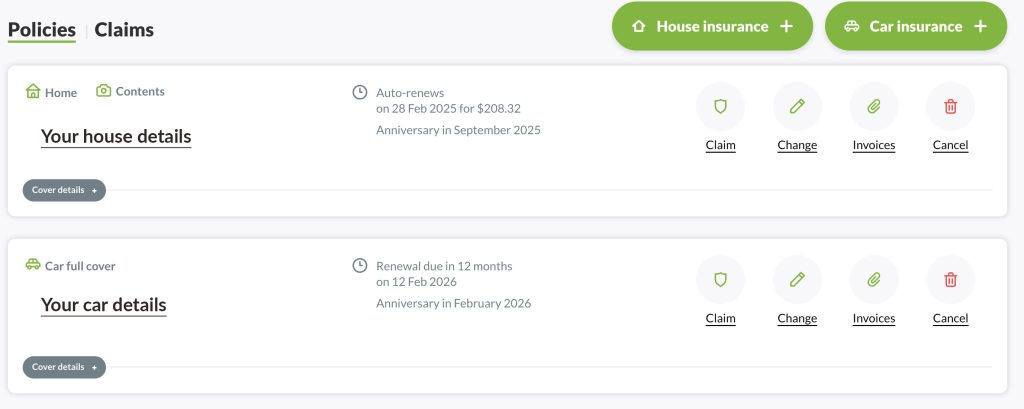
Changes are made to your policy online by logging in to your initio dashboard and selecting the “Change” button from the right-hand side action menu or one of the Quick Change buttons shown beneath the address by expanding the Cover Details option.
What can I change using this option?
Once you have clicked on the change button, proceed to the “Cover” section to make changes to your policy and select the relevant option.
You can now edit the following;
Address where the vehicle is usually located
Type of Cover – choose from Full Cover, Third Party Fire & Theft or Third Party Only
Review agreed value
Include or Exclude Roadside Assist (available on full cover only)
Amend your current excess
Review policy options of including/excluding drivers under 25 years old
Review policy option of anticipated kms per year
What can’t I change using this option?
A new (replacement) vehicle
A new Main Driver
Policy start date
Payment frequency
To make changes to any of the above, it requires a new policy to be taken out. This is also a simple process by using the “vehicle insurance +” option on your initio dashboard. Once the new cover is in place, you can then cancel the original policy, a refund will be provided for any unused portion of the cancelled policy.
If you have obtained a personalised plate or there is a change to your current vehicle’s registration, please contact our support team ([email protected] or 0800 763 929) for assistance to have that corrected on your policy.
A new Owner (Insured Name)
If you have sold the vehicle, any new owner will need to take out their own insurance policy using their own details. If you just wish to make a correction to the Insured Name/Owner details, such as amending the spelling or changing it to your own business name, please contact our support team ([email protected] or 0800 763 929) for assistance to have that adjusted on your policy.
What about nominated drivers?
Aside from the main driver, we do not require you to nominate other drivers. However, If you have agreed to exclude drivers under 25 years of age and now wish to change that, you can do so using the change option (or vice versa).
It can be a shock for your vehicle to be damaged – whether you’ve been in an accident, had your vehicle stolen, or discovered it damaged in a parking lot. We’re here to help, so when you’re ready and able, lodge your claim online and we can guide you through the process.
In the meantime, here are some FAQs for what information to collect, and how vehicle claims are processed.
If you have further questions about vehicle claims, chat with us, or you can e-mail or phone the initio claims team.
What information should I gather when my vehicle has been damaged?
Recording the damage and the other people involved straight away helps us in processing your claim.
Photos – Take clear, detailed photos of the damage from multiple angles. If you can, capture the surrounding area to provide context, such as where the car was parked and any possible sources of the damage.
Witnesses and CCTV – Check if there are any witnesses who might have seen what happened. Also, see if there are any nearby CCTV cameras that might have recorded the incident. If you find witnesses, gather their contact information and a brief statement. CCTV is usually available from the local council. You will need to reach out to them directly to obtain this as we are unable to request the footage on your behalf.
Police – Record the Police reference number and the name of any attending officers. If your vehicle was stolen, report the matter to Police – you can do this online.
Other drivers – Record the name, address, contact details (mobile and e-mail address) of other drivers when possible. Confirm whether they have insurance and who with. Provide other drivers with your details where appropriate, and let them know you’re insured with initio.
Include as much information as possible when you lodge your claim online with us.
How do I arrange an alternative vehicle under my claim if mine is undrivable?
Under our alternative transport additional benefit, we will contribute towards the reasonable hire costs incurred if you need a rental vehicle following a loss covered by the policy while your car is being repaired, is not fit to drive while awaiting repair, or is awaiting settlement of a total loss claim. Please note that this benefit only applies to claims on Full Cover policies, and can only be applied once your claim has been accepted. This benefit is provided on the condition that we have arranged the rental vehicle through our approved supplier, or where you have arranged a quote yourself, we have reviewed this and accepted the quote as fair and reasonable. You will need to contribute $20 per day (paid to our supplier when the rental vehicle is obtained), pay any bond or deposit, and cover all running costs. We will contribute towards these costs for a maximum of 14 days. More information on this can be found on page 6 of initio’s motor vehicle policy wording under the heading ‘Alternative Transport’.
If you would like to utilize this policy benefit, please let the person handling your vehicle claim know and they will be able to assist with these arrangements.
What happens if my vehicle is written off (also called a “total loss”)?
If your vehicle can’t economically be repaired, or has been stolen and not recovered within 7 days, then we would settle your claim at the Agreed Value of your vehicle, which is the value you selected when the policy was taken out/renewed. We will deduct your excess from the settlement if it has not been waived.
Some or all of the settlement money might have to be paid to your finance company if there is security registered over the vehicle. We will let you know where the settlement will be paid as part of the claim.
Initio (and our underwriters) take ownership of the vehicle wreck and will deregister and then sell it to recover some of the costs.
Where will my vehicle be assessed and repaired?
You can use a repairer of your choice, or one from our approved repairers network.
If you would like us to help you choose a repairer, we’ll recommend one of our approved repairers. These repairers come with:
A quality guarantee
Pre-authorisation to repair damage, speeding up the repair process
Loan vehicles usually on hand
When do I pay my excess?
If you have Full Cover and your excess has not been waived, you will generally pay your excess to the repairer when you collect the vehicle.
If you have Third Party Only cover, and are responsible for damage to someone else’s vehicle, then we will send you an invoice for payment of your excess before we settle the costs to the other party.
Does initio cover tyre repairs?
Generally, insurance isn’t designed to cover punctures, cuts or bursting of tyres, and you are not covered for damage caused by breaking. If you have Roadside Assist, they can assist you with fitting your spare tyre or getting your car towed safely to a tyre repair centre for you to arrange repair/replacement at your own costs. Initio can only look to consider cover for tyre punctures, cuts or bursting of tyres due to the following causes: fire, collision, overturning, malicious damage, theft or conversion, or natural disaster.
Meth contamination claims aren’t common, but when they do happen, they can be complex. Here’s a simple guide to how the process works with initio and what to expect.
When should I test for meth?
Regular testing isn’t an insurance requirement, but it’s recommended at key times:
Between tenancies
When purchasing a home
If a tenant’s circumstances change and things seem suspicious:
People coming and going at odd hours
A new, unlisted person moves in
Police raid the property
Known gang associations
Types of meth testing (and costs*)
DIY tests
Purchased from retail stores or online. These tests use swabs and extraction solution and can be easily completed by the landlord or property manager.
Easy to obtain an indication of contamination.
Not able to provide robust results sufficient for insurance purposes.
$100.00 – $150.00 for a pack with multiple test kits.
Composite test
Completed by a meth testing professional.
One test result for multiple rooms – combines all results and provides a maximum theoretical level.
$300.00 – $400.00, depending on the property size.
Detailed test
Completed by a meth testing professional.
Each room is individually tested. One wipe is used per surface to confirm exact contamination levels.
$500.00 – $3,600.00 depending on the property size/number of samples required.
Tip: Ensure your testing professional complies with the New Zealand Standards 8510.
The meth claim process
The initial composite test comes back positive
Detailed test confirms room-by-room levels
The insurance claim is lodged, and the relevant documents are collected. As well as the testing results, we need you to supply information about the tenancy and support meeting the Landlord’s Obligations of your policy
The claim is assessed, and could be accepted or declined at this stage
Decontamination is arranged (by IAG-approved cleaners)
Post-cleaning tests confirm levels are now below the required level
Clearance certificate issued
Remediation (e.g, new carpet, curtains etc where required)
Property can be re-tenanted
Decontamination costs
These can vary widely, so initio will require two quotes.
For example, below are 2 quotes we obtained to clean a property:
Provider 1: $12,063.50
Provider 2: $22,218.00
Only hard, non-porous surfaces can be cleaned (e.g., walls, benches). Soft furnishings, carpet, curtains, etc. in the contaminated rooms must be removed and replaced.
Loss of rent cover
Starts on the date of confirmed contamination
Ends once the property is liveable again (usually after remediation is complete)
Typical timeframe: 2 to 16 weeks (average is 7 weeks)
Final thoughts
Meth contamination isn’t the most common type of claim, but it can be one of the most disruptive. Being aware of the signs and testing at the right time can help you stay ahead of it, and if the worst happens, initio’s claims team is here to make the process as simple as possible.
Finding out your property is contaminated with meth can be scary. Here’s a quick few tips to helping you through making and managing a claim.
Step 1: Get a detailed composite test
If you’ve detected meth at your property it’s likely this was from a base-level composite test, or with a self-testing kit. After a positive preliminary test you’ll need to get a full detailed test. This is a room by room test that take sample wipes in accordance with the IANZ accredited NISOH testing method.
When you receive this test back check that any part of the house has a reading above the 1.5 μg MOH level. Usually this is the case, and means you can make a claim on your policy.
Step 2: Lodge a claim through your dashboard
If the detailed test shows levels over 1.5 μg then login to your dashboard to make a claim. We’ll also need the following documents which you can upload along with the claim:
Composite test result and invoice
Test report from the testing company that includes photos and details of samples
Invoice for detailed test
Tenancy agreement
Tenancy reference checks
Written inspection reports
Remember that you need to meet your landlord obligations to have cover for meth contamination.
Step 3: Get a cleaning quote
You will need to get a meth decontamination company to give you a quote for cleaning the property back below 1.5 μg. They’ll use your detailed test results to put this together.
When you receive this send us a copy to [email protected]. We will then advise you about going ahead with the cleaning.
If you need any assistance or support during the process please do not hesitate to contact us.
Protect your rental with initio’s landlord insurance
No. Through our internet-first approach we aim to provide competitive premiums across our house, car and contents insurance products – regardless of quantity or type.
IAG, which backs Initio, has shared insights from their latest Wild Weather Tracker.
The May 2024 update provides:
An in-depth analysis of significant weather events across New Zealand, highlighting climate impacts on housing, with 90% of New Zealanders seeking flood information when buying homes.
A six-month weather snapshot: Nine major storms resulted in 6,712 claims, with Canterbury lodging the most.
Weather-related claims percentages across NZ.
Insights into understanding insurance premiums.
The interplay between wild weather and the housing market: House claims made up 62% of weather-related claims.
Natural hazard risk research.
Preparation tips for extreme weather.
This report aims to keep you informed about current weather trends and their potential implications. Stay prepared and updated with comprehensive weather tracking.
initio launches its rental property insurance site on 01 November 2010. Be here for excellent cover and sharp premiums. initio – an online insurance revolution in New Zealand. The online site where you can manage your own insurances online. No phone calls… no paperwork
Rental properties not on non town water (bore water, trickle feed, tank water, all of the above) can now be insured online through initio.
If this is you just click ‘No’ to the town water question on the quote calculator. Initio insurance just keeps getting better. Providing you quick and easy quotes without the need for time consuming paperwork and questions.
Insure your non town water property online with initio rental property insurance.
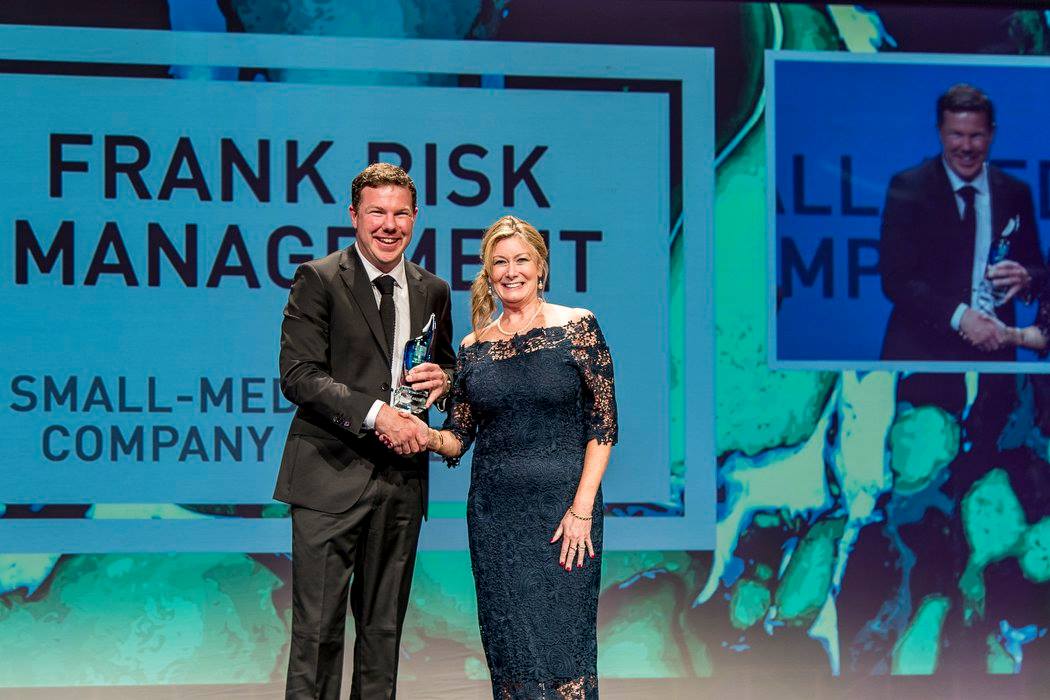
Last night our friends and colleagues at Frank Risk were recognised with the Australia New Zealand Institute of Insurance and Finance (ANZIIF) Small-Medium Broking Company of the Year Award. This is the second year in a row they have won the award.
Frank Risk Management is very special to the team at initio, as the co-founder, Rene Swindley, is also the co-founder of initio. We are very proud of the achievements of Rene, Andrew Newman and the rest of the Frank team.
Also, congratulations to our partners, NZI, for taking out the Intermediated Insurance Company of the Year Award.