Search results for: {search_term_string}/get-quote
Initio is pleased to announce that it has teamed up with Bookabach to provide insurance for holiday homes and baches that are rented out on occasion. Our specialist rental property insurance policy has been tailored to meet the needs of properties with long term tenants and also those properties which are rented out on a short term basis (eg holiday homes).
If you own a holiday home and this sounds like you…. Even if you don’t rent it out that often, our policy is for you.
The main question is do you have the right covers. Your existing insuring may take exception to the fact that your property is let our on occasion. Get it right from the beginning and insure with initio.
See the recent bookabach article for some great things to think about: Got insurance (no, Really)
This guide answers common questions about landlord insurance, tenants, and property use — including how family arrangements or business activities can change your cover.
Do I need to notify you when my tenants change?
You don’t need to notify us every time a new tenant moves in. But to stay covered under your landlord insurance, you must meet the landlord obligations:
- Choose tenants carefully
- Keep records of pre-tenancy checks
- Complete inspections at least every 3 months, and at every change of tenants (with written records and photos kept on file)
You can review these in more detail on our landlord obligations guide.
“Tools like myRent can help with tenant checks, tenancy agreements, and ongoing property management — it’s a handy way to stay organised and meet your landlord obligations.”
If the change involves a different type of tenancy – for example, switching to short-term guests or another arrangement that could affect your cover – please let us know so we can check you’re on the right policy wording. You can also compare our options on the ‘help me choose’ page
My family member ‘rents’ the house – what kind of policy do I need?
If a family member lives in the home and pays rent under a tenancy agreement, you’ll usually need landlord insurance. This gives you cover for things like loss of rent or intentional damage by tenants. Read more on our landlord insurance page.
If it’s a second dwelling on your property that a family member lives in permanently and you don’t want/need specific landlord benefits such as loss of rents , this usually requires a separate own home policy for each dwelling. More details are here: second dwelling – family lives in it.
Examples:
- Your brother pays rent and you want to cover that rent income → landlord insurance
- Your parents live in a granny flat rent-free → own home insurance
What if my tenant wants to run a business from my rental?
Your tenant is responsible for arranging their own commercial insurance to cover their business activities. This is separate from your landlord insurance and not something we provide. See our guide: When do I need commercial insurance?
If the business changes the way the property is used (for example, a salon, office, or childcare), it could affect whether we can provide cover. Get in touch with us if you’re unsure – we’ll be happy to review your situation with you.
Ready to make the switch to initio? Start with a quote
Related articles

We currently offer Landlord insurance, Landlord insurance for multiple attached units, Own home and contents insurance, House flip insurance, Car insurance, Holiday home insurance and we also have an add-on for Short term paying guests insurance (e.g. Airbnb) for your home or holiday home.
All our policies are underwritten by IAG New Zealand Limited (IAG). IAG has received a financial strength rating of AA from Standard & Poor’s (Australia) Pty Ltd, an approved rating agency. Learn more about financial strength rating.
We’re constantly working on new and exciting products and features that are designed to improve our customers experiences. We would love to hear your feedback.
Get a quote
Related Articles:
Navigating the intricacies of insuring a home with an attached flat in New Zealand, especially one that is rented out part-time, can be overwhelming for landlords and property investors. At Initio, we are dedicated to helping you make sense of these complexities, equipping you with the tools needed to make the right insurance choices for your unique situation. This article is specifically designed to assist you in understanding the process for homes with attached flats rented out occasionally.
Guidelines on Insuring Your Home and Attached Flat in NZ
If you happen to own a home with an attached flat rented out occasionally, you may find yourself unsure about how to secure the right insurance coverage. This situation differs from one where both units are exclusively used as long-term rentals (which are catered for by our multi-unit policy). Insuring a property where you live and have an attached flat rented out part-time necessitates a more nuanced approach.
Here’s what you need to know:
- Own Home policy: This policy has been crafted to cover the portion of the property that you inhabit.
- Landlord/Rental policy: This policy needs to be put in place to provide coverage for the attached flat when it’s rented out. Even if the rental isn’t full-time, coverage for the times when the flat is tenanted is ensured by the landlord/rental policy.
Should a significant claim arise, both policies would be engaged, with the combined sum insured being applicable to the whole property.
Why do I need Two Policies?
Each policy is designed specifically to cover one self-contained home/unit only and for the risks associated with the type of occupancy. The Own Home policy provides coverage for the main house/unit where you live, while the Landlord/Rental policy covers your rental home/unit including the legal liabilities and other specific risks associated with renting.
Conclusion
The process of insuring a home with an attached flat, rented out on occasion, needn’t be a difficult one. With an understanding of how Initio’s insurance products can be strategically combined, comprehensive protection of your property is ensured. Additional information on this topic, as well as other insurance solutions offered by Initio, can be found here.
Get a quote
Useful links

Reduce your costs, Insure your property online
We know house insurance. Initio is NZ’s specialist in house insurance. We can insure your own home and contents, holiday home or your rental property.
Its risky being a landlord. With a policy designed just for property owners, Initio has you covered with replacement home insurance and landlord insurance.

You can buy a policy today, and for a future effective date within the next 30 days. We’ll ask you to enter a cover start date on the initial quote page before proceeding to the application form.
Purchasing a new house
If you’ve purchased a house, you should set the cover start date as the same day as the settlement date for the purchase. This means your insurance will start when you own the house. We are unable to provide cover prior to the day you become the legal owner.
Changing your insurance company
If you’re changing to initio from another insurer, it’s a good idea to set the cover start date on your new initio policy to the day that your existing policy expires. This way, there is no period where you are not insured.
Ready to get your journey started with initio?
Get a quote
Related articles:
Found intentional damage at your rental property? Don’t worry, your Initio landlord insurance policy covers up to $25,000 of intentional damage by tenants. If you’ve found holes in walls, smashed windows, graffiti etc, please follow our below steps.
What you need to do
- Take photos of the damage – it helps us if scale is provided in the photos, take both close up and pulled back photos
- Get a quote to repair any damage – a room-by-room- itemised quote will speed up the settlement process
- Login to your initio dashboard and select ‘Make a Claim’ on the property. Complete our smart claims process and attach your photos and quotes.
- Hold tight. We will email or call within a business day to tell you what happens next.
- Consider applying to the tenancy tribunal for vacant possession, and to recover any uninsured losses.
Remember the more information the better. We will require other documents such as:
- Tenancy agreement
- The most recent 3 inspection reports
- Tenant references & application
- Or anything you might think is relevant
This can help us determine when damage occurred, and speed up our claims process for you.
What will we cover?
The intentional damage caused by the tenant is covered. However, bear in mind that insurance is designed to help you recover from unexpected sudden losses, but does not cover damage that has occurred throughout the tenancy. Like all insurance, an excess will apply to each damage incident.
If there has been damage from one event – such as an out of control tenant party – all the damage could be covered under one excess. However, if any of the damage has occurred throughout a tenancy, multiple excesses will apply.
What won’t we cover?
House insurance covers sudden and unexpected events. We understand that there can be other areas of damage or neglect to your property. Unfortunately, insurance cannot cover everything!
- Rent arrears
- Wear and tear
- Rot or other gradual deterioration
- Rubbish removal
- Cleaning costs
- Gardening costs
- Repairs under excess
- Removal of tenants belongings
Some of your ‘uninsured losses’ can be claimed back via the tenancy tribunal.
FAQ’s
Am I covered for loss of rent?
If the home is so badly damaged that it is deemed ‘uninhabitable’, you might be entitled to loss of rent. ‘Uninhabitable’ means unable to be lived in. For example, no access to kitchen or bathroom facilities, water or electricity. There is no cover for loss of rent if the repairs are just cosmetic (carpet/painting/plastering etc).
Will initio send an assessor?
If damage is significant and needs further examination we may get an assessor to your property. Usually, if the damage is likely to be under $5,000 then we are happy to proceed based on photographs and formal written quotations.
What is my excess?
Your standard policy excess will apply. This amount is chosen when you first purchase your policy. If you can’t remember, check your policy schedule which you can find on your dashboard.
Can I use my own repairer or does initio have companies I must use?
You can use any repairer or supplier you like as long as their costs are reasonable. Please make sure you are happy with the standard of work they provide.
Related Articles:
Smart moves, part IV

In the fourth part of our chat with Graeme Fowler, we dig into risk – where it comes from, how to think about it as a property investor, and why you shouldn’t assume location alone will keep you safe.
Do natural disaster risks influence where you buy property?
“Not really. Any location can be hit. Look at Cyclone Gabrielle – it hit parts of the country hard, but none of my properties were affected. That wasn’t strategy – that was just luck.”
Graeme believes that chasing the “perfectly safe” location is unrealistic. Disasters don’t follow predictable maps, and if you’re insured properly, where your property is becomes less important than how it’s protected.
From initio: our quick quote tool, shows your property’s natural hazard profile upfront.
Do you consider climate risk in your buying strategy?
“I’m aware of it, but I don’t let it stop me. What matters more is making sure you’re insured properly – because whether it’s a storm, fire, or flood, anything can happen.”
Graeme says the best protection isn’t where you buy – it’s what you’re covered for.
From initio: Our landlord policies include comprehensive cover for events like storms and floods. But having the right type of cover is only part of the picture. It’s just as important to make sure your sum insured is accurate. This is the maximum amount your property will be rebuilt for after a total loss, so it needs to reflect today’s building costs – not what it might’ve cost a few years ago. You can check and update your sum insured anytime through your online account. Not sure how to calculate your sum-insured? The Cordell Sum insured calculator is a great place to start.
So, how should landlords think about risk?
“You can’t avoid it entirely – so accept that some risk is part of the game. Just make sure it’s managed. For me, that means keeping insurance current and making sure I’ve got enough cover.”
Graeme suggests thinking about risk as part of the cost of doing business, not something to fear, but something to plan for.
From initio: Risk management is at the core of what insurance does – we carry the risk for you. That’s what you pay us for when you buy a policy: to take on the financial risk of the unexpected, so you don’t have to.
Location plays a big role in how risk is assessed. Some properties sit in higher-risk zones – floodplains, liquefaction-prone areas, or coastal regions exposed to storms. But risk isn’t just about the region. Two houses on the same street can have different risk profiles based on their floor level, drainage, slope, or construction.
That’s why we do the heavy lifting in the background. Our system automatically pulls up-to-date risk data from government hazard mapping, scientific assessments, and advisory updates. When these maps change, due to new modelling or recent weather events, we update our software accordingly.
Our quick quote tool includes these insights from the start, showing you a property’s natural hazard profile upfront. So you’re not just getting insurance – you’re getting a risk management tool that helps you make smarter decisions.
When you quote or renew your policy, we make it easy to check your current risk profile, coverage level, and any potential gaps. If something doesn’t look right, we’ll let you know.
What’s your advice to landlords who worry about “what if” scenarios?
“That’s exactly why you have insurance. Fires happen. Storms happen. And sometimes you get lucky – but sometimes you don’t. The point is being prepared either way.”
Coming up next in the Smart Moves Series:
Is self-insurance ever a smart move for landlords? (Spoiler: Graeme says no.)
Want the quick version?
We’ve pulled together the key takeaways from this series into our Landlord Insurance Fundamentals Guide—including a bite-sized version of our interview with Graeme Fowler. It’s a great place to start if you’re after a practical overview of insurance essentials for NZ landlords. Read it here
Related support articles:
Have peace of mind, knowing you have a tailored house and landlord insurance policy that’s right for you. Enjoy some of the best coverage, and get it instantly online – no fuss, no stress.
[initio_cover_type_cards]
Who is initio?
Founded in 2011 by landlords, Initio is a New Zealand owned online house and landlord insurance provider. We love being online, but you can still get hold of us via phone or email. You won’t get the run-around from a call centre – we pride ourselves on personally answering our phones and emails. We’re setting a new standard for house and landlord insurance; we’re online and we put you, our customer, first.
Who backs us?
We’re underwritten by New Zealand’s largest insurer, Lumley, a business division of IAG New Zealand Limited. This means you can rest assured knowing that no matter what happens, your house is in good hands. Learn more about IAG’s financial strength rating.
What happens if I need to make a claim?
You see value from your insurance cover when it comes time to make a claim, and that’s why we make it easy. At Initio we take each claim seriously, and should you suffer a loss, we are here to help. You can easily lodge a claim online, but if you prefer email or phone support, our team is happy to assist. Find our contact details here.
Get Quote View Policy Wording PDF Rebuild Calculator
[initio_quote_calculator title=”Instant free quote & buy online”]
Updated 24 June 2025
Terms and Conditions
Initio is excited to offer a promotional event that considers both new and existing customers who have come via the myRent partnership. This promotion is structured into two main components and is subject to the following terms and conditions.
Promotion Period
This promotion is active for a three-month period, concluding on 1 November 2025. Participation is open throughout this timeframe.
Eligibility
- Quote Generation:
- Open to all New Zealand residents who generate a full insurance quote for a property registered with MyRent using any New Zealand address on the initio platform during the promotion period.
- MyRent members with active policies from initio automatically receive five entries for each policy held with initio at the end of the promotional period.
- Only addresses that have been through to the ‘See full quote’ page qualify for the draw.
- Quotes must be generated via the partnership landing page www.initio.co.nz/myrent
- New Policies:
- This component rewards every individual who signs up for a new policy with initio during the promotional period where the property is also registered with MyRent.
- This is a promotion for new customers only – one per customer.
- To qualify for the prize, please sign up through initio.co.nz/myrent.
- One prize per customer: Participants who sign up for more than one policy will receive only one prize, regardless of the number of policies purchased.
Prizes
- Main Prizes: There is one main prize available, a Eufy Security Indoor/Outdoor home security kit, valued over $1000. This will be allocated to entrants of the quote generation draw.
- New Sign-up Rewards: Individuals who sign up for a policy with initio during the promotional period will receive a Eufy Security C210 2K SoloCam, valued over $100 RRP
- Prizes depend on availability. The value of the prizes will be equal to or greater than before, the brands of the prizes may change or the cash equivalent will be offered.
Selection and Notification of Winners
- Winners of the main prizes will be chosen randomly from all eligible entries after the promotion ends.
- Prizes for new policies will be sent after the promotion ends.
- Prize winners will be notified via email or phone within one week of the draw.
General Conditions
- Initio reserves the right to modify or terminate the promotion (including the prize if needed for supply reasons) and these terms and conditions without notice.
- Participation authorises initio & MyRent to use the participant’s name and photograph for promotional purposes without further compensation.
- Employees of initio and MyRent – and their immediate family members – are ineligible to participate.
- Both offers are available to all New Zealand residents aged 18 and over.
- Prizes will be sent to New Zealand addresses only.
- The decisions of initio regarding all aspects of the promotion are final and binding.
Privacy
- Participant information will be processed in accordance with our Privacy policy, exclusively for the purpose of this promotion.
By taking part in this promotion, participants agree to these Terms and Conditions.
For many people, insurance is the ultimate grudge spend. Along with council rates it typically represents one of the most significant expenses associated with home ownership.
Because of the intangible nature of insurance, and its status as everyone’s most hated expense, the insurance industry often gets a bad reputation from the public. Currently, the insurance industry in New Zealand is facing all-time lowest levels of trust among the general public. Here at initio, we are challenging this and the traditional practice of insurance by making insurance easier and more accessible.
To help increase the trust we thought we would break-down the top house insurance myths we encounter:
1. “I have paid my premium, why do I have to pay an excess?”
A common grievance towards insurance companies arises from the customer’s responsibility to pay their excess come claim time. It may seem unreasonable to have to contribute the excess cost towards your claim when you have already paid for your premium. However; there are good reasons that insurance companies will charge an excess:
a) To avoid small claims
If there was no excess on insurance policies then people would rightfully be able to lodge small claims (think $80, $50 or even $10) that would make up a significant portion of total claims. Management, payment, and processing of claims is one of the largest operating costs of an insurance company. For example, for most clunky insurance companies to process a $150 claim, is more than the value of the claim itself. A high volume of such small claims would bloat the expenses for the insurance company, ultimately resulting in higher premiums for customers. Charging a minimum excess is the insurance company’s way of keeping premiums down while making sure they are covering the important stuff – not every broken toy or sock lost in the washer.
b) As a measure of self-insurance.
Insurers also give the option to customers of a higher excess above the minimum. This is a means of self-insurance where those that are more willing to cover additional costs towards a claim can get a reduction in premium via an increase in their excess. Initio for example provides the option of a $2,000 house insurance excess – which was as a result of customer feedback.
2. “Insurers will screw you over with the fine-print”
Whether it’s from a bad claims experience, or a general distrust for insurance companies – people often hold a grudge against insurers. Customers often think insurers are looking for a way out of paying claims and that they will use the fine-print to do it. This may reign true, however will usually reference back to conditions included in the policy wording – and hence the insurance agreement.
The problem isn’t the fine print, the policy wording didn’t change from when the cover was started. The argument is more around the interpretation of the policy and we are the first to agree that this isn’t always straightforward. Policy wordings need to get rid of the jargon and be written in plain english.
At initio, we are taking the Reserve Bank’s (New Zealand’s Financial Regulator) recommendation for clearer, more understandable insurance very seriously. We have prioritised easy to understand policy wordings, compiled to clearly show details of our customers cover, and published real life examples of claims we have paid and scenarios that are not claimable.
Whilst we don’t expect everyone to read each policy wording back to front, there are parts of our policy that are very important to be known to the customer. Therefore it is important for people to take time to get familiar with the useful policy information we provide so that they are not left surprised with unexpected conditions in the event of a claim.
To read our full Home and Contents policy wordings please visit the following links:
Home Insurance
Contents Insurance
For a useful comparison between our policy wording and other covers across popular insurers in New Zealand, visit https://initio.co.nz/#comparison
3. “Insurance companies are just there to make profit not friends”
Perhaps the most truthful stereotype we hear is that people believe insurance companies are there to make money. While this is true; companies have an obligation to shareholders to return a profit, they also have an obligation to pay claims. If insurers were forced to pay out the same amount that they received in premiums and were essentially not there to make money, no insurance companies would exist. Like any business there are various operating costs for an insurance company that include managing claims, administration costs, reinsurance (insurance for insurance companies) and many more.
An insurance company will aim to adjust their price and policy so that the amount paid out for claims is less than that received in premiums. The proportion of this is called the insurer’s ‘loss ratio’. Historically, a domestic house insurer might set up their strategy and pricing to aim for a loss ratio of 60%. Then once the costs of operating the company (including significant re-insurance costs for widespread earthquake losses) are deducted, an approximate profit margin of 3-8% on the original premiums received might be earned by the insurance company – although this varies based on good and bad years.
When you purchase insurance you are buying a product that gives you peace of mind that you are covered when disaster strikes. Like any other product you buy, the seller needs to make a profit to survive. Effectively with insurance you are pooling your premiums with other customers to receive protection should something go wrong. The insurance company is the administrator of these funds and takes the risk (and the margin) of doing so.
4. “You’re better off not bothering with insurance and having your own emergency fund”
Perhaps a myth popular with those who most distrust insurance companies is that you are better off forgetting about insurance completely and putting away the money you save on premiums each year into your own ’emergency fund’. This is the most extreme case of self-insurance. This could certainly be a practical solution for the most disciplined people with a comprehensive approach to reducing their risk. However, there are some obvious pitfalls and major challenges to this approach.
You are likely to experience several years where you are effectively un-insured while you build up your fund. After a number of years have passed you might have saved enough to adequately cover minor losses. However, it will take many many years; if not your whole life, to accumulate enough for a worst case scenario loss. If you put aside $1,500 a year for 50 years at current interest rates you would save $127,000, which seems reasonable, but when you adjust for inflation, that $127,000 only represents $47,000 of todays money. Would that be enough to replace your home and contents in a total loss fire? And could you trust yourself not to ‘borrow’ from the fund? The decision to take out insurance can have a life changing effect on you in the event of a disaster – for the better or the worse.
Remember that when you purchase insurance, not only are you buying cover when things go wrong – but you are obtaining piece of mind to enjoy a less stressful life.

Useful articles
As 2025 comes to a close, we want to take a moment to reflect on some of the ways we’ve helped our customers this year. It’s been a year of quick claims and responsive support at initio – all driven by our core values of customer satisfaction, speed, and making insurance easy. From fast claim resolutions to lightning-quick answers on our support lines, 2025 showed what our team and technology can do to take care of you when it matters most.
Ways we’ve helped our customers with their claims
When it comes to insurance claims, we know you want a swift, clear outcome. In 2025, our claims team made sure “waiting around” was rarely part of the experience. Many claims were sorted out within just a day of being lodged – yes, some were literally resolved overnight. A large number of others were wrapped up within the first week. Nearly half of all claims were resolved within 30 days, with many settled much sooner. Our approach is all about fast assessments and clear communication, so you’re never left hanging.

Speed doesn’t mean we cut corners, even on the tough cases. Big or small, every claim got the same careful attention. We handled hundreds of claims even during the busiest periods (think wild weather weeks and the holiday rush) without breaking stride. And while most claims were everyday-sized or moderate, we also helped customers through some major events – including a few very large claims like house fires and water damage. Those high-value claims were supported just as promptly and compassionately as a cracked window or a burst pipe. Whether it was a minor accident or a serious loss, we followed the same straightforward process and kept our customers informed at each step.

Several clear patterns stood out in our 2025 claims data.
Vehicle glass claims (like damaged windscreens) made up about 12% of all claims. These are the everyday mishaps many drivers run into, and they are usually simple to assess and settle quickly.
Water damage was another common claim type, at around 10% of total claims. While it was not the biggest category by volume, it had a much bigger impact on cost, making up roughly 27% of total payouts. Problems like hidden leaks and burst pipes can get worse fast, so acting early really helps.
At the more serious end, accidental fire claims were uncommon, at about 1% of claims in 2025. But when they happened, they were often significant, accounting for around 12% of total claim costs. It’s a strong reminder that the right cover, plus a responsive claims team, matters most when something major goes wrong.
We also saw how external events can cause short, sharp spikes in claims. 29 April was our busiest claims day of the year, lining up with a bout of severe weather that brought heavy rain and strong winds to parts of the country. As you’d expect, that drove an increase in weather-related claims, with customers reaching out for support when it mattered most.
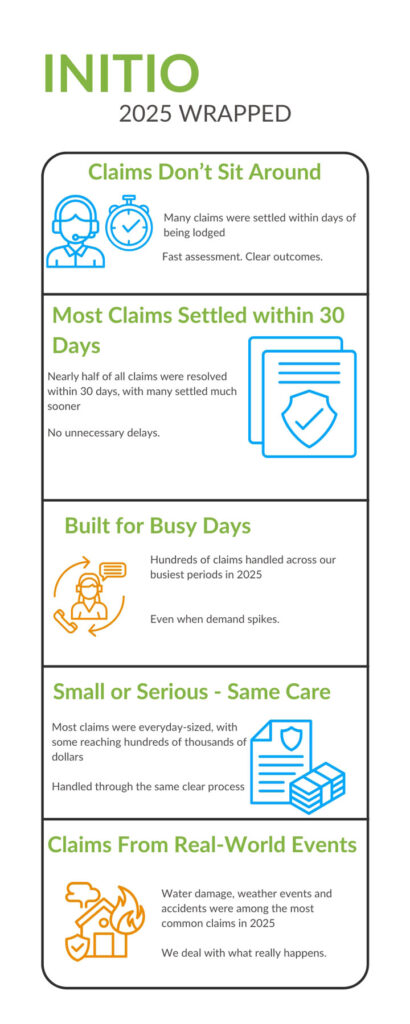
This year, we saw claims for just about everything under the sun (and rain). The most common claims by number were the ones you might expect – accidental damage around the home, car-related mishaps, and weather events. Life happens, and sometimes that means a stray cricket ball through a window, a parking-lot fender bender, or a blustery storm knocking over a fence. These everyday issues kept us busy, but that’s exactly what we’re here for.
Support when you need it
Our commitment to speedy, helpful service wasn’t just on the claims side. The initio customer support team had a standout year in 2025 as well, making it easier than ever for you to get the answers or help you need. We handled over 22,000 customer enquiries throughout the year – and we did so with an emphasis on being both quick and effective. In fact, most customer questions or issues were resolved within about an hour. A huge portion (over 90%) were solved in a single interaction, meaning one call or message was all it took to sort things out. No endless email chains, no multiple phone transfers – just one conversation and you’re sorted. “No follow-ups needed” became a bit of an unofficial motto for us this year, and we’re proud of that.
We also made sure you could reach us in whatever way suits you best. The majority of our customers chose to contact us online – whether by email, live chat, or through their initio dashboard – and they got the same friendly, professional care as if they’d called us on the phone. Of course, whenever a phone call was preferred or needed, we were right there too. Real people, real help, every time. We know sometimes you just want to hear a reassuring voice on the other end of the line, and our phone support team was ready whenever those moments came.
Chatbot Chad played a big part in that easy, quick support experience too. In 2025, Chad handled nearly 3,000 conversations and sent over 7,000 messages, helping customers get answers fast when it suited them. Chad achieved a 95% answer rate, and the vast majority of customers rated their experience with Chad highly, showing that self-serve support can still feel genuinely helpful and human.
Despite handling thousands of enquiries, we didn’t let quality slip during busy seasons. Even in our peak months, response times stayed consistently quick and our service stayed personal. We like to say we’re “built for busy days” – and in 2025, we proved it, delivering the same care and speed no matter how high the volumes got.
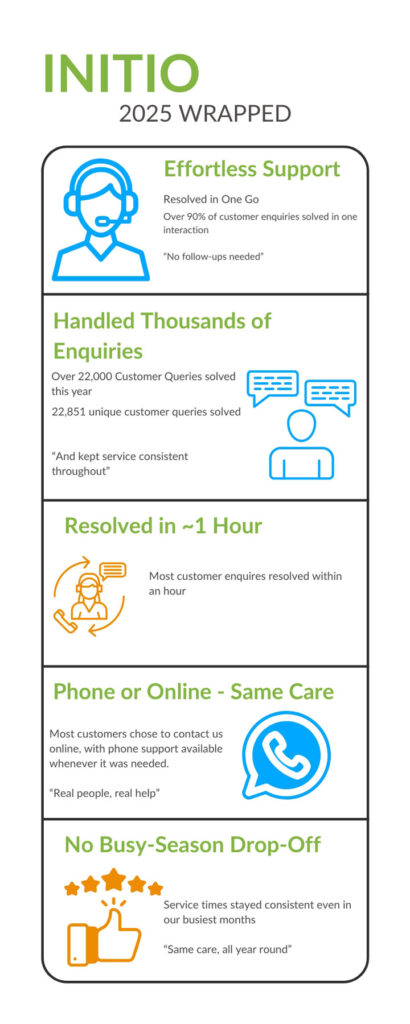
Looking back at these highlights, what makes us happiest is knowing each number represents a customer who got the help they needed and could move forward with peace of mind. Thank you for trusting us with your insurance in 2025 – we’re truly honored to have helped you through everything from everyday hiccups to life’s big storms. We’re excited to keep that momentum going into 2026, with even more improvements on the way to make things faster, easier, and smarter for you. From everyone at initio, we wish you a safe and happy New Year. Here’s to a bright 2026 ahead!
Related articles
Most people do not have the time, or the expertise, to sit down and work out exactly what it could cost to rebuild their home from scratch. If you are looking at your house insurance options, an online house insurance calculator can be a helpful place to start.
It does a lot of the heavy lifting by using property details and current building cost data to give you an estimated rebuild cost. Most of the questions are things a homeowner can usually answer themselves, such as the size of the home, how many levels it has, and what materials it is built from.
Online calculators do not provide advice, and they may not capture every detail that could affect the rebuild cost of your home. Instead, they use the information entered, along with property and construction data, to provide an estimate. If you would like a more tailored assessment for your specific property, a builder, architect, quantity surveyor, or insurance valuation service may be the best option.
It is also important to remember that your sum insured should reflect the cost to rebuild your home, not what you paid for it, what it might sell for, or what the land is worth.
Key takeaways in this article
What is a house insurance calculator?
A house insurance calculator, also called a sum insured calculator, is an online tool that helps estimate how much it could cost to rebuild your home after a total loss.
It is designed to provide an estimate based on typical building replacement costs. It is not intended to provide personal advice, and it may not allow for every detail that affects the rebuild cost of your home.
For many people, it is a practical and straightforward way to get started.

Rebuild cost is different from market value
One of the most important things to understand is that your insurance should be based on rebuild cost, not market value.
The price you paid for your home can include the land, location, school zones, and housing market demand. A rates valuation or QV can also include land value and broader market factors. None of those figures tell you what it would cost to physically rebuild the house itself.
That is why your sum insured should not be based on:
- the purchase price
- the market value
- the rates valuation
- the QV
- the land value
Instead, it should reflect the likely cost to rebuild the home to a similar size and standard using today’s building costs. See ‘Why does my rebuild value change?‘ for more information.
What your sum insured should cover
Your sum insured should reflect the full cost to rebuild your house to its current size and standard.
That can include:
- demolition and clearing the site
- rebuilding the house itself
- current material and labour costs
- architect, engineer, or consent-related costs
- site access or complexity that may make rebuilding harder
Not every property is simple to rebuild, so it is important to think beyond just the floor area.
What can affect your rebuild cost estimate?
A calculator is a helpful starting point, but it may not reflect every detail of your home. That is why it is worth reviewing the result carefully, especially if your property is more complex than average.
Renovations, unusual features, and non-standard materials
The estimate may need a closer look if your home has features that are not typical, such as:
If you have made improvements such as building a deck, installing a swimming pool, adding a new room, or upgrading your kitchen or bathroom, those changes may affect your rebuild cost.
Size, layout, and standard of finish
Rebuild cost is not just about floor area. Two homes of the same size can cost very different amounts to rebuild depending on their design, layout, and level of finish.
Things that can affect the estimate include:
- ceiling height
- kitchen and bathroom quality
- custom joinery
- roof shape
- cladding type
- number of storeys
- architectural design
Site access and demolition costs
The site itself can also affect rebuild costs. For example:
- steep sections can be harder to access
- tight urban sites can increase labour and delivery costs
- retaining walls or complex foundations can add cost
- demolition and debris removal may be more expensive on some sites
House and contents cover are different
A house insurance calculator estimates the rebuild cost of the home itself. It does not calculate the value of the belongings inside it.
If you also want to know what your contents are worth, that should be worked out separately. House cover and contents cover are designed for different things, so it is important not to mix the two.
Why it is important to review your sum insured regularly
It is important to review and revise your sum insured regularly to help make sure it still reflects the likely cost to rebuild your home.
A good time to review it is when your policy is up for renewal, but you can check and update it at any time.
This matters because building costs can change over time, and your home may have changed too. While your policy may include a general inflation adjustment at renewal, that will not usually account for significant improvements, extensions, or alterations you have made.
If you do not review your sum insured from time to time, you could find yourself overinsured or underinsured at claim time.
When should you get a more detailed estimate?
For many homes, a calculator gives a useful estimate. But you may want a more detailed assessment if your home:
In these situations, a builder, architect, quantity surveyor, or other valuation expert may be able to give you a more tailored estimate.
Why this matters in New Zealand
In New Zealand, sum insured matters because house insurance is generally based on the amount you choose as your cover limit.
That means it is important to choose a figure that feels realistic for your home and its likely rebuild cost. If the amount is too low, it may not go far enough in a major claim. If it is too high, you may be paying for more cover than you need.
Final thoughts
A house insurance calculator is one of the easiest ways to get started when working out your sum insured. It saves time, uses relevant property and construction data, and helps give you a practical estimate without having to calculate everything yourself.
But it is still only a starting point. The most important thing is to check whether the estimate reflects your home, its features, its level of finish, and the likely cost to rebuild it. If you are unsure, getting a more tailored assessment from a builder, architect, quantity surveyor, or insurance valuation service may give you more confidence in the amount you choose.
You might also be interested in:
Frequently asked questions
How do I calculate my sum insured?
You can use an online house insurance calculator to estimate what it may cost to rebuild your home to its current size and standard using today’s building costs. If you want a more tailored assessment, you could also speak with a builder, architect, quantity surveyor, or valuation expert.
Should my sum insured be the same as what I paid for the house?
No. Your sum insured should reflect rebuild cost, not purchase price or market value.
Does my sum insured include the land value?
No. Your sum insured is about the cost to rebuild the house, not the value of the land.
Is a rates valuation or QV the right figure to use?
Not usually. These figures do not necessarily reflect what it would cost to rebuild your home.
How often should I review my sum insured?
It is worth reviewing it regularly, especially at renewal time or after any renovations, extensions, or major improvements.
Written by Toby Pudney – Initio’s Support Team Lead

Toby has been with initio since 2023 and is the Support Team Lead. He brings more than six years of experience in the insurance industry, giving him strong knowledge of general insurance. He has studied with ANZIIF and holds a qualification in New Zealand Compliance for Advisers (General Insurance Broking).
When you have had claims you may have to pay more premium on your insurance. Don’t be offended, insurance companies are just trying to automatically place a price on the risk of the driver. In insurance driving this is called ‘pricing risk’.
Car insurance is a bit different to house insurance in that when you claim on your house insurance the vast majority of the time it is something outside of your control, like a storm blowing your roof off or a burst water pipe.
However, the typical car insurance claim does have something to do with the driver of the car. While it’s not always the case, the driver (and policyholder) can be at fault if they lost control of the car and crashed.
Naturally, some drivers are more likely to have accidents. For example, young inexperienced drivers are more likely to crash than a middle aged driver in say their 40s. Insurance companies will price this difference into their base premium rate calculation.
Even within these groups (i.e. under 25 year old drivers) there are subgroups of drivers that are more prone to accidents.
In general insurance companies try to balance long term claims payment trends between good and bad drivers. If someone uses their policy more and is paid out 1 more insurance is it fair that they pay the same premium as someone that has never made a claim?
The way insurance companies try to gauge this is by assigning a Driver Grade to the person applying for the cover.
This is what they are trying to do when they ask you to disclose how many car insurance claims you have had in the last five years.
Why do we only care about claims in the last five years?
Don’t worry, we (and most insurance companies in general) know and expect that the average driver is going to have a car insurance claim in their lifetime.
People’s driving habits change over time so how you drove 20 years ago is not likely to be reflective of how you drive today. Insurance companies realise it’s unrealistic too look too far back into the past. Someone that had three accidents all over 10 years ago does not reflect their driving today.
Therefore you will only be asked about claims in the last five years. If someone has had 3 accidents or claims in the last five years there is a good chance the driver is more dangerous than the average.
Do I pay an excess when I am not at fault?
If you are at fault for an accident, or admit liability you will need to pay your policy excess on your insurance payout.
If you are not at fault, and you have the details of another party who caused the crash and who admits liability its unlikely you will have to pay an excess.
Some particular items of your policy may not have an excess that applies to the cover. Examples include theft, or windscreen damage. You should check your policy for these.
In all other cases it’s most likely that you will have to pay your excess even if you’re not at fault. If you have a crash with another driver, but you are unable to get their details there’s no definitive proof of who was at fault, and you will generally have to pay the excess on your policy.
How do Insurance companies apply the Driver Grade?
Some insurance companies will ask you to only disclose claims where you were ‘at fault’. We ask you to disclose any claims where you were either at fault, or paid the excess on the policy. We are not saying that every claim where you have paid the excess is one that is your fault, but we are trying to offset and balance premiums between those that have used their policy for payouts, and those that have not. It’s only fair.
Login in to make a claim
Related Articles:
Meth Contamination is one of the largest loss leaders for landlords in New Zealand. Cleaning costs for a well-contaminated house can easily cost over $10,000.
Do I need to test for meth before renting out my property?
Regular meth testing isn’t a requirement under initio’s landlord insurance. However, we recommend testing at key times – such as between tenancies, when buying a property, or if you suspect drug use or manufacture.
With initio’s landlord cover:
- Meth testing and cleaning are covered up to $30,000 if a positive reading over 1.5 μg occurs during the insured period.
- Loss of rent may also be covered while the property is being decontaminated.
For Unlawful Substances liability cover specifically, you must test before and after each tenancy to have that liability protection in place.
For more details, see our guidance and claims info:
When do we cover meth testing and cleaning costs?
If you have our landlord cover and you get a positive reading over 1.5 μg from an event during the insured period, our meth cover applies.
We’ll pay up to $30,000 for testing and cleaning the house back to a level below 1.5 μg. A higher $2,500 excess applies to meth however in most cases this cost comfortably exceeded.
Loss of Rent
It can take several weeks, or even months for a property to be fully cleaned for meth. During this cleaning your property won’t be able to be rented.
Our landlord insurance will also cover the lost rents during this period, over and above the $30,000 limit for meth cleaning. We’ll cover the rents until either the property is cleaned (and can be rented again), or the loss of rent limit you selected on your policy has been reached (usually $20,000).
What do I need to do to have meth cover?
To have meth contamination cover you’ll need to meet our landlord obligations. Please make sure you’re doing these so you’re not caught out when you need to make a meth claim.
For details on when meth testing is required, see here.
What do I need to do to insure a home which already has meth contamination?
At initio, we are unable to provide cover for a home that is already contaminated above 1.5μg/100cm2. If you want to insure a home with contamination above that level, you’ll need to arrange for a professional clean and a subsequent report from the provider confirming the property has been cleaned to below those levels. We can then consider cover for you.
Protect your rental with initio’s landlord insurance
Get a quote in seconds
Related articles:
Insurance made simple when you change homes
Congratulations! You’ve found your new dream home and the day has come for the big move to your new property. But what if something falls off the back of the truck during the move? Does your insurance still cover it? Moving house can be stressful at the best of times, so here are a few simple steps to ensure that at least your insurance is under control.
Firstly, it’s important to remember that your house and contents insurance cover is for a specific address. When you’re moving into a new house and have sold your old house, it’s important to note that you will need to cancel the house and contents policy for your old address and create a brand new policy for your home and contents.
Cancel the home you’ve sold from the sale settlement date and insure the new home from the purchase settlement date. Our system will automatically provide a refund for the unused portion of the cancelled policy.
The new cover will require updated details about your new address, and in some cases these may need to be reviewed by our team. It’s a good idea to apply for cover early – even before you go unconditional – so you know there won’t be any issues insuring the new property. This is especially important for homes that are older, in higher hazard zones, or have unconsented work.
What about contents during the move?
Contents in transit is usually covered by specialty insurance, but your standard owner-occupied contents policy does provide some limited cover.
With initio, your contents are covered for sudden and accidental loss from specified events while being moved from your insured home to another permanent residence in New Zealand. This cover only applies if the loss happens within your insured period.
- Fire, lightning or explosion
- Theft following violent and forceful entry to a motor vehicle or building
- Storm or flood
- Natural disaster
- Aircraft or other aerial or spatial devices, or articles dropped from them
- Impact by motor vehicle
It’s important to know this cover does not apply to accidental breakage or damage – for example, if a box is dropped, something tips over in the truck, or items shift and break in transit. We also don’t offer an option to extend the cover beyond these listed perils.
If you’re making a big move (like between cities) or have valuable items you want extra protection for, we recommend checking the wider insurance options provided by professional moving companies. These can give you peace of mind for risks outside the limited cover in your initio policy.
We’re in between homes, do you offer contents insurance by itself?
We don’t currently offer stand-alone contents insurance. Contents cover is only available when it’s paired with an active house insurance policy for the same property.
If you just need contents cover for a short time (for example, a few days between settlement dates), get in touch with our support team. In some cases, we can help with very short periods of cover.
If you don’t have plans to purchase another home right away but still need contents insurance, you’ll need to arrange this with another provider.
What if your OLD house catches fire and is destroyed on the day you move out?
In this scenario, it’s the new owner’s responsibility to ensure the address on their insurance is up to date. It aligns with the handover date on your sale agreement.
Maybe something was to happen to your NEW house before your official settlement date?
This remains the responsibility of the people you’ve bought the house from. The insurance officially becomes your responsibility from the date of your settlement agreement. You are unable to insure the home for the period prior to the settlement date. On the other hand, if something were to happen to your new house on the day of your official handover, insurance cover becomes your responsibility.
With a self-service platform like initio, making changes to your cover is simple. Start a new policy or cancel old cover in just a few clicks.
That’s it! Just remember, the day you take over the keys is when your new house needs to be insured from.
This guide is intended to be a quick reference when moving house. We recommend reading the full policy wording for the full details of your house and contents coverage.

Related articles
Calculate your contents
As a landlord, you work hard to provide safe and comfortable homes for your tenants. But were you aware that a significant portion of rental-related claims stem from criminal activity?
In 2023, 14% of the claims we processed at initio were related to criminal actions, such as malicious damage, methamphetamine contamination, and burglary. These incidents not only cause stress and financial strain but also unexpected expenses for landlords.
Burglary and theft
As a part of the criminal activity, 30% were related to burglary and theft. This can be a common issue, especially when a rental property is occasionally vacant, making it an easier target due to the absence of people within the home.
Your property being empty for over 60 consecutive days will change your policy terms, and a higher excess of $5,000 will apply if you need to make a claim. If you’re expecting your property to be vacant for reasonably long periods – beyond 60 days, get in touch with us.
Just over 41% of burglary-related claims we received last year were related to theft of copper piping, plumbing, or hot water cylinders!
Not only does this result in stress for landlords to replace these items, it also results in a hefty bill to cover, as well as a potential loss of rent. The average cost for the accepted claim, relating to repairs for our clients last year was just over $8,000.
Our policy offers an automatic benefit for malicious damage, or theft by tenants. 41% of rental-related claims were paid out through our automatic benefit. You can enhance property security with locks and lighting to deter burglars. Consider installing surveillance cameras or alarm systems and maintaining your property adequately. This will help it look lived in as well as deterring unwanted activity.

Malicious damage
Of all the rental-related claims we received throughout 2023, 24% were related to malicious damage. Such damage can occur throughout a tenancy, but we saw 31% of these claims stemming from eviction. In this stressful scenario, landlords face the dual challenge of evicting a tenant as well as addressing significant property damage. These types of claims result in an average claim cost of just over $9,000 – an expensive, and unexpected type of bill!
Fortunately, our landlord cover offers an automatic benefit of $25,000 per event, for claims resulting from malicious damage caused by tenants. Make sure you conduct thorough tenant screenings through reference checks, credit checks and tenancy tribunal history. Also, establish clear lease agreements to minimise risks of eviction-related damage.
In the event that a key is lost or stolen, you can take action and replace it, and initio’s policy has a benefit designed exactly for this! This will help minimise the risk of someone returning while it might be vacant. With our landlord policy, we offer an excess-free keys and locks benefit – where we cover up to $1,000 for the replacement of keys and locks.
Methamphetamine contamination
While not common, this is a costly issue. Across all the criminal activity-related claims that occurred in rental properties in 2023, just over 11% of these claims were related to methamphetamine contamination. While this represents a small percentage, it is the most costly and widespread type of incident to affect your rental property, with an average cost of just over $20,000. Since your property cannot be tenanted when this sort of situation occurs, you as a landlord, will also suffer from loss of rent, another cost that heavily affects you.
Initio’s landlord cover includes an automatic benefit of $30,000 for methamphetamine contamination which will cover the testing, and cleaning costs in the event of a contamination taking place. We also offer an automatic benefit of $20,000 for loss of rent, which can be increased. We are prepared to cover you for this criminal activity as we understand the costs – and time it can take until your property is thoroughly cleaned.
Regular property inspections can help detect early signs of drug-related activity. Also performing reference checks, as well as tenancy tribunal history will help determine in the early stages if they will be good tenants.
Arson
While we only saw one claim relating to arson last year, it can also be the most expensive rental crime-related claim we pay for. This is because a house fire causes extensive damage, which can affect the overall structure of your property. To mitigate this risk, install smoke detectors and fire extinguishers. You could also provide a fire blanket, an invaluable tool for smothering fires. It’s a good idea to have fire safety equipment easily accessible, offering tenants a quick solution to douse flames before they spread.
Check your sum insured
In tough times, lowering your sum-insured to reduce your premium might seem appealing. However, this could lead to ‘under-insurance,’ a risky strategy that could backfire if significant damage occurs. Insurance is there to put you back in the position you were in before any mishaps, and cutting corners on your sum-insured might leave you short when you need support the most. We have seen the occasional customer not having their property fully insured for the right amount. This creates large amounts of stress, so we always recommend reviewing your sum-insured yearly, at the renewal of your insurance policy.
Initio, your partner in landlord insurance
Initio is dedicated to helping New Zealand landlords safeguard their rental properties against unforeseen events. By understanding the potential criminal activities, or accidents, that can impact your investment, you can take proactive steps to protect it. With our comprehensive landlord cover, you can enjoy peace of mind knowing that your property, and your financial well-being, are protected.
Let initio be your partner in navigating the challenges of rental property management. Our goal is to provide the protection and support you need to ensure your rental homes remain safe, secure, and profitable.
Get a quote in seconds
FOR MORE INFORMATION
ARTICLES OF INTEREST:
The statistics presented in this article are based on a comprehensive analysis of claims data from initio for the calendar year of 2023, spanning our entire rental claims portfolio. Please note that all figures are approximate and have been calculated to provide a representative view of the claim trends during this period.
Understanding your cover with initio when you own a lifestyle block or a rural property
Owning a lifestyle block in New Zealand offers the best of both worlds – the comfort of a home and the freedom of rural living. Knowing your insurance policy well is key to ensuring you’ve got the cover you need. Here’s some things to consider when insuring your lifestyle block home(s) with initio. You can get insurance for your home if it’s on a lifestyle property with our standard house and contents cover. However, be aware of a few things, especially if it has extensive fencing, you run a business, or farming activities from your property.
What IS covered
Regarding your home, your policy outlines what is included in the definition section of the policy document. It includes (but is not limited to) the following items, providing they’re used solely for domestic residential (not commercial use, which includes farming) use;
- Outbuildings within residential boundaries*, such as a garage, woodshed, utility shed.
- Driveways of permanent construction that provide access to your home (gravel or shingle driveways are not covered).
- Patios, decks within residential boundaries*.
- Immediate fencing around your dwelling (and alongside the main driveway to the home) – please note that it does not include fencing outside of the residential boundary. In addition, a fence that borders a neighbouring property is covered for your share only (as determined by the fencing act).
- Walls including garden and retaining walls up to $25,000 (can be specified for a higher limit).
- Swimming pool and/or tennis court up to $45,000 (can be specified for a higher limit).
- Permanently sited water storage tank or septic tank.
We also include the following items so long as;
- they’re owned primarily for domestic use,
- but which may also have limited use for rural lifestyle purposes and
- they are not valued above the amounts shown below. If the items do have higher values, then there is no cover unless otherwise agreed and stated on your policy schedule:
- outbuildings that have limited use for rural lifestyle purposes such as for the storage of tools, animal feed, uninstalled equipment, or machinery and vehicles.
- private utility plant and associated equipment, including, but not limited to, wind or water mills, or diesel generators, with a replacement cost of no more than $10,000.
- Any bridge or culvert, permanent ford or dam, with a replacement cost of no more than $15,000.
- Any well or borehole including its pump, lining or casing, with a replacement cost of no more than $10,000.
* Within residential boundaries: In the context of lifestyle blocks, a “residential boundary” refers to the specific area of your property that surrounds your dwelling and is distinct from agricultural or paddock areas.
What’s NOT covered
- Farmer’s liability – Liability arising from farming activities, eg. stock/farm animals escaping and causing damage to third parties.
- Farm fencing (that’s not within residential boundaries*).
- Land outside of what’s provided under the NHC cover (see the link for land NHC will cover).
- Buildings used for business/commercial use (other than a home office).
- Live plants/trees.
- Stock/farm animals.
- Tractors.
- Farm bikes.

Key takeaways
Initio’s policy covers a residential home on a lifestyle block, including some limited farm use of buildings and contents. However, it doesn’t cover liability for farming activities or farming equipment. It’s important to know the exclusions, especially those related to farming activities, natural disasters, and specific property features. Always check your policy details and reach out if you have any concerns.
If you have specific questions, feel free to contact us. We’re here to help you understand and maximize your coverage where we can.
Get a quote
Other articles of interest:
Initio has been named the Fastest Growing Services Business in the 2025 Deloitte Fast 50 for the Central North Island region.
The Deloitte Fast 50 recognises high-growth New Zealand businesses that are scaling rapidly through innovation, technology, and strong market demand. A few weeks after the regional results, initio was also ranked 28th nationally across all New Zealand companies in the 2025 Deloitte Fast 50.
Quick summary
-
Initio named Fastest Growing Services Business (Central North Island, 2025)
-
Ranked 28th nationally in the Deloitte Fast 50
-
Recognised for strong growth as a New Zealand-only insurance provider
-
Growth driven by digital-first insurance and technology innovation
-
Backed by IAG NZ investment and underwriting support

The Fast 50 celebrates Kiwi businesses that are shaking things up – growing fast, breaking barriers, and doing things differently. So, to be recognised in that crowd means a lot.
What is the Deloitte Fast 50?
The Deloitte Fast 50 is an annual programme that celebrates the fastest growing companies in New Zealand, measured by revenue growth over a three-year period.
It highlights businesses that are:
-
Scaling quickly
-
Innovating within their industries
-
Building sustainable growth models
-
Contributing to New Zealand’s economic landscape
Being recognised in the Deloitte Fast 50 signals strong demand, operational strength, and market confidence.
Standing out as a New Zealand-only insurance provider
What makes this recognition particularly significant is that initio operates solely within New Zealand.
Unlike many companies in the Fast 50 that have international markets or offshore expansion strategies, initio focuses entirely on Kiwi homes and properties. Growth has been driven by serving the local market with a digital-first insurance experience built specifically for New Zealand conditions.
This shows there is strong demand for:
Ranked 28th nationally
Following the regional announcement, Deloitte released the national rankings. initio was placed 28th across all New Zealand businesses in the 2025 Fast 50.
Ranking nationally reinforces that this growth is not just regional momentum, but part of a broader shift toward smarter, technology-driven services.
Growth powered by digital insurance innovation
initio’s growth has not been about speed for its own sake. It has focused on removing friction from insurance.
That includes:
The result is insurance that works quickly behind the scenes, so customers do not have to wait on hold, fill in long forms, or deal with paperwork.
Technology backed by people
Strong technology alone does not drive sustainable growth.
The real momentum comes from the team building and improving the platform every day. From software development to claims support, the focus remains on making insurance simpler, clearer, and easier to manage.
Recognition from Deloitte confirms that a technology-led, customer-focused model can scale successfully in New Zealand.
IAG NZ partnership supports future growth
initio’s partnership with IAG NZ strengthens the foundation for continued growth.
With IAG NZ’s underwriting support and investment, initio can:
-
Expand product offerings
-
Continue enhancing its digital platform
-
Introduce new features and tools
-
Maintain high service standards while scaling
The partnership supports long-term growth while preserving the digital-first experience customers expect.
What this means for customers
Awards are encouraging, but the real outcome is improved service.
Growth enables:
-
Faster platform improvements
-
Broader product options
-
Stronger underwriting support
-
Continued investment in technology
The focus remains on protecting Kiwi homes and properties with simple, modern insurance.
Thank you to our customers and partners
This recognition reflects the trust of customers, the support of partners, and the dedication of the initio team.
Growth is not an end point. It is momentum.

Related articles
Smart moves, part II
In the second part of our interview with experienced investor Graeme Fowler, we unpack how insurance decisions can impact your bottom line, especially when it comes to excess, premiums, and payment timing.
How do you decide on the right excess?
“I always choose the highest excess available, usually around $2,000. That helps lower my annual premiums quite a bit. But if you’ve only got a couple of properties, a lower excess might make more sense.”
Graeme treats excess like any other business decision: it comes down to scale and risk tolerance. For those with larger portfolios, absorbing the occasional small cost can be a smarter long-term play.
From initio: When quoting with initio, you can select an excess from as low as $400 up to $2,000. The premium updates instantly as you adjust the excess. A higher excess = lower premium, but the right choice depends on how often you expect to claim and what you can comfortably afford to self-fund. Learn more about insurance excess: Demystifying Insurance Excess

What’s your take on how to pay for insurance?
“I always pay annually. Monthly payments might feel easier, but they usually end up costing more. Over a year, you could save quite a bit by paying in one go.”
For Graeme, annual payment isn’t just about cost – it’s also about efficiency. One payment, done and dusted.
From initio: Our quick quoting tool shows the full cost upfront, with a clear breakdown of monthly vs annual payments. Monthly might feel easier, but it comes with a life admin fee – plus, annual is usually better value. And honestly, how much is your time worth? Adjust your excess or add contents and the quote updates instantly. It’s fast, clear, and makes insurance simple.
How do you view insurance as part of your overall investment strategy?
“It’s one of those things that, if you get it right, saves you money quietly in the background. If you get it wrong – or ignore it – you’ll know about it quickly.”
Graeme treats insurance like any other portfolio tool: it should be optimised, not just set and forgotten. Managing excess, timing payments smartly, and locking in renewal rates all contribute to a more efficient portfolio.
From initio: With our digital platform, you can manage all your policies in one place – tweak cover levels, update payment settings, and renew when it suits you. We also send early renewal reminders and show any pricing changes upfront, so you can stay ahead of known levy increases.
Coming up next in the Smart Moves Series:
Common landlord insurance mistakes – and how to avoid them.
Want the quick version?
We’ve pulled together the key takeaways from this series into our Landlord Insurance Fundamentals Guide—including a bite-sized version of our interview with Graeme Fowler. It’s a great place to start if you’re after a practical overview of insurance essentials for NZ landlords. Read it here
Related support articles:
Hamilton, New Zealand – 1st October 2019
Specialist online property insurer, Initio, has been named as a finalist in the 2019 New Zealand Insurance Industry Awards, run by the Australian and New Zealand Institute of Insurance and Finance (ANZIIF). Nominated as ‘Innovation of the Year’, the Waikato-based insuretech is being recognised for its customer-centric digital insurance products that enable customers to instantly change and update their policy themselves online.
This innovation, called Live Policy, was launched in October 2018. The product promotes instantly modifiable house and contents insurance: self-service innovation that enables customers to modify, add to, start or stop their house and/or contents insurance policy as and when they need to. The customer simply logs into a personalised dashboard to edit the detail, with any policy changes effective immediately.
The traditional process of modifying an in-force insurance policy remains clunky, with other insurance companies requiring additional human input and manual confirmation of policy changes from the insurer or broker.
“Live policy is about giving the customer total control over their insurance, without having to wait,” said Initio CEO, Rene Swindley.
“We found that many customers would set up their insurance online only to want to change something after the policy was created. These changes included things like increasing the insured value, updating an insured or interested party, adding specified contents items, such as jewellery, and simple fixes like a spelling error in their name or address.
“We felt that in allowing customers to modify their insurance when they wanted to, we added significant value to a more transparent and responsive insurance experience – the way insurance should be.”
In addition to Live Policy, Initio is improving the end-to-end claims process; currently able to pay simple claims to the customer in under an hour, the company’s mission is to pay out to customers just as fast as customers purchase their premiums online – in seconds.
When Initio was founded in 2011, it was transformative in giving homeowners and landlords the ability to effortlessly quote and purchase house insurance online in real time through its website, initio.co.nz.
Setting out to make insurance less complicated, Initio was the first provider in New Zealand to bind and receipt payment for a house insurance policy, 100% online with no human intervention, and since then has completed over 30,000 automated insurance transactions online. Remaining at the forefront of insuretech in New Zealand, Initio continues to challenge traditional insurance processes by developing innovations and claims experience that make for a far superior customer experience.
The ANZIIF New Zealand Insurance Industry Award Winners will be announced on Wednesday 27 November at the Cordis in Auckland.
For more information on the ANZIIF New Zealand Insurance Industry Awards, visit https://anziif.com/events/nz-insurance-industry-awards/2019–finalists
For further information or to arrange an interview with Rene, please contact:
Kelly King
022 045 5933
[email protected]
About Initio
Initio is a New Zealand-based online insurance provider, insuring over $2.5 billion in property. Founded in 2011 by a couple of Kiwis, Initio set out to change the broken insurance industry by using technology to put control back into the hands of the customer.
Covering landlord insurance, short-term holiday rentals and home and contents, Initio specialises in tailored online property insurance, including an all-in-one landlord insurance with built-in cover for loss of rent and damage by the tenant.
Having completed over 30,000 automated insurance transactions, Initio’s market-leading policies can be quoted, bought and amended online – all in an instant.
Initio is underwritten by NZI, a business division of IAG New Zealand Limited.
Gradual water damage claims are not always straightforward.
Home insurance protects you from sudden damage like a burst water pipe. But gradual damage over time generally isn’t covered. There’s an exception to this. Most house insurance policies in New Zealand have a extension for Hidden Gradual Water Damage.
However, there’s certain conditions that need to be met to make a claim for this cover.
When can I make a Gradual Water Damage Claim?
Damage needs to be hidden, and caused by an internal water pipe or tank.
Essentially the water damage or leak needs to be hidden from the naked eye. If the leak isn’t hidden there won’t be cover as the damage could have been prevented.
Cover is specific. The source of the water damage needs to come from a tank, hot water cylinder or water/waste pipe.
Examples of Hidden Gradual Damage Claims:
- Sink waste pipe behind kitchen bench top was leaking which damaged and moulded below cabinets.
- Shower’s pressure pipe behind wall was leaking and slowly rotted wall lining and floorboards.
- Broken valve on hot water cylinder leaks water down the inside wall and swells the wooden flooring.
How much cover do I get?
Most house insurance policies have cover for this but with a limit. The limit can range from $1,000 to $5,000 and your excess is taken from the limit.
Our home insurance includes $3,000 of cover.
What will not be a Gradual Water Damage Claim?
The conditions are narrow. Any damage from a leak you can see, or one that doesn’t come from a pipe or tank is unlikely to be covered.
Examples that won’t meet the conditions for a Hidden Gradual Damage Claim:
- Leaking window frame causes rain to leak onto the window sill and rot.
- Water leaking onto the floor from a faulty washing machine (unless the leak was from a hidden pipe).
- Damage to the carpet caused by moisture from a potted plant.
What if I’m not sure what type of damage it is?
It’s hard to know exactly how the damage has occurred or where it’s coming from. If you’re not sure we recommend getting a repair quote from a tradesperson ask them to include their opinion on how the damage happened.
Is the leaking pipe itself covered?
Your insurance cover will protect you for the damage that results from the leak.
The cost to fix the leaking pipe itself; or the actual cause of damage won’t be covered. Insurance will pay to repair the resultant damage, but fixing the faulty pipe or equipment will be your responsibility as a homeowner. In most cases this cost is a small part of the total repair costs.
Learn more about the cause of damage here.
Hidden Gradual Damage Claim Example
A tenant discovers the kitchen floor is spongy under the lino where the water pipe for the cold tap had been slowly dripping. Over time the kitchen cabinet swelled causing the particleboard to deteriorate. The landlord gets a builder to quote the cabinet repairs and a plumber to fix the leaking pipe.
| Item |
Amount |
Claimable? |
| Sink Cabinet Panels |
$866 |
Yes |
| Fixing, Screws, Glues |
$63 |
Yes |
| Particle Board Sheet |
$110 |
Yes |
| Builder’s Labour |
$590 |
Yes |
| Relaying of Lino |
$783 |
Yes |
| Piping Replacement |
$25 |
Not included in cover |
| Plumber’s Labour |
$100 |
Not included in cover |
| Total Repair Costs |
$2,500 |
| Less costs not claimable |
$125 |
| Total Claimable Costs |
$2,375 |
Your standard policy excess will then be taken out of your payout.
Related Topics:
Smart Moves. Part I
Welcome to Smart moves: Insurance insights for property investors – a straight-talking series built from an in-depth interview with seasoned investor Graeme Fowler.
With decades of experience and a sizable rental portfolio under his belt, Graeme shares how he approaches insurance as a key part of successful property investing. From managing risk to avoiding costly mistakes, each article offers practical, no-fluff advice for landlords who want to protect what they’ve built.
The first article in the series explores why insurance isn’t just a checkbox – it’s a must-have for every property investor, no matter the size of their portfolio.
Why do you think insurance is essential for rental properties?
“Insurance is a must-have. I’ve been investing in property for years, and over that time, I’ve had to make a handful of serious claims, usually for accidental fires. A couple of those meant tenants had to move out for months. Without insurance, the financial hit would’ve been huge.”
Graeme says he always makes sure each of his rental properties is covered with a standard insurance policy. While some landlords opt to include extras in their cover, it’s not something he prioritises.
From initio: All our rental property policies come with full replacement cover for sudden and accidental damage, along with automatic protection for things that many other providers charge extra for. What does this include? Loss of rent, methamphetamine contamination, and liability is part of our landlord insurance automatically.. It’s all included as standard – no add-ons, no need to build your cover piece by piece. Just smart, all-in-one protection that actually reflects how landlords use their properties.
What have you learned from making claims?
“Things can go wrong every few years, and when they do, it’s usually not minor. The biggest issue I’ve had was a fire that forced the tenants out for quite a while. That’s not something you want to try to absorb out of pocket.”
Graeme says it’s important to treat insurance as protection, not just another expense. His advice to newer landlords: “Don’t assume you’ll never need it. Sooner or later, you will.”
From initio: We’re here to protect what matters – because when things go wrong, they can go really wrong. We’ve seen too many Kiwis caught out without the right cover (or any cover at all), left to absorb huge costs on their own. That’s where we come in. You pay us to take on that risk, so you’re not left footing the bill when disaster strikes. Whether it’s fire, flood, or the unexpected, we step in when it counts. That’s the whole point of insurance, and why getting it right from the start matters.
What’s your approach to excess and premium payments?
“I always choose the highest excess I can, usually around $2,000. That keeps my premiums lower. But if you only own a couple of properties, a lower excess might be the safer choice.”
Graeme also avoids monthly payment plans.
“I always pay annually as it tends to be cheaper in the long run. And if I know the earthquake levy’s going up, I’ll renew early and lock in the lower rates. That’s saved me thousands across my portfolio.”
From initio: Our quick quote tool puts you in control. You can clearly see the full cost of your insurance, broken down by annual and monthly payment options, before you commit. Want to tweak your excess or add contents cover? The quote updates instantly, so you can find the right balance for your needs and budget. It’s clever, fast, and designed to make complicated insurance simple.
Do you add extras, like loss of rent cover?
“Only if it’s already included. I don’t usually add it as an optional extra.”
From initio: Our cover is comprehensive from the get-go – we include the things that matter, without charging extra for them. Other providers might treat them as add-ons, but with initio, they’re built in.
Do location risks change how you invest?
“Not really. Natural disasters can strike anywhere. Cyclone Gabrielle caused damage to thousands of homes, but none of mine were affected. That’s just luck.”
Graeme says trying to pick a “safe” region isn’t always practical. “Instead of worrying about where it’s going to happen next, I just make sure I’m covered if it does.”
From initio: Our quick quote tool includes hazard indicators like earthquake and flood risk, so you can go in with eyes open. It draws on trusted data sources to reflect your property’s actual risk. And if something does need a closer look, our team will review it quickly, so your cover is based on expert judgement, not guesswork.
What are the most common insurance mistakes you see landlords make?
“Paying monthly when they could save by paying annually. Choosing a really low excess and then getting stung with higher premiums. And not doing regular inspections – big mistake.”
He recommends inspections every three months, minimum. “That way, if anything does go wrong, you’ve got a clear paper trail and fewer hassles at claim time.”
From initio: Knowing what’s covered under your landlord insurance can save confusion if you ever need to claim. This support article explains the key parts of your cover, so you know exactly what to expect.
Would you ever self-insure?
“Never. Even if I owned 500 houses and didn’t owe the bank a cent, I wouldn’t go without insurance. One fire, one flood, one quake – that’s all it takes.”
Graeme sees insurance as a safety net. “You work too hard to build a portfolio to risk losing it overnight.”
Final thoughts
For Graeme, the value of insurance is simple: it’s peace of mind.
“It’s not about whether something might happen. It’s about being prepared for when it does.”
Coming up next in the Smart Moves Series:
Getting smarter with excess, premiums and payments – how to optimise your insurance spend without cutting corners.
Want the quick version?
We’ve pulled together the key takeaways from this series into our Landlord Insurance Fundamentals Guide—including a bite-sized version of our interview with Graeme Fowler. It’s a great place to start if you’re after a practical overview of insurance essentials for NZ landlords. Read it here
Related support articles:
Making a claim is easy.
All our claims are lodged online via your dashboard login.
A ‘Make a Claim’ option appears on the right-hand side menu of each policy. Select this, then follow the prompts that appear to complete the questions.
How long will initio take to settle my claim?
The time it takes to settle a claim depends on the type of claim and the complexity involved.
The good news? We process straightforward claims quickly – often within just a few days. To help us move even faster, please include as much information and supporting documentation as possible when you lodge your claim.
While some claims may take longer due to their nature or third-party involvement, our experienced team has seen it all. We’ll keep you informed every step of the way and work hard to get your claim resolved as soon as possible.
How do I follow the progress of my claim?
Once you lodge your claim, our team will get in touch to let you know what happens next.
You can track your claim through the Claims page in your dashboard, which reflects the same updates you’ll receive via email from your claims manager.
You can also use this page to upload additional documents, such as photos, quotes, or invoices, to support your claim.
If you need an update and there’s no new information on your dashboard, please give our claims team a call on 0800 763 929 or send us an email to [email protected].
What if I want to withdraw or cancel my claim?
To withdraw or cancel your claim, please reach out to the person you have been dealing with by phone or email.
You can learn more about our claims service here.
Watch our quick guide to making a claim
Related pages