Search results for: {search_term_string}/get-quote
Fence blown over – May 2018
Background:
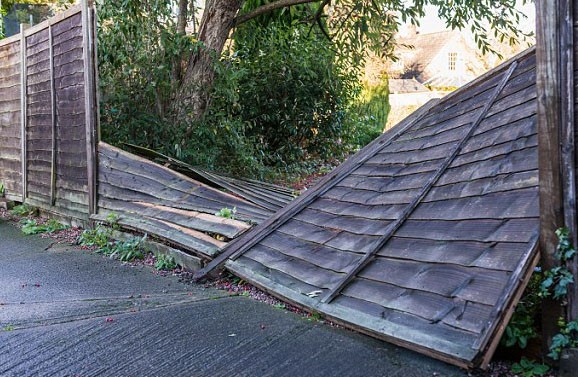
During a severe storm in Auckland, Max’s front fence blew over, snapping the posts off at the ground. After the storm cleared, Max attempted fixing the fence, but it was obvious that it was beyond repair. Max called in the professionals and got a quote to replace the fence.
Claim Process:
Max logged into his dashboard on the Initio website to tell them about his new claim. While completing the details of the claim, he uploaded a photo of the smashed fence and a quote to replace it.
Outcome:
Initio were able to review and pay Max’s claim, straight into his bank account, so that he could get the fence replaced the next day.
All claims are different, and they are assessed on their own merits and facts. The above profiles do not imply a guaranteed approached all such claims
How to claim for intentional vandalism by tenants
Found intentional damage at your rental property? Don’t worry, your Initio landlord insurance policy covers up to $25,000 of intentional damage by tenants. If you’ve found holes in walls, smashed windows, graffiti etc, please follow our below steps.
What you need to do
- Take photos of the damage – it helps us if scale is provided in the photos, take both close up and pulled back photos
- Get a quote to repair any damage – a room-by-room- itemised quote will speed up the settlement process
- Login to your initio dashboard and select ‘Make a Claim’ on the property. Complete our smart claims process and attach your photos and quotes.
- Hold tight. We will email or call within a business day to tell you what happens next.
- Consider applying to the tenancy tribunal for vacant possession, and to recover any uninsured losses.
Remember the more information the better. We will require other documents such as:
- Tenancy agreement
- The most recent 3 inspection reports
- Tenant references & application
- Anything else you think is relevant
This can help us determine when damage occurred, and speed up our claims process for you.
What will we cover?
The intentional damage caused by the tenant is covered. However, bear in mind that insurance is designed to help you recover from unexpected sudden losses, but does not cover damage that has occurred throughout the tenancy. Like all insurance, an excess will apply to each damage incident.
If there has been damage from one event – such as an out of control tenant party – all the damage could be covered under one excess. However, if any of the damage has occurred throughout a tenancy, multiple excesses will apply.
When do Multiple Excesses Apply?
What won’t we cover?
House insurance covers sudden and unexpected events. We understand that there can be other areas of damage or neglect to your property. Unfortunately, insurance cannot cover everything!
- Rent arrears
- Wear and tear
- Rot or other gradual deterioration
- Rubbish removal
- Cleaning costs
- Gardening costs
- Repairs under excess
- Removal of tenants belongings
Some of your ‘uninsured losses’ can be claimed back via the tenancy tribunal.
FAQ’s
Am I covered for loss of rent?
If the home is so badly damaged that it is deemed ‘uninhabitable’, you might be entitled to loss of rent. ‘Uninhabitable’ means unable to be lived in. For example, no access to kitchen or bathroom facilities, water or electricity. There is no cover for loss of rent if the repairs are just cosmetic (carpet/painting/plastering etc).
Will initio send an assessor?
If damage is significant and needs further examination we may get an assessor to your property. Usually, if the damage is likely to be under $5,000 then we are happy to proceed based on photographs and formal written quotations.
What is my excess?
Your standard policy excess will apply. This amount is chosen when you first purchase your policy. If you can’t remember, check your policy schedule which you can find on your dashboard.
Can I use my own repairer or does initio have companies I must use?
You can use any repairer or supplier you like as long as their costs are reasonable. Please make sure you are happy with the standard of work they provide.
Initio recently became a winning 5 star award provider in the 2022 IBNZ (Insurance Business New Zealand) insurance awards and we couldn’t be more proud.
How did we win?
Our winning formula is our smart claims platform, which empowers customer self-service for home, contents, and car insurance. It does this by:
- reducing the number of people involved in domestic insurance transactions
- providing an extra level of customer control with our online dashboard
- every feature, site update, and logic change is made with our customers in mind
- never losing sight of how the end user interacts with our technology
- creating the easiest and most frictionless insurance experience in New Zealand.
Where others have failed, we’ve been able to provide integration and tools that enable partners to get house insurance quotes instantly. We do this by providing customers with their premium and insurability profile of a property in less than six seconds. What’s more, the technology is scalable. This means our customers have the flexibility to adjust the quote based on their unique needs. Currently, initio generates more than 40,000 automated domestic insurance quotes per day.
How were winners determined?
- Technology providers nominated their solution. They explained why it stands out and what makes it the best in the market.
- IBNZ then reached out to brokers. Asked them to rate their overall satisfaction with the insurance technology providers they dealt with.
- The top-scoring technology and software providers were then named 5-Star Award winners.
We’re incredibly proud to come away with this recognition from the industry. Discover just how impressive our software is for yourself by generating your own instant quote today and starting your own journey with initio. You won’t be disappointed.

My first three months at initio
Change is as good as a holiday they say, so after nearly a decade at my previous company, I made the leap, dusted off my CV, stumbled my way through the interviews and signed the contract with initio. But now I had to actually meet new people – ugh. And then there were the considerations around what to wear. Nothing screams that you’re a giant dork like being the only person wearing corporate attire when everyone else is in trendy sneakers & tee’s. The first morning of my new job, after a restless night worrying about everything and nothing probably ranked a solid eight on my anxiety scale. About the same as when I’m not sure whether someone is going for a handshake, high-five, hug, or kiss on the cheek, and I guess wrong. But the good news is that I’ve gotten through the first three months here at initio and I’ve now been here long enough to gather my thoughts about what it’s like to work here and the way it operates. So here are my first impressions;
They have some incredibly smart people working here.
When I say smart, I mean IT smart, which means they’re right at the top of the intelligence pyramid and they keep using words I don’t understand. This is because one of initio’s strengths is digital technology, so we have a very switched-on ‘dev’ (developer) team. They are responsible for keeping our frictionless digital insurance platform in tip-top shape by performing constant updates as well as upgrades. This has meant that I’ve learned I didn’t know quite as much as I thought I did when it comes to the IT realm. To quote a classic movie; ‘You keep using that word. I do not think it means what you think it means’. Yes, that actually happened to me. That experience also ranked pretty highly on my anxiety scale.
Additionally to our talented IT team, our claims and support departments also have smart and savvy team members. Their skills, knowledge and all-around commitment to providing the best service out there are second to none. In fact, I’m surrounded by awesome people who have accepted me into their fold and made me feel right at home.
Positive vibes in spades
I can honestly say that I’ve never worked for a company that’s more committed to creating a healthy company from the inside out. By this, I mean that staff are provided with an incredibly generous and supportive environment which then means that as an employee, we are more willing to go the extra distance for initio. This positive internal culture is nurtured by weekly yoga, a strong social game and rewarding our staff when initio achieves various goals we set for ourselves. This is all great news for our customers who then talk to happy, helpful initio team members.
We’re focused on why we do business
I’ve heard repeatedly since I started working here that initio wants to turn what people think about insurance on its head. Some of the giants in the insurance industry can make their customers jump through hoops when it comes time to pay claims. Initio believes that we should be able to pay (uncomplicated) claims out just as quickly as we get paid for the premium. We’re proud of the fact that we’ve been able to deliver on this for a few simple claims already.
Don’t be suspicious of their affordable pricing.
Talking to my friends and family about my new job would usually lead to us jumping on initio’s website to generate a quick house insurance quote (… which because of those uber-smart people I mentioned, only takes about 5 seconds). They would always ask me ‘why is it cheaper?’ and I initially didn’t actually have a good answer. I’ve since learned that initio is on a mission to offer affordable insurance but with the essential bells and whistles homeowners need. In a nutshell, they save costs by keeping everything online. Customer policies, invoices and all communications are all managed online via the client dash. This in turn means no humans quadruple handling things, not to mention unnecessary printing or postage costs. These efficiency savings are passed on to their customers through their affordable pricing structure.
So there you have it, my first few months in a nutshell. All of the above points are just my humble opinion of course, but I can honestly say that my friends have asked me ‘are you glad you changed jobs?’ and my answer has been an emphatic ‘Yep, so much happier!’.
By Megan Fisher, initio Marketing Manager
For our final topic, we’re looking at why having all of your insurance eggs in one basket is actually a good thing. Last year’s natural disasters brought numerous challenges for those who suffered losses. Managing multiple claims with different insurance providers would’ve been like trying to herd cats during a thunderstorm. You should never undervalue your time of peace of mind.
Consider streamlining your insurance
Having all your policies with one insurance provider simplifies your insurance management. It’s about making your life easier, reducing the jigsaw puzzle of policies to a single, manageable picture. Less time spent on paperwork means more time for…well, anything else.
Initio offers a range of insurance options to cover all aspects of your life. From home & contents to vehicle, landlord, and holiday home insurance, we have you covered. It’s like having a Swiss Army knife in your pocket, but for insurance. Fancy a quick quote? It couldn’t be simpler. In less than 10 seconds, you can see how we stack up against your current provider across the board.. And who knows? You might be pleasantly surprised by our competitive rates and the convenience of having all your insurance needs met under one roof.
Get a quote in seconds for our most popular insurance options:
Combining your insurance policies with the same provider is a smart move. You could save some cash, keep your insurance documentation tidy, and make claiming a breeze. Why not review your current insurance cover and see if bundling them might suit your needs better?
Here’s something to chew on: sticking with one provider for all your insurance needs means less hassle and fewer payments to juggle. As the old saying goes, time is money.
OTHER ARTICLES OF INTEREST
Flood risk is becoming an increasingly significant issue for property owners in New Zealand due to the growing frequency and severity of weather events. This risk often translates into financial hardship due to the damage caused and the potential for increased insurance premiums. Certain areas, like Edgecumbe and Westport, for example, face heightened challenges, with insurance becoming harder to secure.
To help you navigate these challenges, this guide combines insights on flood risk assessment and the implications of living in flood zones, using advanced tools like Risk Management Solutions (RMS) and council-provided data.
Measuring flood risk
Flood risk is determined by two key factors:
- Frequency: How often floods are likely to occur.
- Severity: The potential impact and damage caused by those floods.
Initio is committed to providing transparent and accurate information to help you protect your property.
At initio, we use Risk Management Solutions (RMS) data to assess properties’ flood risk. RMS is a global leader in risk modelling and analytics. They use advanced technologies, scientific data, and sophisticated modelling techniques to assess natural disaster risks, including flooding. RMS determines flood layers by analysing:
- Historical flood data
- Topographical information (land elevation and shapes)
- River systems and water flow patterns
- Rainfall data and climate patterns
- Soil types and ground absorption rates
- Man-made structures like dams and levees
When you get a quote, and the property you’re quoting is in a flood risk zone according to the RMS modeling, we will show you a message detailing what risk has been found. These are as follows:
- “Flood Risk – RMS Flood 50 Year Return”: There’s a 1 in 50 chance of a significant flood in any year, or a 2% chance of a flood occurring in any year.
- “Flood Risk – RMS Flood 30 Year Return”: This indicates a 1 in 30 chance of significant flooding each year, or a 3.3% chance of a flood occurring in any year.
These year values represent the probability for the scale of flooding that needs to occur for the water to reach this property. So when you hear about “one in a hundred year flood”, or “one in 50 year floods”, that is what those flood risks mean; if a “one in 30 year flood” occurs, water is likely to reach properties that fall in the RMS 30 Year flood model.
The risk information don’t mean that a flood will only happen once in 100, 50, or 30 years. As we saw with the Auckland flood events from 2023, multiple flood events can occur in quick succession.Ultimately these are modeled risks, and real world outcomes may vary, but they are a way to better predict flood risks and keep insurance accessible for New Zealand.
However, it’s crucial to understand that frequency doesn’t always correlate directly with severity. Flood severity refers to how damaging a flood might be, regardless of frequency. For instance, a less frequent flood might cause significant damage if it is severe, while a more frequent flood might have a lower impact.
When you get a quote online, if there is a flood risk associated with the address you have provided we will display the risk found on the RMS dataset based on the location of the property.
This information helps determine whether we can offer immediate insurance cover or if further review is needed. However, it’s important to note that these are probabilistic models and real-world outcomes may differ.
Understanding flood severity
While frequency tells us how often flooding might occur, severity helps us understand the potential impact on your specific property. We assess severity by looking at several key factors that combine to create a complete picture of risk:
-
Predicted flood water depths (ranging from shallow surface flooding to depths of over 3 meters)
-
The percentage of land potentially affected
-
Your building’s position on the property
-
Natural drainage patterns
-
Existing flood protection measures
-
The building’s design and construction
The interaction between these factors can significantly influence the actual risk to your property. Here are some examples:
-
A property might be in a 30-year flood zone with a predicted 2.5-meter water depth, but if this only affects a small corner of the section where no buildings stand, the practical risk might be manageable.
-
Conversely, a property in a 50-year zone with a lower 0.5-meter predicted depth could present higher risks if the water would cover most of the land and directly impact the building.
-
A property with moderate flood frequency but high predicted water depths (3+ meters) covering significant building areas would typically represent a more serious risk which may be outside of our capacity to insure.
Our website continually evolves as data and modeling capabilities improve. The rules we use to evaluate properties are regularly updated to reflect the latest RMS data and our growing understanding of flood risks in New Zealand. This means that assessments can change over time as we refine our approach and incorporate new information about flood risks and their potential impacts.
At Initio, we use this comprehensive understanding of both frequency and severity to make balanced insurance decisions. Our approach is designed to be practical – we can typically provide coverage even when some flood risk is present, however not all properties are able to be insured by Initio, depending on the risks involved.
Understanding Flood Zones and Mapping Tools
In addition to RMS data, tools like the Searise website, local council hazard maps, the property’s history and your own LIM report provide valuable insights into flood risks. These tools help both insurers and property owners understand sea-level rise, vertical land movement, and local flood hazards. With these resources, you can view your property’s flood risk, explore hazards like river overflow and storm surges, and prepare accordingly.

Searise example

Auckland Council flood mapping example
Local councils also play a crucial role in managing flood risk by improving infrastructure, such as drainage systems, which are increasingly under pressure. Ensuring that these systems are up to standard is essential in reducing flood risks for homeowners.
Why might my council’s flood risk assessment differ from RMS data?
It’s possible that your local council’s flood risk assessment may differ from the RMS data we use. This can happen for several reasons:
- Updated information: RMS may have access to more recent data or use more advanced modeling techniques.
- Different focus: Council assessments might focus on specific local concerns, while RMS provides a standardized national assessment.
- Varying methodologies: The methods used to assess flood risk can differ between organizations.
- Broader considerations: RMS data may take into account factors beyond what local councils typically consider.
If you have concerns about discrepancies between council and RMS assessments, we encourage you to contact us for further clarification.
How Does Flood Risk Impact Insurance?
Suppose your property falls within a high-risk flood zone. In that case, initio uses all information available to help decide whether immediate insurance cover can be offered or if custom terms would be required.
While insurance can help protect against flood-related damage, it’s important to manage the risks proactively. This might involve flood-proofing your property, improving drainage, or making structural changes to better withstand flood events.
Flood risk can vary across properties depending on:
- Specific property location within a flood zone.
- Local topography and elevation.
- Drainage systems and recent land developments.
What If I’ve Reduced My Flood Risk?
If you’ve taken steps to reduce your property’s flood risk, such as installing barriers or improving drainage, let us know. These improvements would be considered when assessing your property’s flood risk for insurance purposes.
Summary
With the growing threat of severe weather events, understanding flood risk and using available resources is essential for property owners in New Zealand. By leveraging data from tools like RMS and local flood maps, you can make informed decisions, better protect your property, and ensure you are adequately insured.
For more information or help understanding your property’s flood risk, reach out to our support team at initio. We’re here to provide the transparency and guidance you need to manage these risks effectively.
Remember, understanding your flood risk is the first step in protecting your property. Stay informed and prepared!
Related articles & useful links
IMPORTANT – RMS Moody’s disclaimer
This report, and the analyses, catastrophe modelling results and predictions contained herein (“Information”), are based on data provided by Initio Limited, and compiled using proprietary computer risk assessment technology of Moody’s Analytics, Inc. and its affiliates (“Moody’s”). This Information is a single copy, copyright protected work of Moody’s that contains confidential and proprietary information of Moody’s. As with any model of physical systems, particularly those with low frequencies of occurrence and potentially high severity outcomes, the actual losses from catastrophic events may differ from the results of simulation analyses. Furthermore, the accuracy of predictions depends largely on the accuracy and quality of the data used by Initio Limited. The Information is owned by Client or provided under license to Initio Limited and is either Client’s or Moody’s’ proprietary and confidential information and may not be shared with any third party without the prior written consent of both Initio Limited and Moody’s. Furthermore, this Information may only be used by the recipient in connection with, as applicable, (i) Initio Limited’s imminent placement of insurance or reinsurance; or (ii) the recipient’s 3 regulatory activities in relation to Initio Limited; and always for internal purposes only and for no other purpose, and may not be used under any circumstances in the development or calibration of any product or service offering that competes with Moody’s. You are not authorized to use, copy, modify, disclose, and/or distribute this Information in whole or in part in any form, except as expressly and specifically permitted under a written agreement signed by Moody’s. Any unauthorized use, copying, modification, disclosure, or distribution of this Information will constitute an infringement of Moody’s intellectual property and your agreement to pay list price for the use of the product or application associated with this Information, in addition to any applicable penalties or damages or other remedies available under applicable law. The recipient of this Information is further advised that Moody’s is not engaged in the insurance, reinsurance, or related industries, and that the Information provided is not intended to constitute professional advice. Moody’s including its parent, subsidiary and other affiliated companies are all beneficiaries of this disclaimer. MOODY’S (AND ITS PARENT, SUBSIDIARY AND OTHER AFFILIATED COMPANIES) SPECIFICALLY DISCLAIMS ANY AND ALL RESPONSIBILITIES, OBLIGATIONS AND LIABILITY WITH RESPECT TO ANY DECISIONS OR ADVICE MADE OR GIVEN AS A RESULT OF THE INFORMATION OR USE THEREOF, INCLUDING ALL WARRANTIES, WHETHER EXPRESS OR IMPLIED, INCLUDING BUT NOT LIMITED TO, WARRANTIES OF NON-INFRINGEMENT, MERCHANTABILITY AND FITNESS FOR A PARTICULAR PURPOSE. IN NO EVENT SHALL MOODY’S (OR ITS PARENT, SUBSIDIARY, OR OTHER AFFILIATED COMPANIES) BE LIABLE FOR DIRECT, INDIRECT, SPECIAL, INCIDENTAL, EXEMPLARY, OR CONSEQUENTIAL DAMAGES WITH RESPECT TO ANY DECISIONS OR ADVICE MADE OR GIVEN AS A RESULT OF THE CONTENTS OF THIS INFORMATION OR USE THEREOF.
It can be a shock for your vehicle to be damaged – whether you’ve been in an accident, had your vehicle stolen, or discovered it damaged in a parking lot. We’re here to help, so when you’re ready and able, lodge your claim online and we can guide you through the process.
In the meantime, here are some FAQs for what information to collect, and how vehicle claims are processed.
If you have further questions about vehicle claims, chat with us, or you can e-mail or phone the initio claims team.
What information should I gather when my vehicle has been damaged?
Recording the damage and the other people involved straight away helps us in processing your claim.
- Photos – Take clear, detailed photos of the damage from multiple angles. If you can, capture the surrounding area to provide context, such as where the car was parked and any possible sources of the damage.
- Witnesses and CCTV – Check if there are any witnesses who might have seen what happened. Also, see if there are any nearby CCTV cameras that might have recorded the incident. If you find witnesses, gather their contact information and a brief statement. CCTV is usually available from the local council. You will need to reach out to them directly to obtain this as we are unable to request the footage on your behalf.
- Police – Record the Police reference number and the name of any attending officers. If your vehicle was stolen, report the matter to Police – you can do this online.
- Other drivers – Record the name, address, contact details (mobile and e-mail address) of other drivers when possible. Confirm whether they have insurance and who with. Provide other drivers with your details where appropriate, and let them know you’re insured with initio.
Include as much information as possible when you lodge your claim online with us.

How do I arrange an alternative vehicle under my claim if mine is undrivable?
Under our alternative transport additional benefit, we will contribute towards the reasonable hire costs incurred if you need a rental vehicle following a loss covered by the policy while your car is being repaired, is not fit to drive while awaiting repair, or is awaiting settlement of a total loss claim. Please note that this benefit only applies to claims on Full Cover policies, and can only be applied once your claim has been accepted.
This benefit is provided on the condition that we have arranged the rental vehicle through our approved supplier, or where you have arranged a quote yourself, we have reviewed this and accepted the quote as fair and reasonable. You will need to contribute $20 per day (paid to our supplier when the rental vehicle is obtained), pay any bond or deposit, and cover all running costs. We will contribute towards these costs for a maximum of 14 days.
More information on this can be found on page 6 of initio’s motor vehicle policy wording under the heading ‘Alternative Transport’.
If you would like to utilize this policy benefit, please let the person handling your vehicle claim know and they will be able to assist with these arrangements.
What happens if my vehicle is written off (also called a “total loss”)?
If your vehicle can’t economically be repaired, or has been stolen and not recovered within 7 days, then we would settle your claim at the Agreed Value of your vehicle, which is the value you selected when the policy was taken out/renewed. We will deduct your excess from the settlement if it has not been waived.
Some or all of the settlement money might have to be paid to your finance company if there is security registered over the vehicle. We will let you know where the settlement will be paid as part of the claim.
Initio (and our underwriters) take ownership of the vehicle wreck and will deregister and then sell it to recover some of the costs.
Where will my vehicle be assessed and repaired?
You can use a repairer of your choice, or one from our approved repairers network.
If you would like us to help you choose a repairer, we’ll recommend one of our approved repairers. These repairers come with:
- A quality guarantee
- Pre-authorisation to repair damage, speeding up the repair process
- Loan vehicles usually on hand
When do I pay my excess?
If you have Full Cover and your excess has not been waived, you will generally pay your excess to the repairer when you collect the vehicle.
If you have Third Party Only cover, and are responsible for damage to someone else’s vehicle, then we will send you an invoice for payment of your excess before we settle the costs to the other party.
Does initio cover tyre repairs?
Generally, insurance isn’t designed to cover punctures, cuts or bursting of tyres, and you are not covered for damage caused by breaking. If you have Roadside Assist, they can assist you with fitting your spare tyre or getting your car towed safely to a tyre repair centre for you to arrange repair/replacement at your own costs.
Initio can only look to consider cover for tyre punctures, cuts or bursting of tyres due to the following causes: fire, collision, overturning, malicious damage, theft or conversion, or natural disaster.
Related articles
We’re proud to share that initio has been recognised as a 5-Star Insurance Innovator in the 2025 Insurance Business New Zealand (IBNZ) awards. This award celebrates the companies that push the industry forward with real innovation, delivering meaningful results for customers.
Why this award matters
For us, innovation isn’t about shiny technology for the sake of it. It’s about using smart digital tools to make insurance simpler, faster, and smarter for homeowners and landlords across New Zealand. That’s why being recognised by IBNZ is special. Their judging looked not just at new ideas but also at proven results – how those ideas genuinely improve outcomes.
In 2024, we rolled out major improvements to our platform:
- Smarter online quoting that allows customers to compare cover and buy a policy in minutes
- A more intuitive dashboard where policyholders can manage their insurance 24/7
- Faster claims processing supported by real-time updates and better data sharing
- Behind-the-scenes risk technology that reduces friction for customers while keeping cover accurate and fair
Each of these developments was designed with one question in mind: how does this make life easier for our customers?
Smart insurance for smart people
Our customers are busy people who want insurance to just work – without the jargon, paperwork, or hold music. That’s why we’ve built a platform that puts control in their hands. The award validates that our approach, removing complexity and giving transparency, is working.
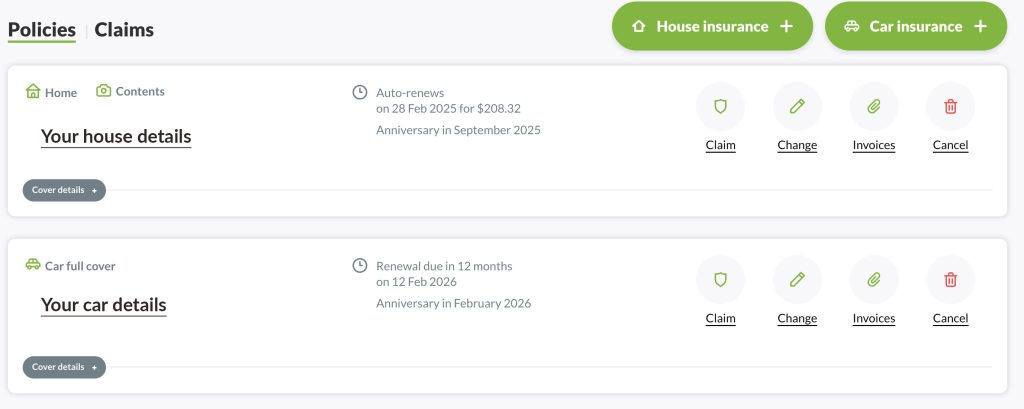
For example, being able to update your policy online, lodge a claim, or instantly access documents via your client dashboard isn’t just a “tech feature.” It means less stress when something goes wrong, quicker answers, and confidence that you’re in control.
What it means for our customers
Recognition from IBNZ is encouragement to keep going. But the real win is for our customers. Because every innovation we introduce is about:
- Saving time – no waiting on hold or posting forms
- Clarity – cover explained in plain language, upfront
- Confidence – knowing you can rely on us at claim time
- Fairness – technology that helps us keep pricing sharper and more accurate
Our customers sit at the front of every decision we make. This award highlights that focusing on them, rather than outdated processes, leads to better outcomes.
Looking ahead
We’re proud of the recognition, but we see it as a milestone rather than a finish line. Innovation never stops, and we’ll continue to improve how we serve New Zealand homeowners and landlords.
Complex insurance, made simple.
Try it for yourself. Start by getting a quote
Related articles
Want to check over the full details of your cover? It’s best to read your policy wording. You should also check your summary policy schedule from your dashboard to see what applies to your cover.
If you’re not sure what everything means, our guide on how to read an insurance policy walks you through each section in a simple, easy-to-follow way.
Owner-occupied Homes
See our full house insurance policy wording below. If you’ve included contents with your cover, download the separate contents insurance wording.
Download House Wording Download Contents Wording
Rental properties (including multi-units) and Holiday homes
Our holiday home and landlord cover are both under the below combined policy wording. To see what applies to your policy, it pays to check your policy schedule.
Download Landlord Wording
Car Insurance
See all the details of our comprehensive car insurance cover below.
Download Car Wording
If you have any questions about your cover, feel free to get in touch with our friendly team.
Related articles
Our robust cover means it’s not the end of the world if you use your car for some business use. You’re still covered as long as it’s not being used for any of the below.
Business use that is NOT covered:
Your car will not be covered if used for the following:
- Ride-sharing, or carrying fare-paying passengers such as a Taxi, or Uber.
- Courier or delivery business (including food delivery such as UberEats).
- In connection with a trade or servicing business that does any installation, maintenance, cleaning or repair work on homes.
- To carry goods or samples for financial gain or reward, as part of any business (apart from Farming)
- As part of any motor (or automotive) trade profession (such as a mechanic)
- Formal driver training or education.
- Towing for reward (e.g. to a tow another car)
- Car being hired out (e.g. a peer to peer hire)
If your car is used for any of the activities listed above, our policy is not suitable. We would recommend purchasing commercial cover – typically available through an insurance broker or commercial insurer.
What if I don’t usually use it for the above activities but that changes later?
Your vehicle won’t be covered at any time it’s used for any of the excluded activities listed above. If you’re involved in an accident while using the vehicle for any of those purposes, your initio policy won’t respond – and the claim would be declined.
Will my cover include damage to or replacement of the car’s signwriting?
No, our policy does not include cover for any vehicle signwriting.
So, is all other business use covered?
Yes! For any business activity not listed under the exclusions above, your car can be covered – even while performing that business task.
Our policy acts as a hybrid between private and commercial cover, designed to accommodate most other business uses.
Examples of covered occupations (not exhaustive):
- Office professionals visiting clients.
- Property managers driving to properties for inspections or viewings.
- Property Owners carrying out work on their own rentals
- Farmers using a ute for on- and off-farm activities to run their operations.
- Real estate agents or salespeople traveling for work.
Still unsure?
If you’re uncertain whether your business use is covered, get in touch with us – we’re here to help clarify!
Other articles of interest
When you insure your belongings, you pick a total amount of cover for everything. But, some items still have a sub-limit on how much they’re covered for. For the items in the table below, if you think something is worth more than this limit, you can add it as a specified item. The described, specified item will then have a high upper limit in the event of a claim.
If you’ve already got your Own Home contents cover with initio and want to add a specified item, please login to your initio dashboard and use the “change” and then “cover” options to specify any of the below items in your contents cover. More information about making changes to an existing policy can be found here.
The limits on jewellery, watches, bicycles, drones and collections can be increased if you specify a higher amount (for up to a maximum limit of $20,000 per item). The watersport equipment can be increased for equipment but not for any watercraft. For example, a fishing rod valued over $2,000 can be specified but a powered, runabout dinghy over $2,000 cannot. The powered dinghy would require a separate marine policy.
|
|
|
Jewellery & Watches:
|
$3,000 per item |
Camera or Camera Equipment:
|
$3,000 per item |
Bicycles (Present value):
|
$2,000 per bike |
Watersport Equipment (Present value) for any watercraft not powered by motor or sail, eg. surfboard, paddleboard, dinghy, kayak:
(Our contents policy cannot cover any watercraft powered by motor or sail, with a value of more than $2,000) |
$2,000 per item |
Drone / remote controlled aircraft (Replacement if less than 2 years, otherwise present value):
|
$3,000 per item |
Collections (Stamps, medals, coins):
|
$3,000 per collection |
It’s important to note that some categories of contents are still insured for their present value (read more), so make sure you are specifying the amount for present value or replacement value depending which applies.
As an example, bikes are insured for their present value. If you purchased an e-bike 2 years ago for $8,000 it may only be worth $5,000 today (present value). In the event of a claim, your settlement would be based on the present value, (in this example $5,000). Since this is over the $2,000 policy limit for bicycles, you would need to specify the present value, otherwise the claim would be limited to $2,000.
Since the present and replacement value of items changes over time, we recommend that each year you check the present or replacement values (depending which applies) for your items. If they’re insured for more than their value (replacement or present value, depending on the type of contents), you’re paying extra for no real benefit.
Multiple Items of Jewellery
For any single piece of jewellery or watch, there is a policy limit of $3,000 unless the item is noted as a specified item.
For any jewellery that is not specifically specified there is a maximum payment limit for any one event.
Unless a different maximum payment amount is shown in the schedule, the most we will pay for any event for multiple items of jewellery and watches (that are not separately specified) is $15,000.
For example, if you lose 10 pieces of jewellery in one event, each with a value of $2,000, the most we will pay is $15,000 unless we have previously agreed to increase the limit to $20,000..
Camera or Camera Equipment
Any piece of camera equipment is limited to $3,000 per item unless specified. Please note that our contents policy does not cover items used for earning income. If you use your camera equipment for earning income, you will require a separate commercial insurance.
E-Bikes
We can insure e-bikes on your contents policy provided that they are “pedal operated bicycles with motor assistance” If the motor is the primary source to propel the bicycle then the NZTA considers those to be classed as a vehicle and they would therefore need to be insured under a motorcycle cover. Visit NZTA to learn more. Don’t forget to specify your e-bike if its present value is over $2,000.
Drones / Remote controlled aircraft
The cover is automatically provided under your existing home contents policy for drones and their accessories for up to $3,000, provided the drone is;
- only used for personal use (ie. Not commercial/business) and
- is operated within NZ Aviation legislation and
- reasonable precautions/care are taken when securing and operating the drone
Drones are insured for replacement value whilst they are under 2 years old, present/market value applies for drones over 2 years old.
If you would like to know more, please contact us.
Watersport Equipment
Our contents cover does not cover any watercraft powered by motor or sail, with a value of more than $2,000. Please arrange marine/boat insurance with a relevant provider if required.
Antiques & Works of Art
While it’s not a requirement to list these as specified items on your policy, it is important to disclose them when applying for cover (under the general disclosure question) — especially if you have individual items valued at more than $25,000.
If you have works of art or antiques individually worth more than $25,000, please provide the details when completing your insurance application. Items of this value are considered material information and need to be reviewed by our underwriters before we can confirm cover.
As part of the review, we’ll need copies of the latest valuations, along with details of any security and fire protection measures in place.
Other Valuable Items
Generally, most personal contents items don’t need to be specified separately. Examples include personal medical devices such as hearing aids or insulin pumps, musical instruments, luxury items like handbags or shoes, and electronic equipment for your own personal use. These are covered under your main contents sum insured, with no sub-limit applied.
If you’re unsure whether a specific item is covered or needs to be noted, please check your policy wording or get in touch with our support team for guidance.
Initio Replacement Contents Cover
Related support articles:
Monthly insurance cover means that it is renewed and paid for each month. It’s a month-to-month policy that automatically renews and is charged to your credit card on the same day each month.
How can I pay monthly?
You can choose to either pay monthly or annually when you first purchase a policy. Our monthly payment is only available with a visa debit or credit card payment. We don’t offer a monthly direct debit from your bank account.
For details on switching between monthly and annual payments, check out our article on ‘Switching Payment Frequency‘.
Will you tell me if my monthly insurance payment changes?
Yes, we’ll let you know in advance if your monthly payment is going to change thirty days prior to any payment.
Your total insurance cost will typically change on the anniversary of your policy (i.e the day and month you first started the cover). This means that your monthly payment will remain the same for the year. The exception being that if there is a government levy change (for example Fire & Emergency New Zealand levy rate change) that is mandated to be applied from the effective date of your next monthly renewal.
Each month we will send you an email confirming the renewal of your policy. In that email, if the next month’s payment is going to be different (i.e its the anniversary renewal) we’ll let you know.
Your initio dashboard will also show you the date and amount of your current and next months payment.
When will my card be charged?
When you first purchase your policy the first payment will be withdrawn from your card on that day. All following monthly payments will be withdrawn from your card the day your policy renews (your chosen renewal date).
For example, if you buy a new policy on the 1st of January and the start date of the policy is the 5th of January, you’ll initially be charged for the first month on the purchase date, ie 1st Jan. All future monthly payments starting from the February renewal will then be withdrawn on the 5th of each month.
What if I need to change my card details?
You can change the card that’s used for the payments at anytime. To do so, please login to your initio dashboard and choose “credit card” from the “account” menu in the top right corner of your dashboard. Here you can enter the new card information and any future payments will automatically default to the new card. You can also see what card is currently registered for your payments on this screen.
What if my monthly payment fails to go through?
We’ll make four attempts in total to process the payment, you’ll receive an email notification each time — whether the payment succeeds or fails. We’ll include when the next transaction attempt will be on our email correspondence, so you can ensure funds are available at the right time.
Prior to the fourth and final Attempt:
- You can contact us prior to the final fourth attempt to request the payment to go through at an earlier preferred time. You can also trigger an earlier payment re-try by updating your credit card details kept in your initio dashboard — updating this field (even with the same card info) will automatically trigger an immediate re-try of any outstanding monthly payment.
- Get in touch with your bank if the payment has missed despite the funds being available, in some cases your bank may have put a hold on transactions for security reasons.
- Cover remains in place pending the successful payment within this time.
After the fourth and final Attempt:
If the premium remains unpaid after the final fourth attempt, the policy will lapse. Cover then ceases back to the date of the initial missed payment.
We are unable to re-activate the original policy once it has lapsed. To re-instate the cover at this time, please do so by beginning a new policy from your initio account (dashboard) using the ‘+’ options.
What if I want to use a different card for each policy?
If you are purchasing annual insurance, you can use a different card for each and every purchase. If you are purchasing monthly insurance, we are only currently able to facilitate one card for any monthly payments under your account. If you wish to use a different card for a monthly policy, you will need to set up a new initio account using an alternative email address for any policy to be paid via the new card.
What if I want all my monthly policy payments to be aligned on the same day of the month?
The monthly due date automatically aligns with the original inception date of the policy. Should you wish to change a policy’s monthly due date you would need to replace it with a new policy, effective on the preferred date. Once the new policy is in place, you can then cancel the original policy, any unused portion of that policy will be automatically refunded.
Why does the cost of insurance change?
There are a number of reasons why your house or car insurance premiums can change each year. Some of the more common reasons are:
- Change in the costs of materials and labour, which makes repairs to houses and cars more expensive (Covid supply chain issues put pressure on materials costs)
- Increased in the frequency and severity of weather events (Auckland Floods 2023, Nelson Floods 2022, Napier floods 2023 & 2021, Auckland tornado 2021 to name a few)
- Government earthquake levy changes
- Fire Service levy changes
- Increased re-insurance costs due to the way international insurers view New Zealand’s natural disaster risk (NZ is one of the highest risks in the world unfortunately)
- For cars, the main driver may have had birthday or an accident which changes the risk and in turn changes the premium (up or down) at the next policy anniversary renewal.
Related articles
How can I pay my premium?
How does monthly insurance work?
Switching payment frequency
Can I pay with direct debit?
If you’re doing alterations or renovations to your house you might be wondering if you’re covered by your initio house insurance policy.
Depending on the works involved you may need to arrange a Contract Works policy, also known as ‘construction insurance’ or ‘ builders all risks’ cover. Initio does not currently offer this type of cover, but you can obtain it through a contract works insurance provider, such as Builtin Insurance.
Who arranges the cover?
If you’re doing an alteration, renovation or work to your existing house, it’s generally your responsibility to arrange construction cover.
For a new build, full contract works cover is required, and is usually arranged by your builder.
Works that don’t require Contract Works cover
Cosmetic Renovations
If you are doing cosmetic renovations to your house (with no structural alterations) you don’t need a contract works policy. Generally your house insurance policy (including the initio house insurance policies) will cover damage that occurs during the works.
What is considered ‘Cosmetic Renovations’
Cosmetic renovations are work that doesn’t involve structural alterations or changes to the house. Cosmetic renovations that are covered by a standard house insurance policy include:
- Painting
- Installing new carpet
- Replacing a toilet
- Removing non-load bearing walls
If you spill paint on your carpet while renovating, there’s cover to fix the stain. This is not considered structural construction related damage, so your standard house cover will respond.
Works that require Contract Works cover
Structural Alterations
If your work involves any structural alterations to your house, you will need a separate contract works policy to have cover for construction related losses to the existing house, and for the new work itself.
Your existing house insurance policy will stay in place to cover non-construction losses (e.g. an earthquake), and your new contract works policy will provide cover for damage to the:
a) New work (e.g. the new garage being built, or the new roof), and
b) Existing house for construction related risks (e.g. storm damage while roof repair is half complete) – please be sure to include this section on any contract works cover taken
A standard house insurance policy will not cover these risks.

People are often confused about when contract works is required, and what it covers.
What is considered ‘Structural Alterations’
Some examples of structural changes include:
- Re-roofing
- Building a new extension to the house
- Removing a load-bearing wall
- Re-cladding
It’s works that involve changes to the supporting parts of the house (e.g. bearing walls, beams or floor construction), or the weather tightness of the house (e.g. cladding and roofing). These require construction cover and a house insurance policy can’t be relied on to assist.
If you need contract works insurance, we’ve partnered with Builtin to offer you a suitable solution. Like initio, BuiltIn are underwritten by IAG so this means that you will have the same ultimate underwriter for the house and contract works risk, which is important.
Still unsure if your works are structural? Contact us and we will let you know, or contact your insurance company.
What if I do structural work but don’t get Contract Works cover?
Essentially you’re taking the risk of damage to the new works, and any construction related losses to your existing house not having cover.
This will only be covered by a contract works policy, and are excluded from your house insurance cover (see below).
Causes of loss not covered
You are not covered for loss to the home connected in any way with:
- Structural additions or structural alterations
- Water in any form (including hail and snow) entering the home because any roofing material, exterior cladding, window or door has been removed by: (a) you, or (b) any other person who is acting on your authority, or
Construction related losses that would require contract works cover (Examples)
-
-
- Builder puts nail through water pipe, causing internal flooding.
- Blowtorch catches fire on wiring and house extension is fire damaged throughout.
- Builders were replacing roof, and strong storm winds ripped roofing off when it was half complete.
- Roof trusses collapse when builders removed load bearing wall
Note that these all relate to the construction work, and cause damage to the contract site being the existing structure of the house.
Consider your Risks
It’s up to you to decide if you need contract works cover. While there’s always an element of risk with structural works, you might be happy not to have cover if you think the risk and severity of damage is low.
You should consider the price of contract works cover and the peace of mind provided. Premiums start at around $500 premium for a small project. The longer the works take, the more expensive the policy will be.
My builder has liability cover, why do I need contract works?
Most builders will have some form of their own liability insurance. Don’t be fooled – this is not a form of contract works insurance.
What does a builder’s Public Liability cover?
It covers them for accidental damage to other people’s property they are held liable for. For example, the builder walks in the house with paint on his shoes and damages carpet.
Note that a builder cannot be held liable for something they didn’t cause (unless they are grossly negligent). If an earthquake or storm damages your work, your builder will not be to blame.
Most public liability policies also exclude property being worked on. In most cases your house is the product (so it’s unlikely there’s cover if the builder causes damage).
The upshot is you shouldn’t rely on your builders public liability policy as an alternative to contract works insurance.
Disclaimer: This support article is a guide only. It is not intended as specific advice for your situation. It is general guidance only. Consult your insurer/provider if you have specific queries relevant to your specific situation.
Related Articles:
There can be unfortunate scenarios where you may have to pay your excess more than once when you make a single house insurance claim.
We try to make insurance transparent for everyone, but there are insurance conventions that we have to work with. Applying an excess per incident can be particularly annoying if you’re not aware of it, so here’s some help to mitigate any future frustration.
Firstly, what does house insurance usually cover?
You might already be familiar with this. House insurance covers sudden and accidental events – something unexpected that results in physical damage. This will extend to intentional damage by tenants if you have landlord’s insurance.
Your house insurance won’t cover gradual damage over time such as rotting weatherboards. Like humans, houses need maintenance to stay in working order. There is no sudden (or unexpected) event that’s causing the rotting, so there’s no insurance claim.
If you have some unexpected damage, you’ll then need to pay your excess before your insurance kicks in. However, it’s not as straightforward as it sounds – because the excess applies to each insurance ‘incident’ and not just to each claim.
So, what’s considered an ‘event’?
The ‘incident’ is the time and place the damage or loss occurred.
For example, if something caused a hole in the wall on two different days, and in two different rooms of the house, then those would be seen as different ‘incidents’ – even if the landlord found all the damage on the same day and lodged a single claim.
Each separate incident could result in a separate excess being payable on each. Which can be a nasty surprise.
Why does this have to apply?
Trust us, this is something we want to avoid, but there is a reason it applies.
If a landlord could group all bits of damage over a tenancy into a single claim with a single excess charge, you could claim on any little dents and damage around the house. House insurance would begin to look like a property maintenance cover, and ultimately the premiums and volume of claims would become astronomical, and make insurance unaffordable for everyone.
What does a ‘multiple incident’ claim look like?
The most common example we see is when a tenant moves out, and the landlord discovers they’ve left behind a lot of unreported damage – holes in walls, stains in carpets, doors with broken hinges etc.
The landlord then files a single claim for recovery of all the damage. However, if it’s clear the damage was from multiple ‘incidents’ over the course of the tenancy, an excess is applied to each one.
This means the insurance payout is either much lower, or the claim will not proceed if all the excesses exceed the repair costs.

Stains in carpet – a sight all too familiar for landlords.
Exceptions to the rule
It isn’t always the case that an excess will apply to each piece of damage. This is where it can become a little technical, and on a case-by-case basis.
Multiple bits of damage at the same time
Sometimes multiple incidents are considered to be the result of a single source event, and only one excess will apply.
- For example, if a tenant is given eviction notice, and decides to take this out on walls in anger before they leave; or if a party gets out of control, with predictable damage to doors, windows and carpets.
In these examples there is a single source that caused the event in an approximate time period. The interpretation of the source can be subjective, and every claim has its unique circumstances and will be considered on its own merits.
One excess per room
Policies are designed to cover damage resulting from a single event. When a ‘single event’ cannot be confirmed, most insurers apply an excess to each incident, meaning each stain/dent etc. However, at initio we believe this approach can be unfair, so we endeavour to apply one excess per room, per item of damage (one excess for wall damage in a bedroom, one excess for carpet damage in a room).
What about those ‘one excess’ advertisements?
Paying an excess per incident is standard practice. When insurers advertise that they charge only ‘one excess’, they are usually referring to a single event that causes damage across several policies.
For example, if a flood soaks your garage, car and some loose contents, you might only have to pay one excess – usually the highest. It’s one of those ‘check the fine print for the asterisk’ sort of promises.
What you can do to manage this risk
The best way to avoid all of this is to keep on top of the condition of your property with regular inspections. This will help identify bits of damage before they become widespread. If you’re recording the house’s condition for each inspection, you’ll also have a better idea of when damage was caused.
The best form of risk management is being a proactive landlord. Most landlord policy wordings include requirements, called landlord obligations – that you should get yourself familiar with.
Meeting these are a great way to reduce your risk; like screening tenants, monitoring rents, doing regular inspections and collecting a bond at the beginning of a tenancy.
Insurance is a two way agreement. The more you do to manage your risks, the better chance you have of avoiding an ugly multiple excess claim.
Related topics:
Landlord insurance is a tailored policy for a property used as a rental. It is different to normal house insurance. Landlord insurance covers both the rental (your house itself) and the additional risk added by having a tenant in the property.
All homeowners are exposed to common risks such as fire damage, flood, and earthquake, but as a landlord you face an additional occupancy risk due to a tenant living in the property. Unlike family, tenants are not generally known to you.

How is landlord insurance different from house insurance?
In short, landlord insurance is the same as insurance for your own home, but for two big differences:
- Disclosure – use of the property:
Landlord insurance specifically accounts for the fact that your family does not live in the property. This is very important. If your rental property burns down and your insurer is not aware that it is a tenanted property the insurer could be entitled to deny your claim.
- Additional landlord risks:
Unlike your own home insurance, most landlord insurance includes coverage to specifically address the additional landlord risks:
What are my additional risks as a landlord?
Accidental damage by tenants
This is where your tenant un-intentionally causes damage to the property. For example: they spill a glass of red wine on the carpet. In this situation you need a landlord insurance policy in order to have a successful claim. It is unlikely that you can recover the cost of your insurance excess from the tenant.
Deliberate damage by tenants
Deliberate damage, also known as malicious or intention damage is usually the case when, as a landlord, you discover holes in walls and damage that is unlikely to have been the result of an accident. Cover for this is provided by a landlord insurance policy, usually up to a limit of around $25,000. The cover protects you from the cost of a tenant deciding to make a mess of your property.
Loss of rents following damage
If your rental property suffers a loss that deems the house uninhabitable then you face having an un-tenanted property while the repairs are completed and the property is occupied again. This will mean a loss of rental income. Landlord insurance provides cover for this loss of income up to a selected value (eg $40,000) for a payout period of usually 12 months. For major losses the cover will stop as soon as the loss of rent amount is used or the payment period ends, whichever comes sooner.
Loss of rents resulting from eviction or abandonment
This is where your tenant is evicted from the property (by decision of the Tenancy Tribunal) or your tenant leaves without giving notice. In both situations it means that you will be out of pocket due to loss of rental income. Some landlord insurance policies will reimburse you for this loss of income but only up to 6 or 8 weeks, following the formal eviction or discovery of the abandonment.
Landlord contents damage or theft
Even an unfurnished rental property had landlord contents. The oven and curtains are contents, not house. The tenant risk means that you could suffer a loss to these items, and this risk increases when you partially or fully furnish a property. A landlord insurance policy protects by providing cover, usually up to a standard limit of $20,000. Some landlord insurers provide an option to purchase more contents cover for an additional cost, which is important for furnished properties.
Landlord liability
As a landlord you accepting money (rent) for providing a house (accomodation). This makes means that you are in the business and with this comes additional regulatory obligations that, if breached, can cost you. Tenants can also have a go at you if they suffer a loss because of something you did (or didn’t do). The best example here is if a landlord did not change the locks after a previous tenant abandoned it and the new tenant was robbed (with no sign of forced entry). Some landlord insurance policies include cover for landlord liability, meaning that if you are pursued by a tenant or a regulatory authority the insurer use their lawyers to defend you, and if you are held liable pay certain awards against you.
Meth contamination
Meth and other illegal substances can cause significant damage to a property, especially when the substance is being manufactured. Meth clean-up costs can easily exceed $10,000. Reducing the risk of contamination occurring is best managed through good tenant vetting procedures and meth testing in between tenancies. If you do suffer a contamination loss and have a robust landlord insurance policy you will have cover for up to $30,000, plus the loss of rental income incurred.
Can I hold the tenant responsible for damage?
Yes and no. It really depends whether the damage was accidental, intentional, or just careless. Having a good landlord insurance policy would mean you are covered for all the causes of damage by the tenant – and then your insurers will decide whether to go after the tenant for the repair costs.
The good news is that the Residential Tenancies Act now provides scope for landlords (and their insurers) to recover the cost of repairs or their insurance excess from the tenant. Learn more holding tenants responsible. It is important to note that, more often than not, tenant damage claims result in the landlord’s insurer applying more than one excess. This is because insurance works on incidents, and each incident is a separate claim that attracts its own excess. Learn more about how insurers look at events
Ready to get started with initio?
It just takes a few minutes.
Buy Landlord Insurance
Want more information?
Explore these additional articles that may interest you:
Your safety on the road is our priority, and we’ve taken comprehensive measures to ensure you’re covered in every situation. Here, you’ll find everything you need to know about our optional cover for roadside assist service.
Roadside Assist Overview
Initio, backed by IAG, is committed to providing comprehensive support to its existing customer base. Our partnership with First Rescue enables us to offer a wide range of roadside assistance services. Whether you’re facing a flat battery, lost keys, or a breakdown, our support team is always here to help.
With our new Roadside Assist portal, getting back on the road has never been easier:
Roadside Assist portal
You can also reach Roadside Assistance at 0800 694 555.
Roadside Assist Services Include:
- Jump Start & Battery Replacement
- Breakdown Tow
- Keys Locked & Lost Support
- Wrong Fuel Assistance
- Car tyre Services
- And more!
Please note that some exclusions apply, such as unattended vehicles, towed vehicles such as boats, trailers or caravans, vehicles bogged down on non-public roads, or any vehicle exceeding 3.5 tonnes.
Roadside Assist is only intended for breakdowns, lost keys, and similar issues. Don’t use this service if you’ve had an accident.
How to Add Roadside Assist Cover
Whether you’re an existing customer or new to Initio, adding Roadside Assist Cover is a breeze. Roadside Assist can be added to your policy (full cover only) for a nominal fee, the details of which will be visible once you include it in your coverage. Here’s how:
For Existing Initio Customers:
- Log into your Initio dashboard.
- Find your vehicle policy section.
- Modify your policy to include Roadside Assist.
- Confirm the addition, and you’re all set!
For New Customers:
New to Initio? No worries! Simply add Roadside Assist to your vehicle policy as you set up your account with us.
Please note:
- Vehicle cover through initio must be paired with other insurance policies and cannot be purchased as a stand-alone option.
- Roadside Assist is only available with full cover vehicle cover.
Emergency Assistance
Now help is just a few taps away. If you’ve purchased the new Roadside Assist Online service, getting back on the road has never been easier:
Roadside Assist Online
If you are in an emergency and need immediate help, you can also call the 24/7 helpline 0800 694 555.
What about in the case of an accident?
- Always inquire about the well-being of everyone involved.
- Arrange a tow ASAP, the tow is covered under your vehicle policy if you have full cover on the damaged vehicle.
- Advise the police within 24 hours if anyone is injured.
- If no injury, you must give your name and address to any Third Party (and collect theirs). Inform the police within 48 hours if you cannot find the Third Party.
- If an animal is injured, advise the owner or call the SPCA on 0800 447 722.
Lodge your claim online to get a claim underway, or call us on 0800 763 929 if you need urgent assistance in relation to a vehicle collision.
Accommodation, Repatriation, Taxis:
Please be aware that these services are not included in your roadside assistance package; however, they may be covered under the terms of your specific vehicle policy.
You can find more information about all of our policy wordings here
Your safety is our priority. Keep this page handy for any roadside emergencies, and know that Initio is always here to help!
Related Articles
It can be common to claim for fallen trees and branches after a severe weather event, for the damage caused to houses and guttering, fences, cars and neighbouring properties.
In general, a home insurance policy doesn’t cover trees themselves; but you may be covered if a fallen tree has damaged your insured structures (cars, buildings, fences, special/recreational features) within the boundaries of your home. In these situations, we’ll cover the costs to remove the sections of the tree required to enable safe repairs – and you’ll need to arrange the tree’s disposal.
Some common examples;
1. A tree has fallen and damaged your car or living room
If the fallen tree has damaged your insured property, we’ll cover the cost of repairing the damage as part of your claim, including removing specific sections of the tree required to enable safe repairs. The insured is responsible for arranging and paying for the tree’s disposal.
2. A tree has fallen over on the lawn or driveway
If the tree has not caused damage, cover for the cost of cutting up or disposing of the tree does not apply.
3. A tree has partly fallen against my house, but it hasn’t caused any damage – am I covered?
If there is no damage to the house, then the cost of removing the tree is not covered. You should take reasonable steps to remove the tree to protect your property and prevent future damage. If you discover damage after removing the tree, then please let us know.
4. My tree has fallen onto my neighbour’s property – am I liable?
A homeowner will generally not be held liable for damage that their trees cause to other people’s property in a severe weather event. However, if it can be proven that they were negligent in not removing rotten trees or had ignored requests for removal, then they may be held liable.
5. Tree roots have grown and caused the underground pipes to block – is the removal of tree roots covered?
Our automatic additional benefit ‘water or sewage pipe blockage’, will pay a limited annual amount toward unblocking pipes. But, the cost to remove the tree roots is not covered.
Tips for tree maintenance
Got a tree or two around your property? Taking care of them is one way to reduce the risks of damage when bad weather strikes. Here’s the lowdown on how you can keep them in tip-top shape:
- Give ’em a good look: Assess the trees around your place before and after severe weather. Spot anything weakened or damaged? They might need a trim or even removal.
- Chat with the Council: Check with your local council about the rules for chopping, pruning, or trimming a tree on your, your neighbour’s, or council land. And don’t forget to see if the tree has any special protection.
- Spotted something? Speak up! If you notice a problem with a tree on council property, don’t be shy. Report it to your council pronto.
- Know your limits: Trimming a branch is one thing; taking on a big project that could damage a house or hurt someone is another. For the bigger stuff, it might be best to bring in a professional arborist.
- Think before you plant: Before you get that tree in the ground, think about how it’ll grow. Steer clear of planting large-growing trees too close to your house or other property. Know how your trees will grow above and below the ground before you plant them, and avoid placing ones that will grow large and too close to your house and other property.
For more information, please refer to your full policy
MORE ON THIS TOPIC
As a homeowner in New Zealand, you may have noticed fluctuations in your house insurance premiums over the years. While factors such as the rebuild cost of your home and the frequency of local weather events play significant roles, there’s another crucial element influencing your home insurance pricing: the global pool of insurance funds.
To put this into context, consider your personal insurance excess, which might be $650 for your house. In comparison, IAG has a $500 million excess for covering multiple homes in New Zealand in the event of a disaster. Similarly, while your house might be insured up to $1 million, IAG’s reinsurance limit is $10 billion. Although this is a simplification, it helps explain how reinsurance works.
The key takeaway here is that initio and IAG ensure you are well-covered. For more details, you can read the official article from IAG here.
New Zealand: A high-risk country with a small pool

New Zealand is one of the highest earthquake-risk countries in the world, situated within the volatile “Ring of Fire.” This inherent risk, combined with our relatively small population, means we draw from a comparatively smaller pool of insurance funds than larger nations. Consequently, our home insurance market heavily relies on global reinsurance companies to provide additional coverage and spread the risk.
New Zealand’s high exposure to natural disasters like earthquakes, floods, and cyclones makes it one of the riskiest countries for insurers. This, coupled with our small population and insurance market, underscores the importance of attracting global reinsurers to provide essential coverage.
For reinsurers to support the New Zealand market, it must be a worthwhile proposition. They carefully assess the risk-reward balance, considering factors such as the frequency and severity of past events, the potential for future catastrophes, and the insurance penetration rates in the country. If the risks outweigh the potential returns, reinsurers may limit their exposure or demand higher premiums, ultimately impacting the cost of home and contents insurance for New Zealanders.
What is a reinsurer?
A reinsurer is essentially an insurance company for insurance providers. When an insurance provider issues policies to customers, it takes on the financial risk associated with potential claims. To manage and mitigate this risk, the insurance provider may seek additional coverage from a reinsurer.
Here’s how it works:
- Risk transfer: The insurance provider transfers part of its risk to the reinsurer. This process is known as “reinsurance.” By doing this, the insurer reduces its exposure to large or unexpected claims.
- Premium payment: In exchange for taking on this risk, the reinsurer charges the insurance provider a premium. This premium is typically lower than the total premiums collected from policyholders, allowing the insurer to maintain profitability while securing additional risk protection.
- Financial stability: Reinsurers help insurance providers maintain financial stability, especially in the face of large-scale disasters. For example, if a major earthquake occurs, the financial burden of the claims is shared between the insurer and the reinsurer, ensuring that the insurer can meet its obligations to policyholders.
- Global risk distribution: Reinsurers operate globally, spreading risk across different regions and types of insurance. This global reach allows them to balance their portfolios and better manage the financial impact of claims from catastrophic events.
The importance of reinsurers
Reinsurers play a crucial role in the insurance industry by providing a safety net for insurance providers. This enables insurers to offer coverage to high-risk areas, such as New Zealand, which is prone to natural disasters like earthquakes, floods, and cyclones. Without reinsurance, insurers might be unable to cover such risks or would need to charge prohibitively high premiums.
Reinsurers enhance the capacity and resilience of the insurance market, ensuring that policyholders receive the protection they need, even in the event of significant and unexpected claims.
Global events and local insurance impacts
 While major weather events or natural disasters overseas may not directly impact New Zealand, they can still influence home and contents insurance pricing locally. For example, when hurricanes, earthquakes, or wildfires strike other regions, reinsurers must divert funds to cover those losses. This depletion of the global insurance pool can lead to higher reinsurance rates, which local insurers must then pass on to their customers through increased home insurance premiums.
During hurricane seasons in the United States, insurance companies often raise their premiums due to the increased risk. This increase is subsequently passed on to reinsurers, making the US market more attractive to them compared to New Zealand. Reinsurers get a better return on their investment in the US market due to higher premiums and a larger risk pool. It’s also important to note that the IAG program covers both Australia and New Zealand, which makes it relatively smaller compared to the US market.
It’s not just the overseas events that can impact your house insurance pricing. Local factors can also have significant consequences. The devastating floods and cyclones of 2023 led to substantial claims and higher reinsurance costs for local home insurance providers.
The impact of regulation on pricing
New Zealand’s prudential regulation, particularly since the 2020 review by the Reserve Bank, has significantly impacted the cost of house insurance for homeowners. Most insurers globally have to hold sufficient reinsurance or capital reserves to cover the risk of a 1-in-200 year catastrophe event. However, New Zealand insurers must hold sufficient reinsurance or capital reserves for a 1-in-1000 year catastrophe event. This stringent requirement drives up the cost of reinsurance, which, in turn, increases the cost of insurance for homeowners.
Balancing risk and affordability
Insurers and reinsurers are constantly reassessing their risk appetites, pricing, and capacity in response to global and local events. While this process aims to ensure the sustainability of the home insurance industry, it can result in higher premiums for homeowners. However, it’s a necessary measure to maintain the availability of home insurance coverage and spread the risk equitably across the global pool.
Enhancing New Zealand’s reinsurance market
To make our market attractive to global reinsurers, it’s essential to maintain a robust and well-regulated insurance industry with adequate pricing and risk management practices. Initiatives like the new disaster response model between insurers and the Earthquake Commission (EQC) aim to improve efficiency and customer experience, potentially enhancing New Zealand’s reputation in the global reinsurance market.
By demonstrating our commitment to responsible risk management and ensuring a fair return for reinsurers, we can continue to secure the necessary backing to protect New Zealand homeowners against the risks we face in our hazard-prone environment.
Making informed decisions
As a homeowner in New Zealand, understanding the interconnected nature of the global insurance market can provide valuable insights into the factors influencing your home and contents insurance costs. By staying informed and working closely with your home insurance provider, you can make well-informed decisions to ensure you have adequate protection against the risks we face in our beautiful but hazard-prone country.
When choosing house insurance in New Zealand, it’s essential to know that initio is backed by industry giant IAG. This partnership ensures our financial stability and capability to pay claims, providing you with peace of mind. We understand that the most important aspect for our customers is knowing that we have the financial strength to support them in times of need.
By partnering with a financially robust provider like initio, you can rest assured that your most valuable asset is protected, even in the face of unexpected events.
Useful links
What claims cost the most, and what are the most common claims of 2024?
As we approach the end of 2024, we’ve taken a closer look at the trends in claims across the range of insurance policies we offer. The main ones being holiday homes, rental properties, owner-occupied homes and vehicles. Understanding these trends helps us, as your insurance provider, to stay on top of the risks that matter most to you – and also gives a bit of insight into what’s happening out there in the real world. Here’s a summary of what we’ve found.
Please note these figures only cover the most common categories. They are not an all-inclusive list and may not total 100%.
The most common claims this year
Across all policy types discussed in this article – Own Home, Holiday Home, Rental/Landlord, and Vehicle – two trends dominate: accidental damage and water damage.
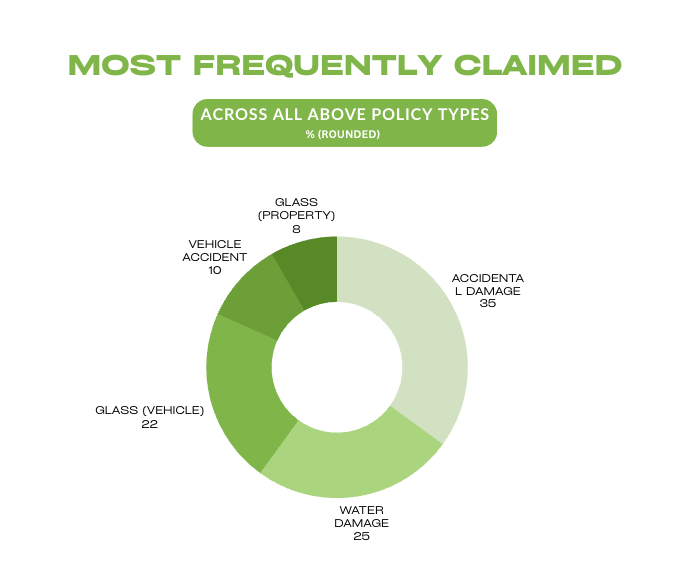
Accidental damage is one of the most common types of insurance claims because it covers a wide range of unexpected scenarios. Accidents are often unavoidable, even with the best precautions, which is why having comprehensive insurance is so important. It ensures you’re protected from the financial impact of repairs or replacements, helping you get back to normal quickly without unnecessary stress.
Water damage, including hidden water damage, is another significant area of cover. Hidden water damage applies to gradual leaks from internal water pipes or tanks that aren’t visible. Coverage is subject to specific conditions and limits, so it’s worth understanding what’s included in your policy. Sudden water damage, such as from a burst pipe, is generally covered under most policies.
For more details about how we handle water damage, visit our water damage support page – it’s always good to know exactly what’s included.
For more information:
The most expensive claims across all policy types
While frequency tells one side of the story, cost paints a different picture. Here’s a look at the claims that we’ve paid out the most amount of money for this year:
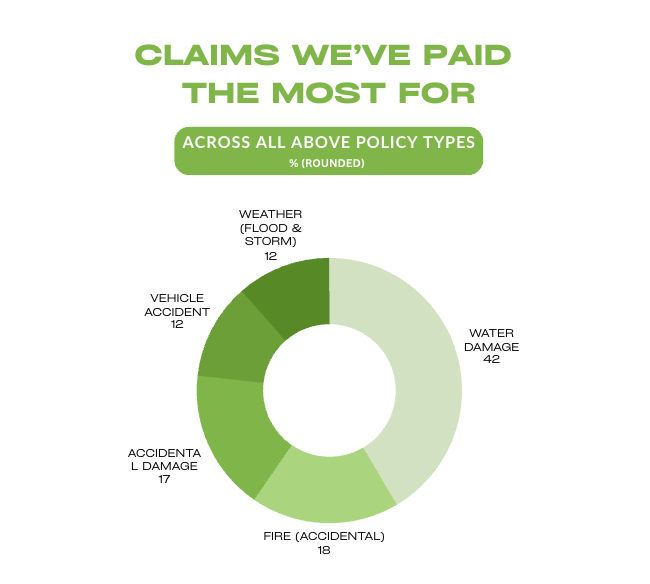
Some key insights stand out when it comes to the costliest claims. Thankfully, weather-related claims have dropped a few spots this year, providing some much-needed relief.
While accidental damage was the most frequent reason for our claims, it accounts for just 10% of the total payouts – indicating many smaller, less costly incidents.
When accidental fires occur, they’re among the most financially costly claims. These events often result in extensive damage, sometimes requiring a complete rebuild of the home.
Prevention is always the best defence against accidental fires. Simple steps like never leaving candles or cooking unattended, regularly testing smoke alarms, and ensuring your electrical systems are safe can greatly reduce the risk. While the financial cost of a fire can be substantial, the threat to human lives is immeasurable.
For more information:
General insights by property type
Own Home/Owner-Occupied
Weather has raised its ugly head again this year, but thankfully we’ve been spared the extreme damage experienced in 2023. Historically, summer is a season when storms and flooding can cause significant damage, so it’s a good time to take precautions to protect your property. If you’d like to learn more, check out our support articles for helpful tips and information:
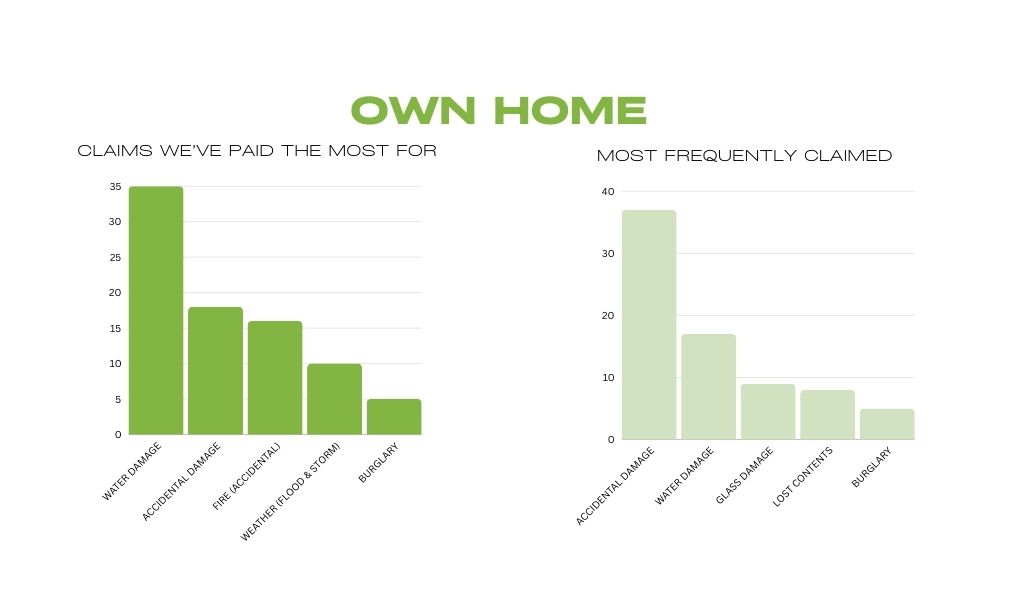
Rental/Landlord
Similar to own home and holiday home insurance, water damage and accidental damage are the most common claims for rental properties. These issues often arise from the higher turnover of tenants or insufficient regular maintenance. What sets rental properties apart, however, is the added risk of loss of rent & malicious damage cover.
Learn more about these topics:
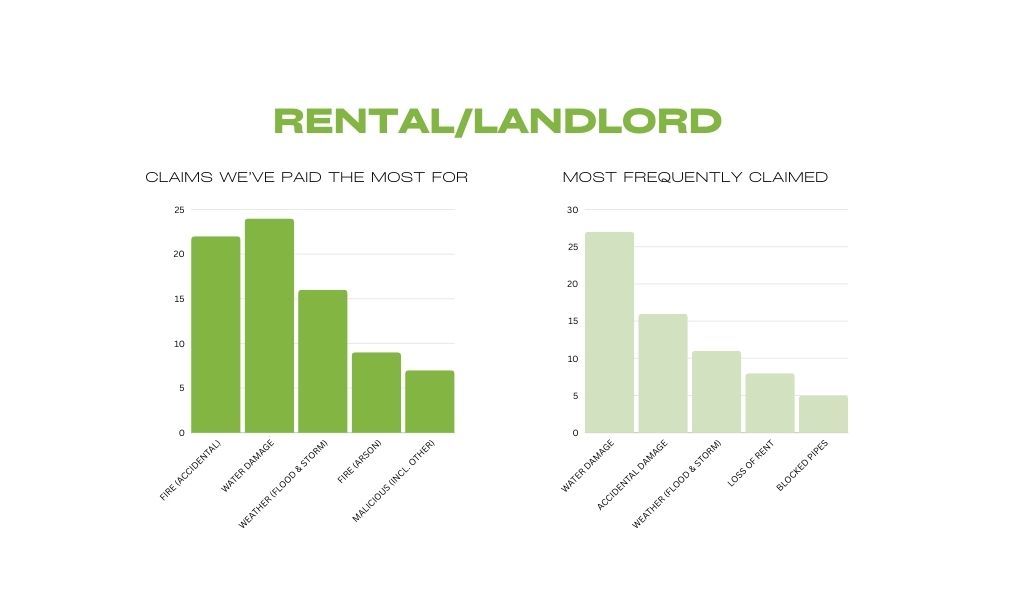
Holiday Home
After the usual suspects of accidental damage & water damage, these properties see a higher risk of burglary and weather-related claims. Being unoccupied for long stretches makes them vulnerable, particularly during storm seasons. Burglary ranks as the third most common issue. Our Holiday Home insurance basics article offers helpful tips on mitigating these risks.
For more information:
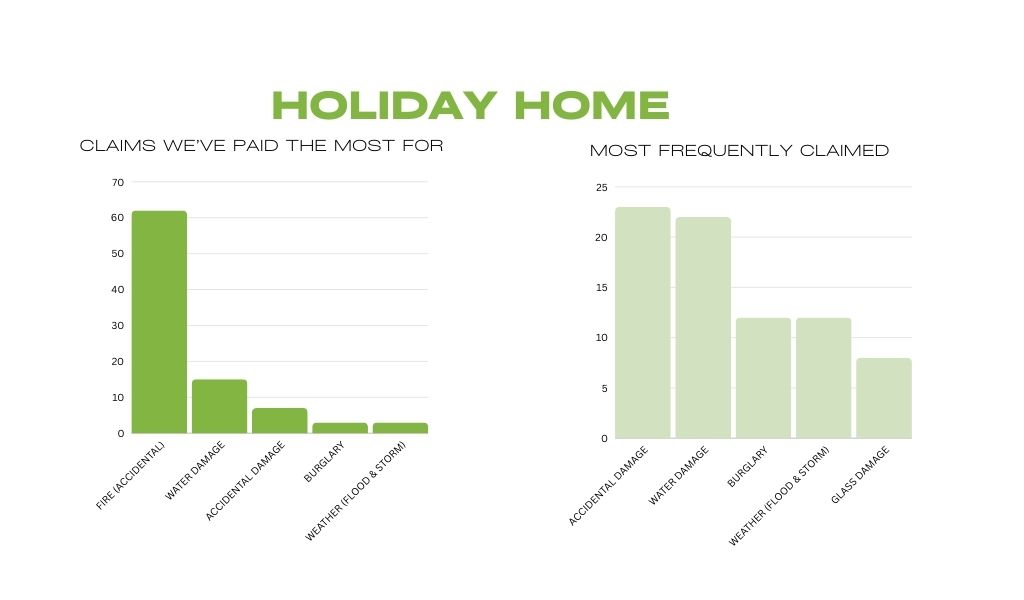
Vehicle
One of the main standouts in 2024 is glass damage – it’s the most common claim by far. These claims, while annoying and inconvenient, usually don’t cost much to fix.
When we look at the vehicle claims we’ve paid out the most for, major accident damage tops the list. The good news? The Roadside Assist portal is now available for vehicle customers who’ve added the Roadside Assist feature to their policy. If you haven’t added it yet and want to know more, you can start here.
Another common (and costly) culprit is damage from static collisions – when your car meets an immovable object.
For more information
Roadside Assist for initio vehicle customers

When we look at the vehicle claims we’ve paid out the most for, accident damage tops the list. The good news? Roadside Assist Online is now available for vehicle customers who’ve added the Roadside Assist feature to their policy. If you haven’t added it yet and want to know more, you can start here.
Another common (and costly) culprit is damage from static collisions – when your car meets an immovable object. And we hate to break it to you, but that pole you reversed into didn’t sneak up behind you.
For more information
What does this mean for you?
These trends highlight the importance of staying proactive with maintenance, securing your property, and ensuring your insurance is comprehensive enough to cover frequent and high-cost risks. As your insurance provider, we’re here to help – whether it’s providing advice on minimising risks or ensuring your cover matches your needs.
Did you find this interesting? You might also enjoy our article on the weird and wonderful claims from this past year.
The statistics presented in this article are based on a comprehensive analysis of claims data from initio for the calendar year of 2024 (1 Dec 2023 – 27 Nov 2024), spanning our entire claims portfolio. Please note that all figures are approximate percentages, calculated to offer a representative overview of claim trends during this period. These figures only cover the most common categories. They are not an all-inclusive list and may not total 100%.
As we wrap up another year, it’s time to reflect on the fascinating, bizarre, and occasionally head-scratching world of insurance claims. While we see plenty of the usual suspects – cars driving into garage doors, kids toppling TVs, and the inevitable shattered dentures – this year’s claims have had their fair share of unexpected surprises. Let’s dive into some of the more unusual and recurring themes that stood out in 2024.
Up in flames
Fire claims are nothing new, but some of the culprits this year were particularly creative. Among the singed and scorched items:
- Electric scooters: Handy mode of transport, but not so handy when left charging unattended.
- Homebrew heating pads: A DIY fermentation item that ended in flames rather than fizz.
- Phone chargers: Reminder that dodgy chargers can do more than just overheat your phone.
- Electronic toys: A child’s aeroplane toy that transformed into an unexpected firestarter during charging.
While these incidents thankfully ended safely, they serve as a good reminder to keep an eye on electronics – especially when they’re charging.
Robots on the rampage
This year, robotic helpers had their share of mishaps, including a memorable case involving a Hydro Robotic Pool Cleaner. While the cleaner was hard at work, the family’s puppy, with a love for chewing, got to the power/control cable, gnawing it clean in half – a reminder that even tech isn’t safe from a curious dog’s teeth!
Another memorable incident involved a robotic mower and a bonfire. While the mower was navigating the lawn, a nearby bonfire burned behind a barricade. Once the fire died down, heat weakened part of the barricade, allowing the mower to wander onto the hot coals. An alert from the mower app came too late – the damage was already done.
We’ve also had our fair share of claims involving robotic mowers being run over by vehicles. Whether these mowers have simply given up on life or were just in the wrong place at the wrong time, it’s a good reminder to check under your vehicle before driving off!

Lost gems and broken dreams
Losing jewellery is heart-wrenching, and this year saw a steady stream of claims for lost or damaged treasures. These included rings, bracelets, and other cherished pieces that were either misplaced, damaged, or, in one case, fell victim to a rogue drainpipe.
PSA: If your jewellery has seen better days, now might be a good time to have it checked for maintenance or repairs. Keeping them in good nick can prevent heartbreak later.
For more details, check out our article on which items need to be specifically listed in your insurance policy.
Wild is the wind
Some claims highlight the unpredictable ways life can get messy – literally. This year, wind played a starring role in several liability claims, showing just how easily the elements can cause chaos. A few standouts include:
- Airbnb fire damage: Strong winds carried hot ashes from an outdoor fireplace through open sliding doors, burning the timber floors inside the accommodation. (We’re betting that bond didn’t cover it!)
- Marquee mishap: While being packed away, a marquee at an event was caught by a gust of wind and struck a parked vehicle.
- Flying debris: In another incident, a gust of wind sent wood from someone’s yard soaring over a fence, denting a parked car.
- Flying trampolines: Unsecured trampolines and strong winds are a recipe for disaster, as we’ve seen in multiple claims this year. In one case, even a properly secured trampoline was no match for particularly strong winds, showing just how unpredictable Mother Nature can be. If yours isn’t secured, now’s the time to make sure it is.
These moments remind us how easily accidents can happen – and why insurance is the best way to protect yourself against life’s unexpected mishaps.
Some of the more unusual…
Some claims stood out for their unique and unexpected nature this year, with these two being particularly memorable:
- The Broken Turtle Tank: A shattered aquarium caused water damage that made a big splash – literally.
- Fireworks inside a holiday rental: Yes, you read that right. Guests decided it was a good idea to let off fireworks indoors. (We can’t imagine the host’s reaction when they walked in to assess the damage.)

Here’s to 2025
While some of the above gave us a chuckle (and occasionally a gasp), they’re also a reminder of the diverse risks we all face. Fires, gadgets with minds of their own, and jewellery mishaps are just the tip of the iceberg.
As we move into the new year, we’ll keep an eye out for trends, helping to ensure we’re always ready to protect the unexpected.
Here’s to another year of keeping you covered – whether it’s for the weird, the wonderful, or the downright bizarre. It’s our privilege to provide the protection and peace of mind you need, no matter what life throws your way. Here’s to a safe, secure, and hopefully less eventful 2025 – though if it isn’t, we’ll be here to help every step of the way.
For more information:
Liability cover in house and contents insurance protects you if you are legally responsible for accidentally injuring someone or damaging their property. In New Zealand, house insurance is not just about covering fire, natural disasters, or theft. The liability section can help pay legal costs and compensation if a claim is made against you. Understanding how liability cover works, what it includes, and when it applies can help you avoid significant out-of-pocket expenses.
Key takeaways in this article:
-
Liability cover in house and contents insurance protects you if you are legally responsible for accidental injury or property damage.
-
It can cover compensation payments and legal defence costs if a claim is made against you.
-
Cover can apply at your home and, in some situations, anywhere in New Zealand.
-
ACC covers medical treatment for injuries, but liability insurance may respond to other related claims.
-
Liability cover is automatically included in initio house and contents insurance policies.
What is liability cover in home insurance?
Liability insurance covers legal costs and compensation if you are legally liable for unintentional damage to another person’s property or for injuries they sustain due to your actions or negligence. It typically includes:
- Personal liability: If someone is injured at your home and you are responsible.
- Property damage liability: If you accidentally damage someone else’s property.
- Legal defence costs: If a claim is made against you, your policy may also cover legal expenses.
When might you need liability cover? Here are some common scenarios:
1. A visitor is injured on your property
If a guest trips over a loose step, slips on a wet floor, or is injured by a falling object in your home, they may seek compensation from you. The New Zealand ACC scheme typically covers injury-related costs, but it has gaps, such as claims for pain and suffering, property damage (e.g., clothing or personal items), and mental injury. In these cases, your home insurance liability cover may help with costs and legal fees if legal action is taken.
2. Your tree falls on a neighbour’s property
New Zealand’s strong winds and storms can cause trees to fall. If a tree from your property damages your neighbour’s home, car, or fence, you could be held responsible if you failed to take reasonable care.
3. Your kids or pets cause damage
If your child accidentally kicks a ball through a neighbour’s window or your dog escapes and damages someone else’s garden, liability cover can help pay for repairs or compensation.
4. You run into a vehicle while riding your bicycle
If you cause damage to other vehicles or property whilst navigating the streets on your bike, liability cover will cover those costs.

5. Water damage to a neighbour’s property
If a plumbing issue in your home causes water to leak into the adjoining unit or property, damaging walls, floors, or belongings, you may be liable for the cost of repairs.
6. You accidentally cause a fire that spreads
Fires can quickly get out of control, whether from a kitchen accident, an unattended candle, or a backyard BBQ. If a fire originating from your home spreads to neighbouring properties – damaging fences, homes, or belongings – you could be held responsible. If a neighbour makes a claim against you for repair costs or compensation, your liability cover may help cover the expenses, especially if negligence is a factor.
7. You accidentally cause damage while staying elsewhere
You’re visiting a friend’s house, and you accidentally knock over an expensive vase or damage a piece of furniture. Or, while browsing in a shop, you accidentally break a fragile item. You might be charged for the damage, but your liability cover may help cover the cost.
What’s typically not covered under the Home/Contents liability section?
While liability insurance provides broad protection, there are exclusions, such as:
- Intentional damage: If you deliberately cause damage, you won’t be covered.
- Business-related liability: If the incident occurs as part of a business activity, you would need separate business liability insurance.
- Liability due to unlawful activities: Any damage or injury resulting from illegal activities is not covered.
- Liability due to operating a motor vehicle (is covered under the vehicle’s insurance)
Conclusion
The liability section of a home insurance policy in New Zealand is crucial for protecting you from unexpected legal and financial consequences. Whether it’s accidental property damage, injury that falls outside ACC cover, or an unforeseen incident, this cover ensures you won’t face costly legal battles or compensation claims out of pocket.
All initio products automatically include liability protection.
You might also be interested in:
Smart moves insight VI

In this final chapter of our Smart Moves series, Graeme Fowler reflects on the future of property insurance and what landlords can do now to stay ahead, no matter what the market throws their way.
Do you spend much time thinking about where insurance is heading?
“Not really—but I do make sure I’m ready to adapt when things change. You can’t control the market, but you can make sure your foundations are solid.”
Graeme’s approach is simple: focus on what you can control. That means keeping your policies current, reviewing your cover annually, and ensuring your paperwork is in order—especially as your portfolio grows or changes.
What do you think landlords should be doing to future-proof their portfolios?
“Keep your policies up to date. Review your sum insured. Don’t let cover lapse just because you’ve had a quiet run. Disasters don’t check your calendar.”
Graeme recommends making policy reviews a yearly habit, particularly after renovations or new purchases. He also stresses the importance of maintaining enough cover to reflect today’s rebuild costs—not the prices from five years ago.
Managing this doesn’t have to be hard. With initio, you can renew your policy, adjust your excess, update cover, or add new properties—all in just a few clicks. You can check and update your sum insured anytime using our digital tools and calculators, with helpful articles to guide you through.
Are there trends landlords should be watching?
“The cost of insurance is likely to keep rising. That’s just the reality. So work it into your numbers—don’t treat it like a surprise.”
Graeme points out that premiums, like everything else, are being affected by inflation, labour shortages, and increased risk exposure. And while you can’t change these external forces, you can plan for them.
Any final advice for new or growing landlords?
“Don’t treat insurance like a checkbox. It’s not something you do once and forget about. Make it part of your overall strategy—protect what you’re building.”
That mindset is key. Insurance isn’t just a cost—it’s a tool to protect your investment, preserve your cashflow, and reduce uncertainty. Whether you’re insuring one property or a large portfolio, the goal should be the same: stay covered, stay compliant, and stay in control.
Final thoughts from initio
Managing your insurance is designed to be easy and on your terms. No paperwork, no phone calls, no waiting around. Just fast, flexible, and fully online insurance that fits the way you work.
We’ve built a platform for property investors who value control, speed, and transparency – because we’re investors too, and we know the frustrations of traditional insurance. Whether you’re updating your cover, adding a new property, or making a claim, everything is in your hands, 24/7.
You get real-time quotes that reflect up-to-date risk and levy data, automated policy updates, instant documentation, and built-in tools to help you manage rebuild costs and risk exposure.
Complex insurance, made simple (finally!). That’s the initio way.
Thanks for following the Smart Moves Series.
Want more insights from experienced investors? Keep an eye on our blog for upcoming interviews, case studies, and landlord resources.
Want the quick version?
We’ve pulled together the key takeaways from this series into our Landlord Insurance Fundamentals Guide—including a bite-sized version of our interview with Graeme Fowler. It’s a great place to start if you’re after a practical overview of insurance essentials for NZ landlords. Read it here
Related support articles:
From a bold idea to a bigger future
If you’ve been with initio for a while, you’ll know we like to do things differently.
What started as two mates – Sam and Rene – deciding they would have a crack at building an online insurance platform from scratch has grown into one of New Zealand’s most trusted ways to insure homes and rentals. We’ve picked up awards, earned more than 4,500 five-star reviews, and built a team that’s proud to make insurance simple, fast, and transparent for thousands of Kiwis.

Rene Swindley & Sam Brook, co-founders of initio.
We’ve always believed insurance could be smarter – that you shouldn’t have to wait on hold, fill out endless forms, or wonder what your policy actually covers. So we built technology that made it easier.
Taking the next step, together with IAG New Zealand
Now, we’re entering a new chapter.
Our long-time underwriting partner, IAG New Zealand (through its NZI brand), has taken a 49% ownership stake in initio. We retain 51%, with our local leadership team – the same crew you know – still running the business and steering our direction.
This partnership builds on more than a decade of working together and reflects IAG’s confidence in initio’s technology, innovation, and customer experience model. It’s a vote of trust in what we’ve created – and in where we’re headed.

We’re proud of our team, the innovation that flows through the business, and the recognition that comes with hard work.
What this means for you
Let’s make this simple: if you’re an existing customer, nothing changes – your policy and cover stay just as they are.
You’ll still:
- Use the same website and dashboard you already know
- Get instant quotes and manage your cover online
- Talk to the same friendly, local team
What does change is what we can do next. With IAG NZ’s support, we’ll keep growing and improving the platform – rolling out smarter tools, faster claims, and more features designed around you.
Building something new for New Zealand
As part of this partnership, initio will power a new digital NZI agency for brokers – built on our platform. It’s the first of its kind in New Zealand, and maybe even the world.
Globally, traditional broker-sold personal insurance is shrinking – in places like Australia, it’s almost vanished. But this new approach flips the model.
Customers of brokers will be able to enjoy the ease of a direct digital platform while still getting advice and support from their broker behind the scenes. It’s the best of both worlds – personal service meets digital convenience.
Why IAG NZ invested in us
IAG NZ is New Zealand’s largest general insurer, known through brands like NZI, AMI, and State. They:
- Insure one in every two Kiwi households
- Protect over NZ $1.07 trillion in assets
Their investment combines IAG’s scale and underwriting strength with initio’s agility and innovation – unlocking opportunities for smarter platform features, data-driven pricing, and real-time policy visibility.
It also marks a broader trend in the industry: insurers partnering with insurtechs to deliver better experiences for customers.
The heart of initio stays the same
We might be growing, but what makes initio special hasn’t changed.
We’re still a New Zealand-owned and led insurance provider. We still pick up the phone, fix problems fast, and obsess over making things simpler.
Whether you’re already insured with us or just getting to know us, our focus is the same – helping Kiwis protect what matters most.

Looking ahead
With IAG NZ’s backing, we’re in the strongest position yet to keep innovating for Kiwi homeowners and landlords.
Thanks for being part of our journey so far. We couldn’t have done it without you.
Still here when you need us
No matter how much we grow, getting help from us will always stay simple. You’ll still reach our friendly local team whenever you need support.
TERMS OF BUSINESS & TERMS OF WEBSITE USE
GENERAL
1.1 Acceptance of terms and conditions: The terms and conditions are the terms on which you, the insured (You), and Initio Limited agree to transact insurance business online. By insuring through Initio you accept these terms and conditions. If you do not accept these terms and conditions, you must refrain from using the Services.
1.2 Amendment of terms and conditions: These terms and conditions may be amended in whole or in part by Initio from time to time. Amendments will be effective immediately upon posting of the amended terms and conditions on this Website. You are responsible for ensuring you are familiar with the latest terms and conditions. Your continued use of the website and associated dashboard represents your agreement to be bound by the terms and conditions as amended.
1.3 Terminology: In these terms and conditions, the following expressions have the meanings set out:
‘member’ means a registered member and customer of Initio;
‘Services’ means any one or more of the services offered by Initio Limited from time to time, including online insurance, claims updates and management, message boards and blogs, other service that Initio may offer;
‘we’, ‘us’ and ‘our’ are a reference to Initio Limited ;
‘the Insured’ ‘you’ and ‘your’ are a reference to you;
‘Dashboard’ means the online application used to manage your insurances
‘Website’ means any Initio website through which the services are offered;
SPECIFIC
2.1 The services: Initio is an online insurance platform. Initio from time to time may add new insurance products and services. It will inform customers of new products. The policy wordings for each product are expressly provided and available on the the Website. We website provides general information and guides on insurance products. We do not recommend a specific insurance policy for you, or provide financial advice. The general information on our website has been provided to you without considering your personal circumstances, financial situation or needs. You should always consider the appropriateness of the information provided having regard for your personal circumstance, financial situation or needs. If you make direct contact with our support team we will provide guidance based on our insurance products, claims, our Website, and our platform. Do not consider any feedback we provide as being financial advice.
2.2 Disclaimer: You expressly understand and agree that:
- no advice or information that is obtained by you from Initio or anyone else shall create any warranty by Initio that is not expressly stated in the terms and conditions or in your policy; and
- the responsibility to act in good faith and disclose all material circumstances as required by law and by insurance contact are your sole responsibility as the insured.
- while Initio facilitates the payment with Windcave or Stripe, initio is not responsible for the misuse of credit card information.
- while Initio has systems in place to reduce the risk of credit card fraud, Initio is not responsible for protecting members from credit card fraud. Windcave’s and Stripe’s fraud protection systems may from time to time block legitimate credit card payments. In these cases payment may need to be made by other means.
2.3 Liability: You agree that, to that which is permitted by law, any and all liability and responsibility of Initio to you or any other person under or in connection with these terms and conditions, or in connection with the services, this Website, or your use of or inability to use, the services or this Website, is applicable only to the extent that Initio is considered grossly negligent.
2.4 Indemnity: You agree to release, indemnify and keep indemnified, us from and against all actions, claims, costs (including legal costs and expenses), losses, proceedings, damages, liabilities, or demands suffered or incurred by us to any person arising out of or in connection with your failure to comply with these terms and conditions.
2.5 Breach: Without limiting any other rights and remedies available to Initio, Initio may limit your activities on the Website, or refuse to provide our Services to you if you breach these terms and conditions and/or where Initio considers it appropriate your insurance policy(s) may be cancelled with appropriate notice. refer 2.6.
2.6 Insurer going off risk: An insurer or Initio may, while providing 14 days notice, cancel your policy. The insurer or Initio may determine that, from the information you have provided or due to a breach detailed in 2.5, the risk is too great and they do not wish to continue with the insurance. You will be formally issued with a cancellation notice by email.
2.7 Policy Management: Initio Limited is responsible for the management of your policy(s) and claim(s) with the Insurer.
2.8 Contacts: All queries will can be addressed to Initio C/- Initio Limited. Or informally through the contact details located on this website.
GETTING INSURED / BECOMING A CUSTOMER
3.1 Becoming a Customer: You instantly become an Initio customer when you purchase your first policy. Your login details will be emailed to you. You can only become a customer if you have property located in New Zealand and can form a legally binding contract that is enforceable against you. By becoming a customer , you warrant that you can form a legally binding contract and that the property on which you seek insurance is located in New Zealand.
3.2 Accurate Information: You warrant that you have provided complete, accurate and current personal information when becoming a customer or when you are obtaining an insurance policy online. You must maintain and update your personal information held by Initio to ensure it is kept current at all times. Initio may phone or email you to verify these details. You must not register as a customer under multiple identities or personas (whether false or not). Under a single customer account you can insure and manage multiple properties.
3.3 Termination: Initio reserves the right to decline to register or to terminate login without entering into further discussions with you. Without limiting the foregoing.
3.4 Security of your login information: You are responsible for keeping your login information, including your email address and password, secret and secure. Without limiting the foregoing, you agree:
- not to permit any other person to use your user name or membership (except for duly authorised representatives); and
- not to disclose, or provide to any other person, your password, email address, date of birth or any other information in connection with your membership that may allow them to gain access to your login (except for duly authorised representatives). NOTE that we can add authorised persons to your insurance policy if you require.
3.5 Emails and newsletters: Initio will send you emails relating to your policies, transactions, claims, and other activities you may perform on the dashboard. Initio may also email you for announcement and marketing of other Initio products and services to you. Initio may also send regular electronic newsletters to you about current products, updates and initiatives. Newsletters will contain clear and obvious instructions for how you can unsubscribe from the mailing list.
IMPORTANT INSURANCE OBLIGATIONS
4.1 Your obligations as the insured
- You must comply with all warranties, endorsements and conditions of the insurance contract (policy wording and schedule of insurance). The policy wording is available on this website.
- You are to act in good faith at all times.
- You must comply with all statutory requirements and common law rules relating to the transacting of insurance business.
- To become insured, you’ll need to make payment online using a credit card, debit card, account2account or online EFTPOS.
e. You have a general duty of disclosure. You are responsible on an ongoing basis for providing the insurer (initio as representative) with all material facts relating to the insurance contracts you transact online. Material facts are those that would influence an insurer when they were deciding whether to accept the risk, and the terms and conditions that would apply. Failure to provide full and accurate information may mean that your cover is reduced, cancelled, or if the non-disclosure is fraudulent, the insurer may be able to avoid (cancel) the contract from the beginning. If you are in any doubt as to what facts are considered to be material you should disclose them to the insurer.
f. You must provide accurate, complete and timely information to us. You are responsible for all information you provide in any proposal, claim form or other material document. We are not responsible for checking the accuracy or completeness of any information you provide to us or any insurer. We will not be responsible for any consequence resulting from a failure by you to disclose all material facts to an insurer (including, without limitation, the possibility of your insurance policies being rendered void or limited)
g. You must advise us (or your insurers) as soon as is reasonably practicable of an event or circumstance that may give rise to a claim or potential claim. If you do not inform us (or your insurers) of such a claim or potential claim you may prejudice your rights under your insurance contracts. You will be advised if you need to complete a claim form or produce documentation to support your claim.
h. After receiving your insurance documents from us, you should check them and advise us promptly of anything that does not meet your requirements or requires clarifications. Any errors or concerns should be notified to us immediately.
i. Please note that we have no obligation to fund any premium, taxes or fees (if applicable) on your behalf and we have no responsibility for any loss you may suffer as a result of insurers cancelling the insurance, taking any prejudicial steps as a result of late payment, or your failure to renew your insurance policy prior to its expiry.
j. Insuring your property; you are responsible for the insured value of your property. The ‘replacement sum insured’ of the policy represents the total replacement value of your dwelling, including improvements. We do not accept any responsibility for the accuracy of this value. You are responsible for determining and accepting this value. We are not valuers and cannot advise on the replacement value of you property.
h. You are responsible for the continuity of your insurance cover. Your insurance policy will not renewal automatically and does not continue without your active renewal of the policy. We will automatically notify you by email at least 30 days prior to the expiry of your policy. If you have not renewed your policy 7 days prior to its expiry we will notify you by email again. Your policy will expire at 4.00pm on the date of expiry and we will further notify by email that the property is no longer insured. It is very important that you actively renew your policy if you wish cover to continue. It is your responsibility to ensure that you have access to and check the email address of which you have notified us. Cover extensions of up to 14 days can be granted only upon request. Please contact our office by email or phone if you require an extension of cover.
REMUNERATION
5.1 Income & Premiums
- Initio earns commission from the insurer from transacting your insurance policy.
- Initio may also charge a fee (included in your premium) for transacting your insurance policy.
- Premiums and fees may be subject to change.
- All amounts are inclusive of GST and in New Zealand dollars unless otherwise stated.
- The total insurance cost includes the insurance policy charge, commission, any fees, relevant government levies; including Fire Service Levy and Government Earthquake Levy.
- Our disclosure statement provides additional information
GENERAL PROVISIONS
6.1 System Integrity: Initio will use its reasonable endeavours to ensure the availability of the Website and Services, subject to any downtime required for maintenance. However, Initio takes no responsibility for any system unavailability, or for any loss that is incurred as a result of Website or Services being unavailable; except for one your service unavailability has prevented a member from renewing their policy prior to expiry. Further, Initio assumes no responsibility for the corruption of any data or information held by Initio.
6.2 Complaints: Please refer to the Initio complaints procedure if you wish to lodge a formal complaint.
6.3 Force Majeure: Without prejudice to clause 2.3, Initio has no liability for any lack of performance, unavailability or failure of the Services or the Website, or for any failure of Initio to comply with these terms and conditions where the same arises from any cause reasonably beyond the control of Initio.
6.4 No Waiver: If we do not exercise or enforce any right available to us under these terms and conditions, it does not constitute a waiver of those rights.
6.5 Partial Invalidity: If any provision of these terms and conditions becomes or is held to be invalid, unenforceable or illegal for any reason, and in any respect, that provision shall be severed from the remaining terms and conditions, which shall continue in full force and effect.
6.6 Governing Law: These terms and conditions are governed by the laws of New Zealand.
6.7 Intellectual Property Rights: Initio (and its licensors or suppliers, as the case may be) owns all proprietary and intellectual property rights in the Website (including text, graphics, logos, icons and sound recordings) and the software and other material underlying and forming part of the Services and the Website. Initio is a registered trademark of Initio Limited.
- You may not without our prior written permission, in any form or by any means:
- Adapt, reproduce, copy, store, distribute, print, display, perform, publish any part of this Website; or
- Commercialise, copy, or on-sell any information, or items obtained from any part of this Website.
6.8 Entire agreement: These terms and conditions supersede all previous conditions, understandings, commitments, agreements and representations whatsoever whether oral or written, and constitutes the entire agreement, between the parties, relating to the subject matter of these terms and conditions.
6.9 Privacy: Initio collects personal and risk related information about you through your use of the Services and the Website, including:
- your personal contact information; and
- information about the things you are insuring; and
- information relating to your use of the Website and the content you access.
In order to establish valid insurance contracts, Initio will pass your personal and risk related information onto third party insurers. This is necessary for an insurer to underwrite the risk. You agree that this information will be provided to insurers and another person involved with underwriting the risk or assessing/managing any claims.
You agree that Initio may use this personal information to assist us to provide the Services to you, for internal research purposes, to verify your identity, for promoting and marketing existing and new Initio products and Services to you, and for any other use that you authorise.
If we collect a review from you about your experience with us or the products we sell, we may use your review to show to others, including on our website and as part of digital or physical marketing material. We will only ever show your first name and region (eg John, from Hamilton).
If you are are referred to us by another party (eg an association, mortgage provider, comparison website) you consent to us sharing some basic information including your name and the property insured with that referrer. In the case where you have started an insurance policy through an insurance platform such as Quashed you consent to us sharing the insurance cover information (ie your schedule of insurance) with that provider. If you are a client of, or have been referred to us, by an insurance broker then you content to us sharing your insurance and personal information with that broker including the specifics of the insurance covers you have in place with us, and the details and progress of any claims you lodge with us.
We will not sell or allow third parties to access your personal information without your consent or unless otherwise agreed under these terms and conditions.
Our detailed privacy policy is here
6.10 Discounts and Preferential Pricing: If you are a member of an organisation, with which initio has a preferential pricing arrangement, we will show the saving amount on the new business or renewal quote, and on the invoice. Preferential pricing is applies to the insurer premium component only, and are applied before any government levies, government premiums, or fees are factored in. The preferential price may not apply if the insurer premium is below our minimum insurer premium charge. The preferential price will only apply if you quoted and started your insurance cover through the dedicated landing page of a partner with which we have the special arrangement.
It is this dedicated page that recognises you as a member or client of that particular organisation, which then validates the application of preferential price. It is your responsibility to use the correct page. If you start your cover through another part of the initio website and do not receive the preferential price you can contact us and confirm your membership with that organisation. Once we have been notified, we can update your account so that future applicable renewals or policy modifications will receive the preferential price going forward. We are under no obligation to backdate the application of any preferential price that did not apply to previous transactions.
For the avoidance of doubt, any preferential pricing or discounting does not apply multiple times or “stack”, but is instead priced based on the membership organisation and page you have chosen to transact through.
If you are an existing client of initio when an organisation you are part of enters into a partnership with initio, which includes a preferential arrangement, it is that organisations responsibility to communicate with you about the partnership and its benefits. It is then your responsibility to advise us that you are a member or client of that organisation so that we can update your account. From the date you advise us, any agreed benefits will be applied to applicable future policy renewals, policy modifications and new policies. We are under no obligation to backdate any preferential pricing or benefits that have not been applied to previous transactions occurring before:
a. the commencement of the new partnership, or
b. the date you advised us that you are a member or client of that partner.
Not all policy types receive are applicable for preferential pricing.
If you receive preferential pricing or discounting that you are not entitled to (for example, your membership with an organisation that entitles you to a discount, has lapsed OR you illegitimately use a partners link) we reserve the right to immediately apply standing pricing. The application of standard pricing will be applicable to future policy renewals, policy modifications and any new policies added through your dashboard. If you become aware that you are obtaining benefits that you are not entitled to you must notify us immediately.
WEBSITE TERMS OF USE
7.1 Permitted use: You are not permitted to use this website other than for the following purposes:
(i) viewing this website;
(ii) getting quotes for your own insurance;
(iii) obtaining insurance for your own property or vehicle;
(iv) managing, changing, cancelling your insurance
(v) making claims on your insurance
(vi) transferring to other websites through links provided on this website; and
(vii) making use of other facilities that may be provided on the website.
The use of automated systems or software to extract data or quotes from this website for commercial purposes, (‘scraping’) is prohibited unless the third party has directly executed written licence agreement with Initio which permits it access to Initio’s price, and insurance information.
Rental properties not on non town water (bore water, trickle feed, tank water, all of the above) can now be insured online through initio.
If this is you just click ‘No’ to the town water question on the quote calculator. Initio insurance just keeps getting better. Providing you quick and easy quotes without the need for time consuming paperwork and questions.
Insure your non town water property online with initio rental property insurance.
About Initio
This Disclosure Statement provides important information about the financial advice services provided by Initio Limited (Initio, we, our, or us). This information is required under the Financial Markets Conduct (Regulated Financial Advice Disclosure) Amendment Regulations 2020 and is designed to help you decide whether to seek or act on financial advice from us.
Initio is a Financial Advice Provider (FAP), licensed by the Financial Markets Authority (FMA) to provide financial advice under the Financial Markets Conduct Act 2013 (FMCA). You can verify this by checking the Financial Service Providers Register at www.fspr.govt.nz and searching our Financial Service Provider (FSP) number: FSP523166.
All Initio policies are underwritten by IAG New Zealand Limited (IAG). IAG has received an AA from Standard & Poor’s (Australia) Pty Ltd, an approved rating agency. A rating of AA means IAG has a ‘very strong’ claims-paying ability. IAG’s Financial Strength Rating
Contact Details
| Provider: |
Initio Limited |
| FSP Number: |
FSP523166 |
| Website: |
www.initio.co.nz |
| Phone: |
0800 763 929 |
| Email: |
[email protected] |
| Address: |
6 Garden Place, PO Box 319, Hamilton 3204 |
Nature and Scope of Our Advice
We provide financial advice on the following general insurance products issued by Initio (underwritten by IAG New Zealand Limited):
- Homeowner’s house and contents insurance
- Landlord and holiday home insurance
- Multi-unit rental property insurance
- Motor vehicle insurance
Limitations on Our Advice
Important: The scope of our advice is limited to Initio’s own insurance products. We do not provide financial advice on products offered by other insurers and we are unable to offer comparisons with alternative providers’ products.
Our advice is based on the information you provide to us at the time. It is designed to help you select insurance cover from the Initio product range that is suitable for your circumstances and needs, as communicated to us.
Where your insurance needs fall outside the scope of the products we offer, we may suggest that you contact a specialist insurer or insurance broker who can assist you further. In such cases, we will not be providing financial advice on those alternative products.
Before purchasing any insurance product through us, you should read the applicable Policy Wording, which is available on our website. The Policy Wording contains important information about the product, including what is and is not covered, to help you make an informed decision.
Our Duties
Initio and our financial advisers have duties under the Financial Markets Conduct Act 2013 (FMCA) and the Code of Professional Conduct for Financial Advice Services (the Code) relating to the way we give advice. When providing financial advice, we are required to:
- give priority to your interests by taking all reasonable steps to ensure our advice is not materially influenced by our own interests or the interests of any other person;
- exercise care, diligence, and skill that a prudent person engaged in the same occupation would exercise in the same circumstances;
- meet the standards of competence, knowledge, and skill set out in the Code;
- meet the standards of ethical behaviour, conduct, and client care set out in the Code;
- ensure that the information we make available to you is not false, misleading, or incomplete.
A copy of the Code of Professional Conduct for Financial Advice Services is available at www.financialadvicecode.govt.nz.
Fees, Expenses, and Commissions
Transaction Fees
For new house, contents, and car insurance policies, and for the subsequent renewal of those policies, Initio charges a transaction fee of between $3 and $50 + GST per policy. This fee is shown on your quote and invoice and is payable by you when the transaction is processed on the Initio platform.
Initio does not charge a fee for policy changes, alterations, certificates of insurance, or policy cancellation transactions.
Commissions
Initio receives commission from the insurer (IAG New Zealand Limited) on insurance policies. The commission is included in the premium you pay and is not an additional charge to you.
| Product Type |
Commission Rate |
| House and contents insurance |
22.5% of insurer premium portion |
| Motor vehicle insurance |
10.0% of insurer premium portion |
Claims Handling Fees
Initio may handle claims on behalf of IAG under delegated authority for certain in-scope claims. A fixed claims handling fee is paid by the insurer to Initio for claims handled and settled on behalf of the insurer. This fee is not charged to you.
Referral Partners
Where you have been introduced to Initio by one of our partners or referrers and you decide to purchase an insurance policy, we may pay the partner or referrer. The payment amount depends on the product type, insurance cost, and the specific arrangement with that partner or referrer. Any remuneration paid to our partners or referrers is not charged directly to you and does not affect the amount you pay.
Adviser Remuneration
All Initio financial advisers are paid a salary and are not incentivised by the selling (or claims settlement outcome) of insurance products. Our financial advisers do not receive any commission or other incentives for giving financial advice or selling an insurance policy.
5. Conflicts of Interest
We recognise that conflicts of interest can arise from the way we are remunerated. The following are conflicts of interest that a reasonable client would expect to be told about:
- Limited product range: We only provide advice on Initio’s own products (underwritten by IAG). We do not compare Initio’s products with those of other insurers. This means our advice may not cover all insurance options available to you in the market.
- Commission income: Initio receives commission from IAG on policies sold through us. This could create an incentive to recommend insurance cover that may not be in your best interests.
- Referral payments: We may pay commissions to partners and brokers who refer clients to us, which could influence the recommendations made to you by those third parties.
How We Manage These Conflicts
Initio manages these conflicts of interest in the following ways:
- Our financial advisers are paid a salary only and do not receive any commission, bonus, or incentive linked to the sale of policies or claims outcomes.
- We require all financial advisers to follow an advice process that ensures recommendations are based on your goals, circumstances, and needs.
- Where your needs fall outside the scope of our products, we will refer you to a specialist insurer or broker rather than recommend an unsuitable product.
- All financial advisers undergo training on how to manage and disclose conflicts of interest.
6. Reliability Events
A reliability event is something that might influence your decision about whether to seek or act on our financial advice. Examples include a successful regulatory action, a bankruptcy, a criminal conviction for dishonesty, or a prohibition order by a regulatory body.
Neither Initio, nor its financial advisors, has been subject to a reliability event.
7. What to Do If Something Goes Wrong
Internal Complaints Process
If you are not satisfied with our financial advice service, we encourage you to contact us as soon as possible so that we can try to resolve your concern. You can make a complaint by:
- Email: [email protected]
- Phone: 0800 763 929
- Post: The Complaints Manager, PO Box 319, Hamilton 3204
When we receive a complaint, we will consider your concerns and let you know how we intend to resolve them. Where possible, we will try to resolve your complaint immediately. If we are unable to do so, we will acknowledge your complaint within 2 business days and work with you towards a resolution.
External Dispute Resolution
If you are not satisfied with the resolution of your complaint under our internal complaints process, you can refer the matter to our external dispute resolution scheme. This is a free and independent service.
Initio is a member of the Insurance & Financial Services Ombudsman Scheme (IFSO Scheme).
| Scheme: |
Insurance & Financial Services Ombudsman Scheme (IFSO) |
| Phone: |
0800 888 202 |
| Email: |
[email protected] |
| Website: |
www.ifso.nz |
| Post: |
PO Box 10-845, Wellington 6143 |
8. Privacy
We collect and use your personal information to provide you with financial advice and to arrange and administer your insurance policies. Your personal information is handled in accordance with the Privacy Act 2020 and our Privacy Policy, which is available on our website.
For more information about how we collect, use, store, and disclose your personal information, please refer to our Privacy Policy at https://initio.co.nz/privacy-policy/.
9. Further Information
You can check that Initio is a registered and licensed financial service provider, and verify the registration of your financial adviser, at the Financial Service Providers Register: www.fspr.govt.nz.
This Disclosure Statement is current as at the effective date shown. We will provide you with an updated disclosure statement if there is a material change to the information contained in it.
This information is also available in writing, on request.
This disclosure statement was prepared on: 15th March 2021
This disclosure statement was updated on: 31st March 2026
More options online with Initio
Here at Initio, we’re all about making insurance affordable and easy to manage, which is why you can now insure your own home and contents online with Initio!
This is an exclusive offer, only available to customers of Initio who currently insure their Rental Property(s) or Holiday Home.
Why insure my Home and Contents with Initio?
- You get access to comprehensive replacement cover (just like on your rental or holiday home)
- Access to the same competitive pricing you have already experienced
- Save time by purchasing cover online
- Enjoy responsive claims service
- Bundle all your properties together for easy viewing/tracking online
- Up to $220,000 of replacement contents cover available
- Ability to specify your high value items, such as jewellery, photography equipment, bicycles or collections.
If you choose to take up this option, not only will you enjoy the same competitive pricing offered with online insurance, you’ll be safe in the knowledge that your property is covered by a specialist insurer with your needs in mind.
How can I find out more?
You can get a quote straight away by logging in to your dashboard, and selecting the new “Insure My Own Home” button at the bottom of the page.
As with all Initio cover, the policy is backed by IAG New Zealand with a financial strength rating of AA (Strong), meaning that you can rest easy with the knowledge that there is solid financial backing to your own home and contents.
Useful Links
Buy House Insurance Online
Double whammy on levies
Did you know that a large portion of your house insurance premium goes to the government in levies? For the average initio house insurance policy sold through our site www.initio.co.nz, over a THIRD of the cost to the home owner is levies…… and unfortunately that proportion is about to jump significantly with fire service levies increasing by 40% from 1 July 2017 and earthquake commission levies increasing by 33% from 1 November 2017, which will mean total levies will then make up almost HALF of the cost of an average initio house insurance policy.
While levies are perceived as a bad thing, because they hit each of us in the pocket, it is important to take account of the fact that the fund essential community necessities such as the New Zealand Fire Service, many of which are volunteer fire brigades in smaller communities. These brigades require specialized trucks and machinery to attend fires and accidents of all types. So as the running costs increase, so too do the levies.
The good news is that the team at initio continue to work hard to keep the actual insurance premium down so that home and rental property owners can enjoy some of the best value cover around.
Initio keeps premiums down by making the process of insurance simple, and its online. Get a quick quote in seconds and get covered in a little more…. ‘no death by a thousand cuts’ paperwork or long winded phone calls. Unfortunately, we just can’t do anything about the levies.